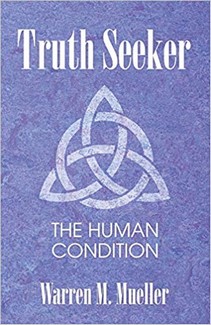

Kindle Edition
Amazon
Crosslink
Category:
Inspirational
Publisher: Westbow Press
Type: Non-Fiction
Pages: 234
Copyright: May 7, 2019
ISBN-13: 9781973659815
Price: $3.99 (eBook)
This book explains why we think and act the way we do based on how our brains are wired. It also explores ancient legends and recent scientific discoveries that harmonize the Bible with science.
Have you ever wondered why humans think and act the way we do? This book explores how we are wired and the limitations and biases of the way we are designed. It also explores the convergence of science and the Bible based on recent discoveries. It then develops conceptual models that synthesize and harmonize this information to explain the meaning and purpose of being human.
Excerpt
WHO AM I?
No one can comprehend what goes on under the sun. Despite all his efforts to search it out, man cannot discover its meaning. Even if a wise man claims he knows, he cannot really comprehend it. (Ecclesiastes 8:18)
CHAPTER 1
TINY STATURE
I seem to be an insignificant speck of carbon–based chemicals that are saturated with water. I am one of billions of my kind who live on a small planet in a small solar system. This solar system is an insignificant speck in what is estimated to be a galaxy with one hundred to four hundred billion stars and at least one hundred billion planets.2 Our galaxy is an insignificant speck among the billions of galaxies that we have observed to date. Estimates of the number of galaxies in the universe continue to grow dramatically. Recently, the number was increased ten-fold to one to two trillion.3 My life span is less than one hundred years, which severely limits my ability to experience this life. My senses define my experience, but they only extend to my immediate surroundings. Therefore, I live in a bubble world that is a small fraction of reality on planet earth. (Even though television and radio enable me to experience at a greater distance, these media are surreal to me as I am not immersed in what they depict.)
In order to understand who I am I must seek to understand my place in the universe. However, the complexity and scale of just my immediate surroundings quickly overwhelm my mental capacity. Indeed, even though the human brain is remarkable, its computing or processing capacity is very limited. For example, it takes about half of our brain power just to listen and process what one person is saying to us. Right now, I am looking out my window and I see a pine tree. But do I really see it? I notice that it appears as I expect it to be, based on my experience of looking out this window in the past. I quickly note its height and its general shape. This surface view registers as what I expect, so I move on to perform a similar scan of what I can see of my neighbors’ house and our yards. Within a few seconds, I am satisfied and move on to look at other things. However, I have not even begun to understand or appreciate the complexity of what I am looking at. For example, I have no idea of how many needles there are on the pine tree (nor do I have the desire or ability to count them). When I look at one pine needle under a magnifying glass, I see innumerable plant cells. If I increase the magnification, I can see the nucleus and other components inside a limited number of cells. At even higher magnifications, I see the double helix of the DNA inside one cell as well as proteins and cellulose of the cell wall. Going further, I would eventually see molecules, atoms, and sub-atomic particles. Although my brain accepts that I have seen the pine tree, I have clearly not seen it in the sense of coming anywhere near to understanding or appreciating the complexity before me. Therefore, my concept of my surroundings is superficial.
Human experience of reality is reduced to general images that lack detail. We “see,” but we do not understand. I have driven the same route to work for over thirty years and know what intersections and major features to expect to see, such as ponds, rivers, buildings, and landfills. However, I could not tell you anything about how many trees there are or what they look like unless there was something striking about them. This becomes even more problematic when I consider smaller and more numerous plants, such as shrubs, flowers, and grasses.
This limitation is compounded by the fact that my knowledge is largely limited by my experience. What I “know” is mainly based on sleep, work, and recreation routines. While it is true that I can learn indirectly by reading and watching television, these methods are generally less influential than my life experiences. My life experiences are largely limited to routines that shape my thinking and behavior patterns or habits.
Therefore, there is a massive amount of reality in this world that is constantly beyond my experience. Indeed, even if I could somehow extend my sensory abilities, I am limited in how much my brain can capture, process, and retain so that I experience and learn more. This is why humans selectively retain and forget many of our experiences. Even if every moment of my life is somewhere recorded in my brain, I can only access a very small amount.
Given these limitations, it is no wonder that humans seek immediate gratification or, at best, short term goals. I am one of a race of creatures that tend to seek pleasure, security, and purpose in events that seem shallow and are transient. Ultimately, what difference will my life make? Am I here just to reproduce and then pass into oblivion within a few generations? Perhaps this explains why humans tend to focus on the next sporting event, vacation, work assignment, etc. Perhaps this is why many turn to alcohol, drugs, and anti depressants. Could drug use be a means of escape or coping with an existence that seems insignificant and meaningless or an existence where there is anxiety over the future?
King Solomon had a reputation of being gifted with great insight and wisdom. He was also one of the wealthiest and most powerful kings in history. He reportedly pursued every pleasure he could conceive, built great buildings and gardens, and; amassed enormous wealth and livestock. However, he came to the conclusion that everything he accomplished in his life was meaningless and his efforts were like chasing the wind (Eccl 2: 1-20).
Why does human life seem so transient and meaningless? Are we really doomed to lives that will be forgotten? Humans dream and strive to achieve goals by pouring our focus and energy into accumulating wealth and power. We seem to be like industrious ants building a mound of sand and expanding our numbers, but, greater forces of nature and time ultimately destroy what we accomplish. In order to understand our tiny stature and possible explanations for our limitations, we need to further explore the depths of our physical, mental, emotional, and spiritual dimensions. This is the journey that we will embark upon in the following chapters.
CHAPTER 2
CONFLICTED CREATURE
Besides being so small that my significance seems less than a grain of sand in a vast ocean, I am a conflicted creature. This is reflected in the anatomy of my brain, which has two symmetrical halves that control different thoughts and systems. The left side of my brain controls rational, logical, sequential, and analytic functions, as well as data, whereas the right side controls intuitive, emotional, visual, and creative functions, as well as impressions and relationships. Another way to view this is that my left brain tends to make me more introverted and prefers me to be in a controlled environment, whereas the right side wants me to be extroverted and, spontaneous and take risks in my environment. The left side drives me to compete and dominate, whereas the right side wants me to be collaborative, compassionate, and sensitive to others.
Through our culture, educational system, and life experiences, one side of the brain can become dominant. For example, I was raised in a school system that stressed the importance of reading, writing, and arithmetic. This educational system stressed the development of the functions of the left side of my brain, which tends to over-ride input from the right side. This duality in the way my brain functions causes me to have endless debates with myself over how I should react to my surroundings. I sometimes wake from dreams in a state of fear and imagine that I am in danger. My heart is pounding, and every small sound seems to validate that my dream was real. About this time, the left side of my brain tell me that it was only a dream and that any sounds that I am hearing are just part of my excited mental state.
|