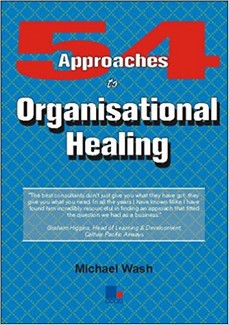
Over a period of 20 yrs the author has worked with dozens of different organisations – all of which were trying to strive to be better, more efficient and profitable and a great place to work. What is captured in this excellent book is the success formula to develop organisations from top to bottom and inside out! It considers all aspects of human resource development and describes how you can empower staff to take ownership of the quality improvement agenda.
Each chapter is preceded by a fictional tale of a chief executive attempting to transform an organisation single handed making the classical mistakes many over enthusiastic leaders do when taking on a new job or project. Over 200 pages of informative and illustrative examples of how to make the work place thrive with the best people realising their full potential at work.
Very often, organisations embark upon programmes of change and improvement.
This may be as a result of a crisis, a need for turnaround, change in leadership or
a demand from ‘on high’ regarding policy or political change.
Whatever the reason, these programmes of change are unsustainable as
programmes, just as a diet is a quick fix for losing weight, joining a gym to get
fit, or swotting for an exam to get qualifications. They are all short term ‘flavours
of the month’ and without a longer-term, value-based strategy will die off until
the next fad appears.
Too often, organisations seek ‘treatment’ rather than ‘cure’. They opt for
training, re-engineering, structure change, imposition of new targets, management
consultants. Organisations have been doing this for years, and they will continue
to get what they have always got – short term success.
Opting for a cure, rather than a treatment, requires Leadership to embark upon
the path of creating a ‘healing organisation’. A healing organisation changes its
way of life so that it becomes self sustainable, naturally growing healthier
because its value base is in the hearts and minds of everyone who works there.
Everyone cares and everyone benefits, as they grow healthier out of a blueprint or
DNA of excellence which is the core of the organisation’s genetic identity.
54 Approaches to Organisational Healing explores best practice for
sustainable excellence, proposing radical, challenging and creative approaches to
becoming the best at what you do. In this book, there is a strong analogy between
our attitude to our own personal health and well-being, and our attitude towards
the way we behave at work.
Organisations have predominantly been seen as mechanistic structures to
manipulate and mould according to the whims and demands of their leaders and
customers. By acknowledging the organisation as a living organism, we can
clearly and significantly relate personal health to organisational health.
All organisations have some aspect of ‘disease’. Ignoring this disease process
can lead to institutionalised dysfunction, substandard service, stress at work and
the inevitable loss of business and/or increase in customer/consumer complaints.
Introducing models and processes, investing in training and education, or
using smart or lean tools and techniques is not enough to sustain health. These
approaches need to be introduced on a firm foundation of a ‘healthy organisation
vision’, underpinned by strongly held beliefs and values about how people should
be ‘treated’ at work.
Organisational Healing is the process of developing the organisation to
achieve a state where the people, processes, systems and policies are sustainable
and consistent with achieving a continuously improving healthy state of being.
A ‘Healing Organisation’ is an organisation with a culture of selfsustaining
continuous improvement which achieves the best quality of
service, outcome or product. In doing so, it creates a healthy and fulfilling
work environment for everyone.
The 54 Approaches to Organisational Healing are highlighted in the body of the
text (see page 24 for the first). These approaches are not discreet and are part of
an integral process of organisational development. For the busy manager wishing
to dip into particular aspects, I have listed the 54 Approaches in the next section.
Whether you are about to embark upon, or are in the process of, a change
programme, you may have a question related to one of the approaches identified.
This will help focus your reading.
There is a fictional tale at the beginning of each chapter which provides a
sequential read and indicates the importance of designing and implementing
organisation-wide changes on solid foundations. While the company and its
employees are fictional, the characters and incidents have been shaped by real life
examples I have come across during my consultancy assignments over the last 20
years. The events described have largely been shaped by my experiences in the
Health Sector and other service industries.
The tale is based on a medium-sized manufacturing and distribution business
in the North of England. Each Chapter gives a snapshot of organisational life
through the relationships between the Managing Director, his team and key
incidents that challenge that state of ‘organisational health’.
After each work based story, our Managing Director, Dave Battle, gains relief
from stress by playing golf with his friend, Ged Shaw, who happens to be a
retired Management Consultant. It is amazing what new insights and parallels can
be made when playing golf or indeed any time out of a work situation where play
and creativity can flourish.
Bringing creativity and insights back to the workplace is the challenge.
The book can be read and used in a number of different ways, depending on
the readers’ needs and interest. If an overview of what it takes to introduce a
system-wide development process is needed then a sequential journey through
each chapter may be the best option. If there are particular areas of weakness or
‘disease’ in your organisation that you want to strengthen, then focusing or
particular ‘approaches’ or chapters can help. If you wish to understand the role of
manager as a facilitator, then Chapter 4 is particularly useful.
See the reviewers comments