Kindle Edition
Amazon
Joe Prentis Website
Category:
Western
Publisher: Joe Prentis
ISBN-10: B00B35SXL4
Pages: 220
Copyright: Jan 18, 2013
Price: $2.99 (eBook)
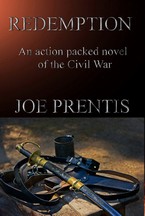
Redemption is the prequel to The Renegade Series, set in Washington D.C. as the governement searches for the associates of John Wilkes Booth.
Washington, 1865: As the American Civil War drew to a close, military and government leaders realized they were facing grave dangers they had not anticipated. There were many who did not understand that it was easier to start a war than to end one. The Confederacy was crumbling rapidly, and Generals Nathan Bedford Forrest and Robert E. Lee were willing to surrender, provided they could do so with honor. Many government and military leaders did not agree with President Lincoln’s intention to grant a full pardon to anyone who would agree to the terms of surrender. And the most difficult thing of all was the radicals who were not willing to give up a lost cause, and were determined to stop the peace process regardless of the cost.
Excerpt
REDEMPTION
Chapter 1
“It was an honor to have you aboard my vessel, General McClellan,” the captain of the steamboat Belvedere said, darting an anxious glance toward the pilothouse where the pilot was cautiously easing the boat toward the dock. The walking beam driving the port side paddlewheel rocked slowly, swinging the bow around in the eddying current. It had rained the previous week, and the normally placid waters of the Potomac had become a raging torrent. Uprooted trees and assorted flotsam had threatened to demolish the vulnerable side wheels of the steamer until the captain had stationed two men near the bow with long poles to push the floating debris away. As the boat crept closer to the dock, two deckhands rushed forward to lasso the pilings. As soon as they had warped a mooring hitch around the chocks, the gangplank dropped into place with a rumbling clatter that caused a flock of pigeons to explode skyward from the shelter of a dockside shed. The captain’s eyes darted past the three soldiers toward the deckhand manning the windlass. His face flamed red, but he did not utter the oath that was damned up behind a set of wide set teeth.
General McClellan extended his hand and grasped the captain’s work worn fingers between his own. “My pleasure,” he said. “Our luggage . . .”
“Your luggage will be delivered to Willard’s Hotel within the hour,” Captain Wilkes assured him, with a brief movement at the corner of his mouth that might have been a smile. He extended his hand toward Staff Sergeant Oakley, while ignoring Private McCade standing like a stalled ox behind the other two men. As the three soldiers turned away, Captain Wilkes darted another glance toward the place where the deckhand had been only a moment before. The heavy-handed scoundrel had no doubt disappeared around the corner of an equipment locker, seeking a safe haven somewhere on the lower deck. For all times for this to happen with one of the most famous combat generals in the Eastern Theatre aboard. Blast the insufferable sod to the lowest levels of perdition!
Ignoring the little drama that was being played out between Captain Wilkes and the deckhand, McClellan crossed the deck toward the gangplank, his mind occupied with his own concerns. If we’re lucky, this war will be over in a matter of weeks, he thought, as they made their way down the bouncing gangplank to the stone wharf.
It had been four long years since the firing on Fort Sumter, and McClellan was weary of battle and the endless demands from the overanxious officials in the War Department. Perhaps this meeting with Major General Butler would bring about some workable plan that would get them through the trying days ahead. Ending a war was always more difficult than starting one, which was an undisputable fact that seemed to evade most of those in government. In recent months, the war strategy had been altered on a daily basis as congress waged an endless tug of war with the president. General Butler was a master at organization, but there were fewer and fewer in the War Department who were willing to listen to his carefully thought out strategy. Butler’s problems had started during his stint as the military governor of the Gulf Region and had resulted in some animosity from many influential politicians. There were a surprising number of congressmen that had southern sentiments. As McClellan considered the situation, it was difficult for him to point to one single mistake Butler had made that had caused the ill feeling, but it had continued to plague his career wherever he served. There were some who believed that Grant was pressuring Lincoln to allow him to remove Butler from command.
McClellan grasped the brim of his slouch hat as a sudden gust of wind threatened to tear it from his head. Oakley and McCade followed closely on McClellan’s heels as he crossed the dock and stepped down to the freight loading area. Captain Wilkes’s enraged voice could be heard above the noisy chattering of the boiler’s pressure relief valve.
Looking from right to left along the length of the quay, McClellan realized that the coach that was supposed to convey them to Willard’s Hotel had not arrived. General Butler was a friend, or as much of a friend as a superior officer could be, but he didn’t like to be kept waiting.
“Whoa up, General McClellan,” Oakley said, taking a careful look around the staging area, and not liking what he could see. McCade, sensing the same thing, had drawn his revolver and drifted off on McClellan’s left flank, eyeing the windows and rooftops of the nearby buildings. Except for the presence of the steamboat, the area was completely deserted. On a normal workday, there should have been dozens of workers loading and unloading freight. There were none now, giving the dock a forbidding appearance. Washington had been in possession of Union troops since the start of the war, but many of its citizens had an unswerving loyalty to the Confederacy and still spoke with pride of it being a southern city. It had been less than an hour since a group of riflemen had fired on the slowly moving steamboat from a place of concealment behind a thicket of box elders. Oakley wondered if the absence of the carriage was an oversight, or if there was something else afoot.
|