Download an ebook sample:
http://www.smashwords.com/books/view/4786
Making peace with the world, sooner or later most of us have to. But how?
For Ian Mac Bride, his way begins almost accidentally when, in 1909, he watches a fly-casting tournament in New York’s Central Park, and begins to dream of becoming a great fly caster.
But soon Ian experiences personal tragedy, and then is appalled by the unexpected slaughter of World War I.
He retreats into the world of fly fishing and fly casting, and meets unforgettable anglers like: Doc, a Civil War veteran, who tells how, after he enlisted in return for drinking money, he was unexpectedly changed by the horror of war; Izzy, a mysterious immigrant, who, in his way, teaches Ian perhaps the most important lesson of long-distance fly casting; and George M. L. La Branche who, though torn by self-doubt, writes the book that revolutionizes fly fishing.
And so, these anglers help change Ian’s hopes and values. Though his father questions his courage, Ian decides to become a teacher instead of a lawyer, and moves near the beautiful Beaverkill River, the birthplace of fly fishing in America.
But tragedy still follows him.
Torn by grief, he curses the world and loses faith in it - until, almost by accident, he finds a way to come to terms.
How? The answer will surprise you.
Making peace with the world, sooner or later most of us have to. But how?
For Ian Mac Bride, his way begins almost accidentally when, in 1909, he watches a fly-casting tournament in New York’s Central Park, and begins to dream of becoming a great fly caster.
But soon Ian experiences personal tragedy, and then is appalled by the unexpected slaughter of World War I.
He retreats into the world of fly fishing and fly casting, and meets unforgettable anglers like: Doc, a Civil War veteran, who tells how, after he enlisted in return for drinking money, he was unexpectedly changed by the horror of war; Izzy, a mysterious immigrant, who, in his way, teaches Ian perhaps the most important lesson of long-distance fly casting; and George M. L. La Branche who, though torn by self-doubt, writes the book that revolutionizes fly fishing.
And so, these anglers help change Ian’s hopes and values. Though his father questions his courage, Ian decides to become a teacher instead of a lawyer, and moves near the beautiful Beaverkill River, the birthplace of fly fishing in America.
But tragedy still follows him.
Torn by grief, he curses the world and loses faith in it - until, almost by accident, he finds a way to come to terms.
How? The answer will surprise you.
Prologue
THE BEGINNING, FOR ME
Looking back, I still don’t know what I was after: A magazine article? A way to compete with Eric, my fiancé? A combination of both? But certainly not the life story of a long-distance fly caster, certainly not what I found.
Where did my hazy search start? I guess before I climbed the steps of the Wall Street station, before I saw the clear sky and again thought of the two-hundred dollar, turquoise Ferragamo shoes I had tried on a week before.
I smelled Ground Zero.
I wondered if it was the smell of death, as some described, or of decay? Or was I, an editor, just being too picky about the use of a word?
I stepped into the sunlight and onto the bright sidewalk. I walked alongside a high, black-bar fence. On the other side of the fence was the Trinity Church cemetery. Gray ash dusted the cemetery like fallen snow. Sprinkled on top of some of the ash were bread crumbs. Pigeons ate the crumbs, disrespectfully, I thought, even though I knew pigeons didn’t know anything about the three thousand people who were killed horribly.
I looked through the jail-like bars, at the old tombstones. Time had erased or chiseled off many of the letters—the dead people’s last testament on earth. Time was also disrespectful. One tombstone that wasn’t erased read: “Here lies interred the body of Katherine, late wife of John Crawler who departed this life.”
I asked myself, Could Katherine or John Crawler ever have imagined buildings over a hundred stories high and jet planes crashing into them?
No, of course not. Life was simpler then. God, like the dealer in a card game, held the answers. But was life better then? And what if a person didn’t believe in God? Well, at least there weren’t big questions, like how the Big Bang or 9/11 could have happened. But back then there were smaller questions, like my question: Should I tell Brad Mac Bride the truth? But don’t I want an article?
The shaded, curving Broadway was much narrower than the wide, two-way Broadway of the residential Upper West Side, or of the neon-lit Theater District. This lower Broadway had been changed by 9/11. It was lined with peddlers selling buttons, tee-shirts and photographs. The photographs showed different views of the World Trade Center bathed in bright-white or soft-orange sunlight. The buttons and the tee-shirts showed illustrations of the Center. Below the illustrations were phrases like: United We Stand, We Will Never Forget.
I walked past the peddlers and soon saw Bowling Green, a small park. In front of the park was a big brass statue of a running bull. Tourists took pictures of the bull. One man grabbed its horns and tried to climb onto the bull. But the statue was too big.
I laughed and looked for 26 Broadway. It was an old, white stone building that curved gently with the street and reminded me of the back of an old wooden ship.
I crossed in the middle of the street, walked into the lobby and got on an elevator crowded with “suits,” as I called them.
Again I wondered if I should tell Brad the truth; so when the elevator’s doors opened on the twelfth floor, I didn’t want to step off.
But I had to. Now I faced two glass doors and large gold letters. The letters read: The Law Firm of Miller, Kane & Weinstein.
I pulled open one of the doors. A middle-aged woman sat at a large, beautiful, antique, cherry-stained desk. The desk was right in the middle of an oriental carpet that covered most of the parquet floor. Light reflected off the polished wood. The light came from a large, mansion-like chandelier. Breaking up the light into bright, wide bands, and soft, narrow shadows were small pieces of hanging crystal. Breaking up the old-world motif of the reception area were a tan leather couch, a glass coffee table, and copies—at least I think they were copies—of Impressionist paintings: Degas, Van Gogh, Renoir. I was impressed, but then I thought of my firm’s modest offices. Maybe there really were too many lawyers in the world.
“May I help you?” The receptionist’s upper-class British accent rubbed me the wrong way.
“Yes, I’m here to see Brad Mac Bride.”
“Your name?”
“Jennifer Kull.”
The receptionist announced me.
I sat down. On the coffee table was a line of magazines, but not the women’s magazine I worked for.
“Miss Kull,” a man called.
I looked up.
“I’m Brad Mac Bride.” He wore frameless glasses. His hair was straight and dirty-blonde. His chin was square and strong. His smile stretched from his lips to his oversized, blue eyes. Yes, he was good-looking, in an Ivy League sort of way, not in my way.
I stood up.
He was smaller than I expected, five-nine or so. All in all, he looked a lot more like a Wall Street lawyer than a long-distance, fly-casting champion.
He extended his hand. “It’s a pleasure to meet you.” His voice was soft and warm. His handshake was firm but not too strong. I wondered if he practiced handshaking as well as fly casting.
He wore a wedding ring.
“After 9/11,” he said, “a lot of my clients find it too traumatic to come down here.”
I didn’t want to seem insensitive. “It’s not always good to stay away from what we can’t change.”
He nodded. My reply impressed him.
“Let’s go to my office,” he said.
I followed him down a long, wide, oak-paneled hallway. He stopped in front of a doorway. “After you.”
His office was almost twice as big as mine. A beautiful oriental rug covered much of the parquet floor. On top of his antique, walnut-stained desk was a bound document, a small bronze statue of a fly fisherman landing a fish, and a photograph of his wife and two daughters, I assumed. His wife was blonde and pretty in a Vassar sort of way. And though I went to Vassar, I hated the look, the way I hated neat desks and men who, unlike Eric, seemed to be Mr. Perfect.
How long will Eric make me wait to have pictures of my children on my desk?
He held up the picture of his family. “Even girls are competing in fly-casting tournaments these days, so I guess I don’t have to wish for a son. Please sit.”
I sat in a leather winged-back chair and looked at the beautiful impressionist paintings on the walls.
“They’re copies,” Brad said.
“I assumed.”
“Impressionist paintings aren’t too modern or too old. They go well in offices, I think.”
His answer seemed a little strange, and so did the way his office matched the reception area.
Maybe he is a clone and not Mr. Perfect. I will never be a clone!
He closed the door. Hanging on the wall was a three-piece, bamboo fly rod in a glass case.
“That one isn’t a copy.” He smiled proudly.
“How old?”
“From the World War I era, which was the dawn of the golden age of American fly-rod building.”
I never knew there was such an age. I asked, “How much is a fly rod like that worth?”
His smile dropped faster than a falling stone.
Why did I ask such a stupid question? I asked myself. When will I ever learn?
“I couldn’t put a price on it,” Brad said. “It’s perhaps the only masterpiece built by an obscure rod maker, Billy Reynolds.”
“What makes it a masterpiece?”
“Its workmanship, its bamboo, but most of all, its design. By design I mean its taper.”
Taper? I wondered. Shouldn’t I know what that means? I won’t ask.
He opened the case.
I stood up. He took the rod out and handed me the bottom piece. The cork handle, like the one on my fly rod, was shaped like a cigar. It seemed a little too big for my hand. The bamboo was tinted with a deep-orange, glass-like finish. Though orange was my least favorite color, the finish brought out the beauty of the bamboo.
“Even if you use a microscope,” Brad said, “you won’t see any blemishes in the finish. Now look at the top piece. The tip is thinner than other tournament rods of that era. That’s one of the rod’s secrets. Another secret is that the middle of the rod widens more quickly than other rods.”
He put the rod together and pointed it at the carpet. “Here take it.”
I did.
“Now push downward, slowly,” he said.
The rod bent easily.
“Push down more.”
The rod pushed back.
“Now you’re into the power section. With other rods, including those of today, you wouldn’t have reached that section so easily. Because this rod is probably one of a kind, its taper has, as far as I know, never been copied, the way Payne and Garrison tapers have. To me a great rod is a merging of great art and great science.” His eyes opened wide and seemed to glow with passion.
I handed the rod back.
“Another thing that makes this rod special is that some of the bamboo on the inside is hollowed out. Therefore it’s lighter, so when a caster stops his cast, the rod uncoils very fast. Years later other rod makers hollowed out their bamboo, but in 1917 no one else had perfected the technique.”
He took the rod apart and put it back in the case.
“Sounds like there’s a real story behind that rod?” I said.
He sat at his desk. “You really are an editor.”
“Should I take that as a compliment?” I sat down.
“Why not? Miss Kull, you didn’t come to talk about fly-rod design.”
I crossed my legs but then quickly uncrossed them. “Mr. Mac Bride—”
“Brad.”
“Okay. Brad, since more and more women are taking up fly fishing, we keep hearing how they wish they could cast farther. With your credentials—”
“Ms. Kull—”
“Jennifer.”
“Jennifer, I knew very little about your magazine, so maybe it was unfair of me to agree to meet with you. If so, I am sorry. Now I’ve looked through some of your back issues. I noticed the article on how women should act if and when they beat their husband or boyfriend in a sport.”
“I edited that article myself.”
“Really?” His tone was shaded with sarcasm. “The article you want was written a long time ago, by my grandfather. When it was published in a small, now defunct magazine, it didn’t attract the attention he had hoped for. He was disappointed and hurt. Jennifer, what do you think long-distance fly casting is about?”
The question was too simple. It had to be a trap. “Are you saying it’s like life in some way?”
“A reflection of life. Your smile tells me you don’t believe me.”
What should I say? I wondered. I don’t want him to see through me even more.
I gritted my teeth and tried to read Brad’s blank expression. Finally, I said, “If a person has special knowledge they should share it.”
“That’s one way of looking at it. My grandfather had help, in the beginning, at least. Jennifer, I owe you an apology for not spending more time with you on the phone. The truth is I’m not ready to sell my grandfather’s article.”
“I’m sorry if I angered you.”
“Angered?” He smiled.
“Disappointed, I meant.”
“I have to be in court soon.”
I stood up, thanked him for his time and walked down the long hallway, clenching my fist, cursing myself for lying and blowing an opportunity.
I left the building and again smelled death or decay. I looked at my watch. I had time to see the rubble of the World Trade Center, but did I want to get even more depressed?
I didn’t.
As soon as I walked into my small office my phone rang. I looked at the incoming phone number. It was Eric’s. I wondered if I should tell him that he was right, that I should have told Brad the truth all along.
The phone rang again. I didn’t answer it.
An hour later my anger at myself cooled. I closed my eyes and tried to imagine that I lay on a beautiful beach and listened to the melody played by gently breaking waves. How can long-distance fly casting be a reflection of life? I wondered. Yes, fly fishing is about a lot more than catching fish—but fly casting? Landing a small fly on the water is landing a small fly on the water, whether you do it thirty or seventy feet away. What am I not seeing?
I opened my eyes and took out my personal stationery. I wrote:
Dear Brad,
I want you to know I respect your decision about not publishing your grandfather’s article.
Now that I’ve had a chance to think about our meeting I realize that I might have been shortsighted. All my life I’ve been too attracted to the way things look.
The simple truth is, I’m intrigued by what you said. Now, well, I want to be enlightened.
Please call me if you will be kind enough to help.
Respectfully yours,
Jennifer
Day after day I waited for a reply. Finally, I immersed myself in editing and fixing a hiking article. My waiting waned; then my phone rang. Not recognizing the number, I asked my assistant, Leslie, to answer.
“It’s a Brad Mac Bride,” she said.
I flinched, then picked up the phone. “Brad, what a surprise.”
“I’m going to be in midtown later.”
I didn’t want him to see my small office, but did I have a choice? I invited him to stop by, then straightened up my desk.
An hour later Brad and I again shook hands. He didn’t look over my office.
“I don’t have any interesting antiques to show you,” I said.
“I brought my own, sort of.”
“Please sit.”
He took out a big envelope from his leather briefcase. “Many years ago my grandfather wrote a memoir. In it, he tells the story of the fly rod in my office and the story of what long-distance fly casting means to him. I made a copy for you.” He put the envelope on my desk.
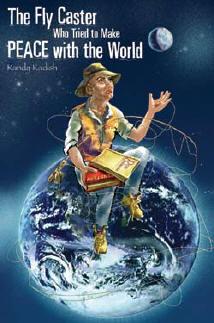
I took the manuscript out and read the title out loud, “THE FLY CASTER WHO TRIED TO MAKE PEACE WITH THE WORLD.” I laughed. “You’ve got to be kidding. There I go again, opening my mouth. I’m sorry.”
“The title is supposed to be funny, I think.”
“I don’t think I ever saw an old-fashioned, manually-typed manuscript.”
I turned to the first page. It was a Xerox copy of a photograph of a man wearing a fly-fishing hat and vest. In the man’s face, especially in his big eyes and his strong jaw, I saw a partial reflection of Brad. I say partial because unlike Brad, the man’s hair was curly, and his cheekbones were high, making him a perfect fit for a Marlboro Man.
“So this is your grandfather?”
“Yes.”
“Thanks for dropping this off. I’ll start reading it tonight.”
“I hope you enjoy it. Sorry, but I have to run.”
We shook hands. His big eyes smiled warmly. He said good-bye.
I wondered why most of the really good guys were married, then called Eric and told him I wanted to cancel our dinner date so I could read Ian Mac Bride’s manuscript.
He understood, as usual.
After work I went straight home, poured a glass of red wine, ordered in Italian food, changed into pajamas and sat down on my soft, leather couch.
I began reading.
Book 1: New York
Chapter 1
I always ran from the things I didn’t like or understand, and maybe that’s the real reason—not the random events in my life or, for that matter, in the wide world—I didn’t become the man my father, or even I, thought I’d become.
You see, I come from a long, long line of blue-blood lawyers, a line first drawn on the other side of the Atlantic, a line then lengthened across the often rough, often beautiful sea, a line ended generations later at the handle of my H. L. Leonard fly rod.
But the handle, as it turned out, was also the start of a new line: one of anglers and of fly casters.
So even now, as the long, snake-curled river of my life flows closer, and seemingly faster, toward where seconds cannot flow—I’m reluctant to call it death—I again reflect on the dark, dark chapter in the history of my life and ask: If I could wade back in time, would I put down the fly rod and become a lawyer instead of an angler and a fly caster?
Yes is the answer I wish for.
No is the answer I run from. Why do I run? Because a voice inside me, often speaking a language I still can’t understand, tells me that, for better or worse, a man who strove to cast farther, who strove to see things differently and to find the courage to make peace with the world, is what I was meant to be.
But like a dry fly dragged by fast water, I am way ahead of my story.
I’ll start by focusing on my parents. Both were from well-to-do families that fell from grace, so to speak. My father’s family fell because his father’s uncontrollable rage led him to punch another lawyer. My mother’s family fell because her father’s reckless gambling led him to bankruptcy.
My father reacted to his family’s fall by turning his back on professional baseball, studying hard and graduating near the top of his class at Columbia Law School. When he didn’t get the job offers he deserved, he, along with a Jew and an Italian, kicked convention to the side of the road and started their own law firm in a cramped, one-room office.
Three months later they had a small but steady client list.
Now before I go any further, I should say that, even though my father came from an agnostic, Presbyterian family, somewhere along the road—maybe to rebel against his father—he came to believe strongly in God. Every night before bedtime, he read the Bible. Every Sunday he went to church where, as it turned out, he made important social and business contacts. His most important, ironically, was my mother. I say ironically because my mother was an atheist. Why she played the organ in a church I can only guess: She was looking for a husband.
But let me wade back in my story.
My mother reacted to her family’s fall by dreaming of becoming a great pianist and practicing—without a metronome she often told us—four, five, sometimes six hours a day; but when her big audition came, her emotion iced. She played coldly.
She went home, cried and never auditioned again. Needing money, she gave piano lessons. Then she met my father. Was she drinking by then? Probably. Did my father see it? Maybe. Tall, beautiful, dark-haired women, I guess, camouflage their defects well.
Three months after my parents met, they married.
Nine months later, in 1896, I was born, and two years later, my sister, Rebecca.
By then my hardworking father’s law practice thrived and, like the rising sun, brightened our family name. And so in his deep voice I often heard love and confidence, especially when he taught me the techniques of playing baseball. If I threw over his head or booted a ground ball he just smiled and said, “Try again. But not so hard. Ian, you always have to try to stay within yourself.”
I once asked, “What does that mean?”
He put his hand on my shoulder and looked into my eyes. “It means you should relax and let your body flow. You see, Ian, if we practice enough our body will memorize the right techniques, almost the way actors and singers memorize words. Does that make sense?”
I wasn’t sure, but I answered, “Yes.”
Sure or not, I loved practicing baseball and being the best player in my class. And I also loved dreaming of being a great lawyer, like my father, and looking into the eyes of jurors and heroically pleading that my poor, innocent client should go free.
And my client always did.
Like most boys, I desperately wanted my father’s approval. So when I became a teenager and my father told stories from his large collection of Civil War books, I listened. My father’s favorite character in the war was Ulysses “Unconditional Surrender” Grant. Grant, in my father’s eyes, was one of the greatest generals who ever lived. Again and again my father told me—my sister wouldn’t listen—how Grant never let anything stop him. “To surround Vicksburg, Ian, Grant didn’t let the swampy land bog down his army. He simply left his supply lines, lived off the land and crossed the Mississippi way south of the city. You see Ian, Grant was a humble man. He always listened to the generals who served under him, and he never tried to impose his will on the roads, the rivers or the hills. He always let the terrain map out his strategy.”
At first I eagerly listened to my father’s stories, until he brought home a big book of Civil War photographs. “Ian, let’s look at these together.” The book’s first photograph was of a battlefield covered with bodies twisted like broken dolls. The next photograph was a close-up of dead soldiers seeming to gasp for air and to stare up at the sky.
Wondering if I was going to end up a dead soldier, I said, “I don’t want to see anymore.”
“Don’t be scared. They’re only photographs—photographs of history.”
“I still don’t have to see it.”
“Ian, like it or not, history is all around you.”
My father turned to the back of the book. “Look, here’s photographs of the Wilderness Campaign. Maybe we’ll see grandpa.”
“How can you believe in God if you believe in war?”
“The Bible is full of war.”
“So God likes war?”
“I can’t understand all the things in this world. But if it wasn’t for the Civil War, the North and South would be two different countries. Colored people would still be slaves. Grant would not have written his great memoirs. And without the Revolutionary War, America wouldn’t have become a nation of liberty and of great discoveries.”
My mother walked into my father’s library-like study, looked at me and smiled.
My father went on, “God didn’t create war, Man did.”
“But the Bible says God created man in his own image.”
“Ian’s right,” my mother said.
“He’s not right!” my father insisted. “He’s only twelve. I’ll tell you what: no more war stories for now.”
I looked at my mother and smiled.
She smiled back.
So let me again turn my story toward her.
My mother’s first great joy was raising me and my sister and helping us with our homework. In her soft, beautiful voice she said things like, “Ian you were almost right. You just forgot to carry the zero ... Ian, don’t try so hard at writing. Even simple sentences can have rhythm and words that paint pictures. And whenever you can, try to compare things to other things. For example, you might write that the waves crashed and broke and seemed to turn into bubbly, fallen snow.”
My mother’s second great joy was playing her black, baby-grand piano. When she did, her passion, her spirit flowed through her body and then somehow seemed to change into long, flowing, music waves. The waves bounced off the walls and seemed to give the lifeless air a pulsing heart.
But the waves, I knew, weren’t like those in the ocean. I couldn’t see them unless I closed my eyes. And I couldn’t touch them, even though they often comforted me like a warm blanket.
So did they really exist?
I wasn’t sure, and I also wasn’t sure how I felt about my mother’s drinking. I mean, it wasn’t as if my mother yelled and screamed. But as time passed, as day after day I came home from school and saw my mother sleeping on the couch, I wondered why my mother drank when she could instead spend time with me. Was something wrong with me? Or was something wrong with the world?
Whatever it was, I decided to stop my mother’s drinking. I searched the kitchen and found her vodka bottle. I unscrewed the cap and started pouring, but then something—maybe fear, maybe a sense of right—told me to stop. I screwed the cap back on, walked into my room and started my homework. Then a strange thing happened: I cried. When I finally stopped, I promised myself that I would never again cry over my mother’s drinking.
My father came home from work and smiled like a boy who had just hit a home run. He told us he bought a house on East 76th Street, just west of Park Avenue.
I thought of my friends, Benny, Steve, Mario, then stared at my father. “I don’t want to change schools.”
“Half the kids in your class barely speak English. In September I’m going to enroll you into the Browning School For Boys. Ian, in this world a person can’t get anywhere without going to the right schools. One day you’ll thank me, you’ll see.”
I waited for my mother to take my side.
She lifted her wine glass and drank. I wanted to yell that I wasn’t going to a new school, but I was scared of yelling at my father. I looked at my steak and almost cried.
After dinner I went up to my room, rounded up the toy soldiers my father had bought me and threw them into the garbage. Later, after school, I poured my mother’s vodka down the sink.
But still I couldn’t hold back the days, or the spring from turning into summer. We moved.
At first I hated our new house, especially since I had to climb a high staircase to get to my room, but after a few weeks I sort of liked living in a house with so many rooms and so many electric lights. The lights brightened the rooms more than the sun. Before long I didn’t hate walking through Central Park to see my old friends.
But September sneaked up, and my mother took me to a store to buy my new school’s uniform: gray slacks, a maroon tie and a blue blazer with a school patch. I looked at myself in the store mirror and wanted to rip the stupid costume off.
My school was on West 56th Street. It looked more like a big home than a school. The classrooms were about half the size as the ones in my old public school.
The first thing I learned was that none of my new classmates spoke with a funny accent. The second was that my class had two sides: a big side of boys and a small side. The big side was friendly. The small side wasn’t. It was led by Brett Wilson.
Maybe Brett didn’t like that the “new kid” was as tall and as good a baseball player as he was, or maybe Brett was just plain evil. I heard how he shot cats with a BB gun. But in spite of Brett, I made new friends, and as fall turned into winter, I again became happy—then one of my mother’s old music-school friends visited.
“Elizabeth, I’m getting married. Would you like to fill in for me at the vaudeville theater?”
“Vaudeville? I didn’t learn the piano to play while men watch strippers.”
“Some of the comedians are real funny. Besides, it’s only for a week.”
My mother glanced at me. “I have a family.”
I thought, Maybe she’ll stop drinking. “Do it mom. It’s only for a week.”
My mother smiled. “All right, as long as your father doesn’t object.”
My father did. But my sister and I convinced him to change his mind.
And so my mother stopped drinking. And I didn’t mind becoming our family’s dishwasher.
The week passed slowly, finally. During dinner, my mother sat quietly, staring at her food, looking lost.
“Elizabeth,” my father said, “now that you’ll be home after dinner, the house won’t seem empty anymore.”
My mother didn’t look up.
“Won’t it be nice to be a family again?” my father asked.
My mother glanced at me and at Rebecca. “My, my friend isn’t coming back to the theater. I was offered her job.”
“You’re not going to take it!” my father stated.
“I’ve always wanted to play professionally.”
“In a vaudeville theater? How will it look?”
“Look? Who’ll see? The bright lights shine on the stage, not on the musicians.”
“We’re supposed to be respectable. What will I tell my clients?”
“Nothing.”
“Elizabeth, you have two children.”
My mother looked at me. “What do you think?”
Yes, I wanted my mother home, but the job helped her stop drinking.
“Ian?” she asked.
And I wanted my mother’s love. “Can you bring home some real-life strippers?”
“Ian!”
“I’m sorry, Mom.”
My father jumped up. “Do whatever you want, Elizabeth.”
My father gave in, I guess, because he too hoped my mother wouldn’t drink again.
But would she?