Kindle Edition
Amazon
Shortsleeves
Category:
Vision/Metaphysical
Publisher: H.T.Manogue
ISBN-10: 097781307X
Type: Fiction
Pages: 286
Copyright: November 2015
ISBN-13: 9780977813070
Price: $2.99 (eBook)
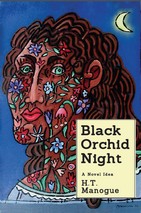
Fiona Mistry was born into a racially mixed family in England. Although her father was from India, she had her mother’s English skin with a touch of color. Fiona discovered her ability to dream lucidly at age 18 after the death of her mother. The first dreams she vividly remembered were dreams about her orchids. But as she aged, her dreams changed.
One night while dreaming, she found herself in a bar in downtown Nashville. When she looked into the mirror behind the bar, the face looking back wasn’t her own. It was the face of an African-American woman dressed in 1940s fashion, but she knew she was looking at herself. As her dreams continue, Fiona realizes that she and the man she loves are living as African-Americans before WWII, and all the people in the bar are people she knows or had known in her waking world.
Black Orchid Night is the story of Fiona, her loves, and her dream world. She begins to ask herself questions like: Where do we go at night while dreaming? Are our dreams as real as our waking life, and when we dream, who are we? Do we see others we know in our present lives, or are there visions that seem familiar, but aren’t? Is something going on while we sleep that goes beyond random thought, and if so, what is the purpose?
Fiona slowly discovers the answers with the help of her therapist and all the people in the Black Orchid Bar.
she experiences in dreams as another form of reality. Her waking world becomes a
schoolroom filled with a new set of choices and probabilities. The lucid dreamer in
this story discovers the connection we have with each other no matter what
segment of the social ladder they represent. We all have been nasty characters,
lonely and depressed individuals that make some really bad choices. The dreamer
in this story is surrounded by the anguish of family dynamics and associations that
can be considered sleazy and harmfully narcissistic. She begins to understand that
she is more than one body and brain in one particular time. She finds another
portion of herself living as someone with different skin color, and in a different
time period. She realizes that skin color and ethnic backgrounds are choices that
produce lesson for soul expansion. She interacts with this particular counterpart,
and that connection influences present moment choices for both individuals.
It’s not necessary to believe you are more than one individual in order to be
another individual. We are wired that way by our multidimensional soul. We will
still function and expand from the action of the soul regardless of our ignorance.
Our mission as individuals is to experience our desires and expand from them. We
are part of the creative activity I call the soul. The soul doesn’t reincarnate.
Reincarnation implies time. The soul creates without time. What we experience
and what the character in this story experiences is one incarnation of the many
incarnations that the soul expresses for creative expansion.
Excerpt
“I see you love the Paphiopedilum and Cypripedium varieties, Doctor. And I love your paintings and decorations.”
“Yes, orchids, art and furniture are some one of my weaknesses.”
Fiona finally made the Dr. Krabb appointment and kept it. She sat in the black leather recliner and looked around the room. Several diplomas were on the wall to her left, and when she looked over to her right, she saw a sleek black 1940s credenza and original pieces of art near the window, which faced the right side of the building. On top of the credenza were three orchids: a moth, a lady slipper and a boat orchid. She immediately felt at home. She turned to Krabb.
“Oh, I like to say that orchids are my strength, but I also like your artwork. Are they the works of local artists?
“Thank you. I do collect art from local and international artists, Fiona. Do you collect?”
Fiona looked at his collection as she answered.
“No, but I would like too. I’m here because one my friends, Mimi Kenworth, is one of your patients. Anyway, she said you kind of interpret dreams for her. She said you told her we have a bond, and I want to know why you said that to her.”
“Yes, I remember that conversation with Mimi. I don’t want to go into too much detail about Mimi’s last session, but she said you have an orchid business. She explained one of her dreams to me, and she wanted to know what the dream meant. You were in the dream, and orchids were in that dream as well.”
“Yes, right, that’s what she said. Do you see a lot of people that dream about orchids?” Fiona asked.
“No, but I do have patients who communicate with other things. You know firsthand that your dreams are interesting experiences. They have no beginning or end. The only thing that ends is your awareness of a particular dream. If you have a dream, you live it just like you do a waking experience. The only difference is you have the freedom to move about the dream without ego restrictions. The images, people and other forms in your dream have the same freedom. Not all dreams have messages, but all dreams are real experiences. Some dreams contain messages about your waking world. Not everyone can communicate with life forms that are focused in another reality. You may be able to do that, and I think Mimi can be if she does a little work. You both have a strong connection.”
Krabb looked at his credenza and then looked at Fiona.
“As you see, I have a connection with orchids as well.”
Fiona looked at the orchids again. The Lady Slipper was the same color as the one in her dream. She stared at the soft pink and yellow flower and thought: “Could that one be the same as the one in my dream?” Fiona looked at Krabb once again.
“Yes, I understand. I was a patient of Art Schuler several years ago. He told me the same thing about dreams. Did you know Arthur?”
“Well no, but I did read some of Dr. Schuler’s work. I must say he helped me in my quest to somewhat understand the dream reality. None of us fully understand it, because it is so personal, but at the same time, it can be very social as well. You know, orchids are social aren’t they? They do communicate, you know.”
“Are you inferring that your Lady Slipper told you about Mimi and me? Can you understand the language of orchids, Doc?”
Fiona smiled, and Krabb started to chuckle.
“Yes, in an unusual way. All forms of life communicate through chemical emissions, frequency vibrations, and in some cases, ultrasound. The study of plant communication is still in its infancy, but scientists now know that plants do communicate with one another above and below the ground. Human to plant communication is still considered impossible by most people, but there have been some case studies that show humans can pick up vibrations from plants, and translate them into words. I don’t claim to be one of those people, but I don’t doubt the fact that some people can pick up some sort of signals from plants.”
“Can we get these vibrations or signals in dreams, Doc?”
“Yes, but I don’t think most people are ready to accept that ability. I did have a patient that said he communicated with trees on his property. Studies now show that trees do have consciousness, but they are not wired the same way as our consciousness. This particular patient is able to pick up the vibrations of his trees, and he understands them. Trees have feelings, but don’t express them the way we do. Trees can detect insect attacks and other natural villains that cause them harm. They communicate with other trees in same area so those trees can defend themselves with chemical substances or other means. Other plants have that same ability.”
“Well that’s why I’m here. I think am able to communicate with my orchids. Wait. Let me rephrase that. I think my orchids are able to communicate with me, but they don’t do it while I’m awake. They do it when I dream. Is that crazy or what? Schuler said my inner sense of communication was open. I also have another dream that seems to be taking over, but let’s talk about the orchids first.”
Dr. Krabb smiled and looked at the orchids for a second.
“Well some folks might say you’re crazy Fiona, or you’ve lost touch with reality, but that’s not the case. Here’s why. Our physical reality is the focus of our energy and our attention. But, understand, sleep is not a byproduct of our wakeful life. You might say the dream world is a shadow image of your waking world. It functions according to the possibilities within it, just as we carry on according to the possibilities inherent in our physical world. We are just as awake while we’re sleeping. When we are in the dream world, most of our energy is focused on that world. Our awareness is turned in another direction, so to speak. Only a small amount of energy is available physically. That energy sustains the body while we sleep.”
Fiona listened without making any facial expressions. Most of what Krabb was saying was old news, compliments of Schuler. Nonetheless, she didn’t take her eyes off the guy who looked like a 1970s hippie but spoke like a doctor.
“Now, we remember only vague and disconnected portions of our dreams, so they appear to be meaningless and chaotic. The ego censors most of the information within our subconscious. The censoring process is important for most people, but some of us are equipped to handle the censored information and focus on it. My guess is that’s what you do. You are able to understand the distortions and live them as they happen. Your consciousness can translate the language of the orchids and use it to create experiences in your waking world.”
Fiona’s lips opened, and she moved her butt around the seat of the chair. Her mind was absorbing Krabb’s last statement. Suddenly a light came on.
“Do you mean my subconscious becomes part of the consciousness of orchids in my dream, Doc?”
Krabb liked her question. He knew consciousness has the ability to change and blend with other forms of consciousness if a person has expanded his or her awareness of reality. Fiona’s question was deeper than she realized.
“Well Fiona, that question is difficult to answer, but the best way to answer it is to say yes. Under certain conditions, your consciousness becomes one with the consciousness of the orchids in your dreams. You are no less human because of that phenomenon. You are living and remembering more than one reality at the same time. Most people can’t do that.”
“Okay. I think I understand, but what about my dreams when I’m awake?”
Krabb smiled.
“Do you mean daydreams, Fiona?”
“Yes, daydreams. I relive past experiences with my family, and I also see dead members of my family. They look alive and happy. My daydreams last a very long time.”
Krabb looked at the Blackberry phone on his desk and realized the session had ten minutes left. He wanted to see Fiona again. He wasn’t completely sure why, but his inner voice let him know this wasn’t the end.
“Daydreams are another form of the dream world, Fiona. Time has no meaning when you daydream. Daydreams relieve stress, foster creativity, and invigorate the body, mind and spirit. You leave your immediate world behind and ponder the past, present and future without your ego hindering your memory. In the daydreaming state, you can see a world filled with expectations or a world locked in worry. Whatever that world is to you, it will become some portion of your waking world.”
“When I daydream, I start in one place and end up in a completely different place,” Fiona said. “I move around and don’t know it. I could wind up in the river one of these days. I even saw my dead parents in one of my recent daydreams. What do you think is up with that, Doc?”
“We often visualize parents who pass on, Fiona. We see them as we remember them in the good times and in the bad. We see them dressed the way we like them, and we watch them go through the normal process of being alive in daydreams. Those apparitions are real to us, and in a sense, they are real to your parents. Most of the time, they are sending us a message through our subconscious. Some of us accept the message, and others ignore it. What do you think they were trying to tell you?”
Fiona looked at the credenza and the orchids. She smiled and turned to Krabb.
“They want me to know there is no such thing as death. And there’s no such thing as one true religion. They want me to use my inner senses and create my life. They also want me to know that my religious beliefs and nurturing ways came with me when I was born.”
Krabb nodded his head.
“Interesting thoughts, Fiona. I’m afraid our time is up today, but I would like to continue if you are up for it.”
Krabb stood and extended his right hand.
“If the money is an issue, you can always pay me in orchids.”
Fiona laughed as she pulled herself out of the recliner. She thought she was daydreaming for a second. She put her hand out and touched the soft hand of the interesting character standing in front of her.
“Are you sure about that? The bartering system is not dead here, Doc?”
“Yes, indeed. I think we can explore new dream territory together if you’re willing. I promise I’ll be an interested companion rather than a dull, unconnected doctor.”
“Do you make this kind of arrangement with all your patients?”
Krabb laughed as he gently pulled his right hand from Fiona’s.
“No, I don’t, Fiona. But with your permission, I think your experiences will help me finish my book, and that is worth something. I’ve been writing it for the last fifteen years.”
“Must be a long book.”
Krabb laughed again.
“No. I’m writing it in my dreams.”
“Does that mean you haven’t started it in your awakened state?”
“Exactly. It’s in the note stage at the moment, but I think you will help me bring it into this world if you come back.”
“Sounds like a deal, Doc. I will call for another appointment.”
Fiona turned and quickly walked toward the reception area. She didn’t know why she told him she would call, but she did. Maybe the Lady Slipper asked her to.
|