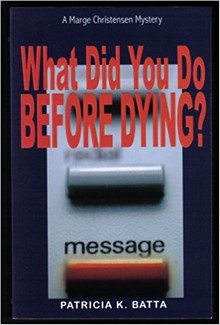
Marge finds her husband, Gene, dead in their garage, slumped over the steering wheel of his car. The police rule the death a suicide. Marge doe not believe Gene killed himself. Marge takes matters into her own hands in an effort to find out the truth.
What Did You Do Before Dying is page-turning mystery about Marge Christensen who discovers her husband dead in their garage slumped over the steering wheel of his still running car. Gene Christensen committed suicide. Or did he? He was having an affair before he died. Or was he? He cheated his wife Marge of their life savings. Or did he? What exactly was Gene Christensen doing before he died? And how did he die? Marge knows Gene would never deliberately leave her without explicit instructions on how to go on with her life, but likely suspects for fraud and murder do not abound in her suburban Bellevue, Washington neighborhood in 1997. In her attempt to discover the truth and find the money, Marge is forced to face the imperfections in what appeared to outsiders to be a perfect marriage.
Professional Reviews
ForeWord Magazine Review by Edward Morris
Coping with grief and the sudden and unforeseen burden of having to earn a living are not conditions that tend to sharpen one’s investigative skills. That, however, is what Marge Christensen must deal with as she sets out to discover who murdered her accountant husband, Gene.
Marge finds Gene dead in their garage, slumped over the steering wheel of his ritzy BMW with the motor still running. The police rule it suicide, a conclusion undergirded by the fact that Gene seems to have recently lost the family’s life savings in shady investments. Marge believes none of this, however. She’s sure it wasn’t in Gene’s character to deliberately cause her such pain. Adding to her emotional turmoil is the guilt she feels from having been on the verge of an affair.
Marge is not alone in this new and frightening world. She has a son living nearby who has his own marital problems, a daughter away at college, and a daughter-in-law who’s publicly contemptuous of her. Then, there are her hovering, obsessively attentive neighbors, Willy and Wilma Watson, both of whom treat her like she’s a basket case. Her would-be lover remains ardent, but she no longer reciprocates. Ultimately, Marge realizes that she’s on her own when it comes to finding the truth behind her husband’s death.
Batta, a teacher by trade and author of two mysteries, does a first-rate job depicting the leaden weight of Marge’s loss—pain unrelieved by sleep, self-recrimination, scary personal appearance, and the duties that once enlivened her. Although there are flashes of grim humor in the book, there is no lightheartedness
The story is set in the Washington suburb of Newport Hills, but Batta location plays little part in the narrative. It’s an understandable omission, however, since the story, while relayed in third person, is still seen through Marge’s eyes—eyes that are initially fixed inward. “Detachment enveloped her like a screen,” Batta writes, “filtering the awakening colors of spring. Marge felt as if she were moving in a different, gray dimension, one filled with emptiness and guilt.”
This book is labeled “A Marge Christensen Mystery,” which suggests future appearances by the somber but resolute widow. It will be interesting to see how she tackles crime-solving in which she has no personal involvement. (December)
Jody M. Clark, Writer and Editor
"Batta inflames your curiosity...you will want to linger over lunch, refuse to turn out the light."
Following several murders, means, motive, and opportunity all point to out-of-work actresses Bootsie Kittredge and Babs Harrison. Their claims of righteousness and lack of guilt seem fabricated, thanks to a cheerfull announcement made to the patrons