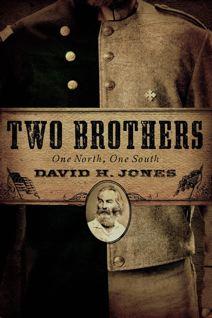
The incredible, true story of the Prentiss brothers of Baltimore, fighting on opposite sides for four years in a cruel war, then finally re-united.
Walt Whitman, whose compassion for the wounded and dying soldiers of the American Civil War is well documented, navigates the journey of Two Brothers: One north, One South. The first chapter finds him at the bedside of William Prentiss, a mortally wounded Rebel soldier. As fate has it, William’s brother, Clifton, a Union officer, is being treated in another ward of the same hospital and Whitman becomes the sole link between the brothers. The reader is taken seamlessly from Baltimore before the war, to many battlefields where North and South collide, and to wartime Richmond, where Hetty, Jenny, and Constance Cary are the reigning belles.
Professional Reviews
Review by Rea Andrew Redd, Civil War Librarian - January 2009
With a diligent handling of the primary sources and a creative approach, David Jones has crafted a fine story of Maryland brothers who are Civil War soldiers, one in blue the other in gray. With settings in Baltimore, Armory Square Hospital in Washington, D.C, and Virginia's battlefields, the author describes historic events from 1861 to 1865. The story is propelled forward by Walt Whitman who comforted soldiers at the Armory Square Hospital and where, in his post-war recollections, he states that he found two brothers in two different wards: Clifton Prentiss a brevet Union Colonel and William Prentiss, an enlisted Confederate soldier.
In Jones' novel, Whitman frequently visits the severely wounded William Prentiss and sits through his passing, and then gathers his two civilian brothers and his wounded brother, who was in the same hospital, together a few days after William's death. In the course of the story, John and Melville tell the civilian side of the war, Clifton the Union side of the war and Whitman the Confederate side of the war as it was told to him by William.
Jones faithfully pays attention to the war's social aspects. Friends of the Prentiss family, Hetty, Jenny, and Constance Cary are themselves divided by the war, their friendships and their loves during the war. At one pont on the veranda of Jefferson Davis' White House, the ladies discuss the role of women. The women past through joy and grief at weddings and funerals that held at St. Paul's Episcopal Church in Richmond. The Prentiss family's free black servant, Elijah, leaves his wife and children to become a sergeant in the 7th U.S. Colored Regiment and the war, as viewed by blacks, is discussed around the unit's campfires.
The Prentiss brothers are reunited during a Federal assault on the Army of Northern Virginia in the Petersburg trenches. Each is founded within yards of the other; here in the story Jones is not recklessly melodramatic. He has the soldiers act like soldiers and not as Victorian era, post-war sentimentalists. With a writing style that is direct and to the point, Jones handles the myriad of characters well. No one character sees everything nor understands everything. It is in the meeting of the four storytellers that the full story is revealed.
There are times though that some characters speak as encyclopedia entries, listing and detailing lives that are tangential to the main story. It is interesting that Union General Benjamin Butler attended the 1860 Democratic conventions (there were three) and voted for the nomination of Jefferson Davis over 50 times, but it doesn't contribute to the main characters development or background story. At times a reader may feel that these characters did not exist outside the story because the events they expierence are so much greater than themselves.
An advanced placement U.S. history high school student who loves the Civil War could enjoy this novel as well as most Civil War buffs. Two Brothers does not read like Killer Angels though. Sharra's style, which is similar to Hemingway's newspaperman's writing style, is unlike Jones' more extensive descriptions of individual actions and behaviors. The author's diligence in staying close to the sources and also carefully layering the stories reminds CWL of John Dos Passos' hallmark USA Trilogy: 1919, The Big Money, and the 42nd Parallel. Like Dos Passos, Jones has achieved writing an intriguing tale of the nation and several individuals' stories while allowing the individuals to tell them.
Review by Craig A. Warren, Civil War Literature - December 2008
When I first received a review copy of the novel Two Brothers by David H. Jones, the subtitle gave me pause: One North, One South. Innumerable fictions and filmscripts about the Civil War have offered up the same equation: two brothers fighting on opposite sides, each convinced of the righteousness of his cause. Did we really need another novel to feature siblings-at-odds as a metaphor for America’s great fratricidal struggle? What persuaded me to give the book a chance was the fact that Jones had incorporated into his narrative the figure of Walt Whitman, America’s greatest poet. Whitman served as a nurse during the war, and in Two Brothers he functions as a caretaker of the wounded Prentiss brothers – men hospitalized in the wake of the fighting.
I wondered how Jones would portray Whitman: an innovative artist who resisted clichés and shattered literary conventions. More specifically, I wanted to see how Jones would use Whitman within a framework designed to appeal to readers expecting the standard brother vs. brother interpretation of the war.
I have a longstanding interest in Walt Whitman, particularly his commentary on the men who fought the war. In Memoranda During the War (1875), Whitman reflected on the centrality of soldiers to his own understanding of the struggle: “[These] two or three millions of American young and middle-aged men, North and South, embodied in the armies . . . were of more significance even than the Political interests involved.” Yet if Whitman knew these men firsthand, he knew that many Americans did not: at least not as he did – men broken and bleeding and dying on cots in hospital wards. The poet fully expected that those less familiar with the troops would not view them as “the main interest of the War.”
Yet the public has indeed shared Whitman’s fascination with the men clothed in blue and gray. The Civil War soldier, by virtue of his flesh and blood humanity, has appealed to generations of Americans as the most compelling and accessible aspect of the crisis. Even when fiction writers have examined the principles at stake in the war, both sacred and mundane, they have usually done so in terms of the words and actions of men in uniform. Jones demonstrates this tendency in Two Brothers. Even when he portrays civilians at some distance from the fighting front, the reader cannot forget the soldiers themselves – the men whose lives and actions define the war.
As it turns out, Jones’s Whitman is not the poet I hoped to see. Certainly I sympathize with any 21st-century author who attempts to recreate Whitman’s tone and diction – especially if the novelist wishes to capture Whitman’s vision of his nation and world. The best attempts are usually in the comic mode, where fiction writers can be suitably grandiose in their estimations of Whitman’s speech. The best effort I know of is the Whitman parody, Wade Wordmore, as found in the 1995 story “Ancestors” by Fred Chappell. There the Whitman stand-in proclaims:
I am Wade Wordmore, American, untrammeled by boundaries, unfixed as to station, and at my ease in all climes and latitudes, answer to no laws save those of my perfect nature (for I know I am perfect, how can a man tall and in pure health not be perfect?), and am powerful to overstep any border.
By contrast, Jones’s version of Whitman is often reduced to making dry statements that flesh out the historical background. Consider this example:
“I am not qualified to expound on military matters, but I know people who would agree that Meade’s pursuit of Lee was dilatory at best,” Whitman responded. (201)
Soon thereafter, Whitman is used to describe the decline of Southern fortunes: “Misery tightened its grip on the South after receiving the sad tidings [about Gettysburg]. Gone forever were the glorious times when Southern arms appeared to be invincible – when victory after victory was achieved on the battlefield” (202). Couldn’t the nation’s most important poet here be used to comment on something beyond the basic tenets of the Lost Cause?
Although disappointed by the portrait of Whitman, I did find other qualities of Two Brothers appealing. The now-stilted language of the nineteenth century is reproduced in the novel with care; to his credit, Jones does not follow Michael Shaara in updating the verbiage of the war’s participants. Nor does Jones condescend to the past when describing the beliefs and motivations of his characters, no matter how outdated or wrongheaded those beliefs may seem to modern readers. In these respects, the novel adheres to historical fact – even if it does sometimes shade into Southern apologia.
I can recommend David H. Jones’s Two Brothers to readers new to Civil War fiction and to those for whom the story of the war – no matter how familiar – bears repeating. Both groups will find profit in the book, less for its portrait of Whitman than for its attention to what the poet-nurse treasured above all else: the humanity that both shaped and cursed America’s most costly war.
Review by Michael Aubrecht, Historian & Author, Pinstripe Press Blog - June 2008
Two Brothers more than just another Civil War novel
A month or so ago I was contacted by an author named David H. Jones, who inquired if I would be interested in reading his novel "Two Brothers: One North, One South.” Although my own work keeps me buried in non-fictional books, I do enjoy historical-fiction works for my pleasure reading. Some of my favorite authors, including Richard Croker and Jessica James, use accurate historical references as the backdrop for their imaginative stories and I appreciate their attention to detail, as well as their creative spins on the subject matter. Despite my busy schedule, I hesitantly accepted David’s invitation as I was nearing the completion of some deadlines. Now that I have finished his book, I am very glad that I did.
The synopsis of “Two Brothers” that was provided by his publisher states: “Exceptionally researched and keenly accurate to actual events, along with the personages that forged them, David H. Jones's novel spans four years in the midst of America's costliest and most commemorated war. The journey is navigated by the poet, Walt Whitman, whose documented compassion for the wounded and dying soldiers of the war takes him to Armory Square Hospital in Washington, D.C., and finds him at the bedside of William Prentiss, a Rebel soldier, just after fighting has ended. As fate has it, William's brother, Clifton, a Union officer, is being treated in another ward of the same hospital, and Whitman becomes the sole link not just between the two, but with the rest of their family as well. The reader is taken seamlessly from Medfield Academy in Baltimore, where the Prentiss family makes its home, to the many battlefields where North and South collide, and even through the drawing rooms of wartime Richmond, where Hetty, Jenny, and Constance Cary are the reigning belles.”
After reading that Walt Whitman would be ‘navigating’ the plotline, I was captivated by the premise of the tale and pleasantly surprised to find that the author did indeed deliver on his publisher’s promise. Far too often, the marketing promotions for books leave the reviewer feeling a bit unfulfilled, but I must say that David Jones has not only presented a highly dramatic and original storyline, but also composed a piece that was meticulously researched for maximum believability. The characters in “Two Brothers” read very real, because they are. The book is closely based on the true story of the Prentiss brothers of Baltimore. Brother Clifton served in the Federal 6th Maryland Infantry Regiment and brother William served in the Confederate 1st and 2nd Maryland Battalions. Walt Whitman wrote about William in "Memoranda During The War".
A former U.S. Navy officer, the West Virginia-based author was able to combine his military training with his passion for Civil War history to produce the novel. The concept of "Brother vs. Brother" is certainly nothing new to the Civil War bookshelf as countless families were torn apart during our nation’s “Great Divide.” That said it is very refreshing to find examples when historians can find a new and exciting way to present these struggles on a personal level. David Jones has managed to do just that with the highly innovative "Two Brothers: One North, One South.” From its award-winning cover that garnered the 2008 Benjamin Franklin Award for design, to the extraordinary tale it contains of a poet and two brothers who found themselves on opposite sides of an American tragedy, “Two Brothers” is a wonderful read that will appeal to history buffs on both sides of the Mason-Dixon Line.
Based on the memoirs of a Pearl Harbor survivor. Letters from two pen pals take the reader on a journey into the past, a past where nightmares came true, and when hatred reigned.