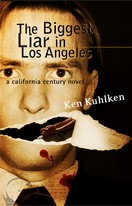
In 1926 Los Angeles a friend of young band-leader Tom Hickey is found lynched in Echo Park. But police and media decline to acknowledge the murder. Nobody except Tom appears willing to hunt for the killers.
THE BIGGEST LIAR IN LOS ANGELES, Los Angeles, 1926
The modern world began in 1926, when Harry Chandler used the persuasive reach of his Los Angeles Times to assure that railroads were out, and cars were in. Since then, Hollywood films have delivered Los Angeles as a prototype for most of world's cities.
In May of 1926, celebrity evangelist Aimee Semple McPherson went swimming at Ocean Park beach and vanished, presumed drowned. Millions mourned or prayed for her miraculous return. On June 23, she walked out of the Mexican desert and crossed the border into Douglas, Arizona.
Though her kidnapped story convinced her followers, the district attorney didn’t buy it. He summoned her to a Grand Jury hearing, which was underway when a widely distribute pamphlet reported that a colored man was lynched and found hanging from an oak in Echo Park, only yards from Sister Aimee’s Angelus Temple. The victim was an old friend of Tom Hickey, leader of a dance orchestra, whose distress is aggravated because the police and popular media have apparently conspired to deny the crime occurred.
Tom recently gave up attending USC, where he starred in football, in order to better raise and protect his sister Florence, a wild seventeen-year-old who fancies speakeasies. Aside from leading the band, Tom works days selling and delivering wholesale meat. Now he adds to his jobs the pursuit of killers, who may belong to the Ku Klux Klan, and the exposure of a city government in cahoots with media giants more dedicated to power and profit than to truth.
The investigation leads Tom to Angelus Temple and Sister Aimee, who appears to befriend him and offer clues in a veiled and cryptic manner. When she announces an upcoming sermon entitled “The Biggest Liar in Los Angeles,” Tom sees the sermon topic as a clue. He easily compiles his own roster of candidates for the title. They include publishing mogul William Randolph Hearst; Harry Chandler, owner of the Times and a vast real estate empire; Sister Aimee herself; and Tom and Florence’s own well-connected mother, from whose wickedness he snatched Florence six years ago. The Biggest Liar in Los Angeles tells a gripping story about memorable characters and resurrects a time and place that, perhaps more than any, created the modern world.
Excerpt
The Biggest Liar in Los Angeles
1
1n 1926, before clarinetist Tom Hickey turned twenty-two, the other musicians, most of them twice his age, drafted him as bandleader.
Tonight they milled around the vacant storefront owned by Archie the drummer’s uncle, trading jokes and filling the room with a smoky blue haze.
Tom hoped a high C blast would grab their attention. He lifted the clarinet to his lips.
Then Oz came loping in. He carried the tattered case that protected his alto sax, and a fistful of leaflets. He mumbled while he shoved a leaflet at each of the boys.
As Tom took his, Oz said, “None of you white folks go telling me the Klan don’t be here out here west.”
The leaflet was a broadside entitled The Forum.
It declared: LYNCHING. “We who ask to live in peace; who came to this City of Angels hoping to leave the terror behind; who judge no man without cause; who take only our meager share of the promise this nation affords to those unbound by color; who wish to believe in justice, must now turn from other pursuits to weep and mourn.
“On Monday, the 11th day of October, a gentleman who shall here go unnamed went out walking in Echo Park just as sunlight spilled over Angelino Heights. In the glare of dawn, a vision appeared. So terrible it was, the gentleman believed he had not risen but was in the throes of a nightmare.
“A dark man hung limp from the live oak not ten yards off Park Avenue, not fifty yards from Sister Semple McPherson’s majestic temple.
“Before this heinous act, the ‘Invisible Empire,’ resurrected by Mister D.W. Griffith’s ‘Birth of a Nation,’ would have us believe that in our locale they limit their hooded activities to smashing the furniture and windows of speakeasies, flogging the occasional adulterer, and marching to protest the election of our first Negro assemblyman.
“The test of a community lies not in the occurrence of sinister deeds. Evil will always live among us. No, the test of our mettle lies in our reaction to manifestations of evil. In the case of this deed, more vicious than simple murder because it targets the spirit of a people, we who seek truth, peace and justice must mourn to our depths more than the loss of an innocent. The implications of the lynching go so deep, they mock the very concept of justice. When public servants attempt to obliterate the truth, they shatter our dreams of a world that could be.
“Members of the Los Angeles Police Department carried off the body in such haste, only the one early-rising gentleman witnessed the shameful deed. Let the reader judge: has the briefest account of this heinous crime appeared in the Times, the Herald, or the Examiner?
“To our knowledge, no publication but The Forum has risked offending the powerful by reporting the murder of Franklin Gaines.”
The floor beneath Tom rose and fell, as if another earthquake had struck. He back-stepped and leaned against the brick wall. “Frank Gaines,” he muttered.
Oz turned from his saxophone. “What you say?”
2
Tom rented in a court on Prickly Lane, near the intersection of Wilshire and Normandie, halfway between downtown Los Angeles and Beverly Hills. He shared the cottage with his little sister Florence.
Florence was seventeen. Six years ago, Tom had snatched her away from their mother, Millicent Hickey, a seamstress for Universal Pictures.
He hadn’t spoken to Milly since the day he and Florence left home with nothing but his clarinet and a suitcase of clothes between them. At first he had believed their mother would track them down, have him arrested or beaten by a gang of her fellow spiritualists. But all these years, she had left him alone.
He credited Leo Weiss for that blessing.
When Tom was in fourth grade, Milly had rented a two- bedroom bungalow on Esther Street near La Brea. The owners, who lived next door, were Leo and Violet Weiss. Leo was a detective with the LAPD.
At first, Leo and Vi appreciated Milly, for her impeccable housekeeping, her passion for gardening that turned the yard into a wild yet orderly scene reminiscent of Eden. But soon they witnessed Milly punishing her children. Vi saw her whip Tom with a rope while shouting in “tongues”. Leo warned her, but politely, hoping to keep Tom and Florence next door where he and Vi could observe and react.
Then Vi rescued Tom when Milly lashed him a fence post in the back yard and left him while she ran errands. For that offense, Leo threatened jail next time. So Milly moved them to Hollywood, several miles away.
After Tom snatched his sister when he was sixteen, Florence eleven, he reported to Leo and Vi what Milly had done to the girl.
Leo informed Milly that although minors running from their guardians was illegal, torture was more so, and got rewarded by long prison terms.
Tom would’ve gone straight from the rehearsal check on Florence. According to his rule, she was to walk straight home following her after-school job sweeping and ushering at the Egyptian cinema in Hollywood. But the broadside changed Tom’s plans. He caught the streetcar on Pico, transferred to the coach line up Western and Wilshire,1 and hustled the several blocks to the neighborhood where he once lived.
The Weiss home was a shingled, early version of the bungalow, with a low-pitched roof and a porch extending the width of the house. Leo came to the door in blue pajamas, no robe. He rubbed his eyes and scratched his head. His thinning hair looked like a windblown nest.
Though Tom hadn’t seen the man since mid-summer, he didn’t waste an instant on pleasantries. He gave Leo’s meaty hand a quick shake. Then he said, “Who put a lid on the Echo Park lynching?”
Leo peered at Tom as if to assure himself this was no imposter. He scratched his head again, then turned and flopped into a rose-patterned easy chair with doilies on the arms. “Sit down.”
Tom entered and shut the door behind him.
“What lynching?”
From his hip pocket, Tom produced The Forum, which he tossed. Leo caught it, held it close enough so he didn’t need his glasses. While he read, Tom watched for a reaction but saw the profile of a poker face.
Leo folded the broadside in half and set it on the chair arm. He looked up and shrugged.
“How about it?” Tom said.
“Meaning you want to know did it happen?”
“Meaning I know it happened. What I want is to know what you cops are going to do about it?”
Leo stared, above him, as though tracing the route of a crack that bisected the plaster ceiling. “What’s it to you??”
Tom folded his hands to keep from shaking a fist. “Besides that a man’s dead, and no doubt a whole lot of colored folks are barricading their doors, and a murderer, or a gang of them, is on the loose?”
“Yeah, besides those,” Leo said.
“You want more?”
“Hey, last month a Chinese fellow got robbed, his gal got raped, and they both got heaved off the Santa Monica pier. You didn’t come running to me.”
“Frank Gaines was a pal of mine.”
“Musician?”
“An old pal,” Tom said. “Long ago, at the mission on Azusa Street, Frank used to take me down the block to the Arkansas Diner, all those times Milly couldn’t break away from the Holy Ghost long enough to keep us kids from writhing with hunger pangs. Frank was a gentleman. Not a morsel of spite or bitterness in him. Good will toward everybody. ”
“I see.”
“Meaning you’re going to tell me who put the lid on?”
“Who says I’m in the know?”
“I’m asking, are you?”
Leo shook his head.
“Okay then, are you going to find out?”
Leo drummed his fingers on the chair arms. “No.”
“Oh,” Tom said. “Orders, from Two Gun Davis?”
The way Leo grimaced meant Tom had stepped out of bounds, which didn’t stop him. “I hear Chief Davis is trigger happy as Billy the Kid and wants you dicks to be the same.”
Leo said, “The city’s crawling with bad guys. Davis is following the will of the people.”
“Which people?”
Leo stood and plodded toward the kitchen. As he passed a small marble topped with a chessboard laid out, a game interrupted in progress, he slid The Forum under the edge of the chessboard. “Tom, I work for the city of Los Angeles. I don’t run it. That’s other men’s job.”
Tom had followed, a footstep behind. “Sure, and if you get uppity about it, you’ll soon be out selling cutlery door to door. I’m aware of that. I’m no freshman. The thing is, as you have told me on more than one occasion, every man’s got to choose sides. If you side with the rats just because they run the city, it’ll prove you’re not the guy I believed you were.” Tom choked down the lump in his throat. He wanted to say, And that would break my heart. But a look at Leo’s eyes told him he’d said enough.
They stood nose to nose. “You’re sounding mighty righteous, boy.”
The word “boy” pinched a nerve. He couldn’t remember Leo ever calling him boy. He leaned on a wall and ordered himself to act civil. “Back when I was a churchgoing youngster, Frank Gaines and some other good folks pounded into my head I should do what the churchgoers say, not what they do.”
“And what do they say?”
“Seek the truth, for one thing.”
A smile broke slowly out of Leo’s stony face. “And where would you got to start seeking.”
Tom gave up the wall and stood straight. “Angelus Temple.”
“Why’s that?”
“Frank was lynched not fifty yards from the place, and I’ll bet plenty of his brothers and sisters from Azusa Street are among Sister Aimee’s flock. I could give you a few names. You can start there.”
“I’m not going to start anywhere.”
“What then, are you toying with me.”
“Tom, you’re the truth seeker. I’m just a cop. Cocoa?”
After a few speechless moments, Tom said, “I’ve got to check on Florence.”
Professional Reviews
San Diego Union Tribune
‘The Biggest Liar’: Roaring ’20s, L.A.-style
By ROBERT WADE
Sunday, May 16, 2010 at 12:04 a.m.
“The Biggest Liar in Los Angeles”
Ken Kuhlken
Poisoned Pen Press, 262 pages, $22.95
Blame it on the climate, its geographical location or its blend of races and diverse cultures, but California has always attracted a special breed of writers, with their own unique vision of their homeland. Among today’s generation, San Diego’s Ken Kuhlken must rank high on the list. His California Century series, in which he roams our state’s past in order to interpret its present, is like no other.
This is the sixth in the series but the first chronologically, and ushers us along with Tom Hickey — former musician, one-time butcher and ex-cop turned private investigator — back to 1926 Los Angeles, when both Hickey and his city were young and each was suffering from growing pains. Corrupt politicians, labor leaders, financial giants, religious charlatans and mobsters were battling for control of the Southland’s immense wealth.
It was a struggle steeped in corruption and violence. Just how violent, young Tom learns when Frank Gaines, a black man who has served as his protector when he was compelled to flee an abusive family, is lynched in Echo Park. Even more shocking, Tom discovers that the murder is being covered up by the authorities, reason unknown.
Outraged, Tom resolves to avenge his friend’s death. This pits him against the city’s power brokers, which include publishers William Randolph Hearst and Harry Chandler, political boss Kent Parrott, bootlegger Jack Dragna and evangelist Aimee Semple McPherson — plus corrupt cops and lethal gangsters, foreign and domestic. Meanwhile, he must protect his gorgeous young sister Florence from their mother as well as her own tempestuous nature.
With his offbeat thriller, Kuhlken serves up a mix of events both actual and imaginary, played out by a cast of characters both real and fictional. Readers unfamiliar with history may have difficulty telling the difference, thanks to the author’s storytelling skill. Kuhlken suggests that the history of 20th-century California may be viewed as a prototype of the world’s future. Whether you agree or not, most should find his argument provocative and his presentation highly entertaining.
Library Journal
From Publishers Weekly
James Ellroy fans will welcome Kuhlken's intriguing sixth California Century mystery (after 2008's The Vagabond Virgins). Set in 1926 and the first in the series chronologically, this entry focuses on the early career of PI Tom Hickey. Outraged to learn that a black friend has been lynched in L.A.'s Echo Park, news that the mainstream media has suppressed, Hickey risks his day job as a meat salesman to look into the killing. Hickey explores possible links to crooked cops, the Ku Klux Klan, city hall, newspaper moguls William Randolph Hearst and Harry Chandler, and evangelist Aimee Semple McPherson, who recently resurfaced after a mysterious five-month disappearance. Kuhlken mixes historical and fictional characters with an ease that will remind many of Max Allan Collins's Nate Heller series (True Crime, etc.). He's equally adept at melding the murder inquiry with Hickey's struggles with his dysfunctional family. (May)
Booklist
From Booklist
Kuhlken’s series about private investigator Tom Hickey and his offspring is set in California at various times throughout the twentieth century. The first of the series, The Loud Adios, took place in 1943; the most recent, The Vagabond Virgins, was set in 1979 and featured Tom’s sons, Alvaro and Clifford. Chronologically, Kuhlken’s latest is the first in the series. Set in 1926, when Tom was in his early 20s, it’s the “origin story,” relating the events that turned Hickey from a musician into a private eye. Dismayed to discover that a friend has been murdered—lynched, in fact—Tom decides to find out why the press is ignoring the story: Is it simply because the murdered man was black, or is there a deeper cover-up involved? As usual, Kuhlken works real people and events into the story (evangelist Aimee Semple McPherson and Randolph Hearst, for example) and vividly anchors the reader in the story’s time and place. The social consciousness and the L.A. setting across decades make this series a fine choice for fans of Walter Mosley’s Easy Rawlins novels. --David Pitt --This text refers to the Hardcover edition.
Book Four in Belinda Lawrence mystery series. Confirming the Professor was murdered proves to be a challenge and, gradually, as they get to know those associated with the Manor House, Belinda and Hazel discover another murder and an intricate web of
When high school principal Jerry Egge is brutally murdered, Deputy sheriff Dave Jenkins begins an eerie investigation. Just about everyone in Soldier, Minnesota, is a suspect.
"Murder isn't usually this funny."
Amazon re