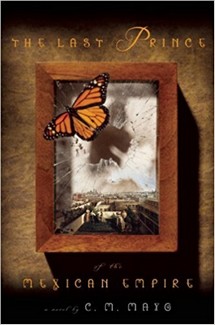
The Last Prince of the Mexican Empire is a sweeping historical novel of Mexico during the short, tragic, at times surreal, reign of Emperor Maximilian and his court.
The Last Prince of the Mexican Empire is a sweeping historical novel of Mexico during the short, tragic, at times surreal, reign of Emperor Maximilian and his court. Even as the American Civil War raged north of the border, a clique of Mexican conservative exiles and clergy convinced Louis Napoleon to invade Mexico and install the Archduke of Austria, Maximilian von Habsburg, as Emperor. A year later, the childless Maximilian took custody of the two year old, half-American, Prince Agustin de Iturbide y Green, making the toddler the Heir Presumptive. Maximilian s reluctance to return the child to his distraught parents, even as his empire began to fall, and the Empress Carlota descended into madness, ignited an international scandal. This lush, grand read is based on the true story and illuminates both the cultural roots of Mexico and the political development of the Americas. But it is made all the more captivating by the depth of Mayo s writing and her understanding of the pressures and influences on these all too human players. Her prose makes the reader taste the foods, smell the spices and flowers and feel the heat of Mexico. Mayo writes for the senses. And for the ages. The Last Prince of the Mexican Empire is a story both sweeping and intimate, of geopolitics, the glamour of royalty, and the grit of military command, of the arrogance of power, the dark labyrinths of ambition, and, above all, of a child who was not, in the end, a prince, but a little boy who belonged to his parents.
Excerpt
Our story turns now to an ivory castle perched by the uneasy sea within sight of the city of Trieste. In the northeastern corner of Italy, then part of the Austrian Empire, Il Castello di Miramare, or, Miramar, was the residence of the archduke who was second-in-line to the throne. Whereas Vienna's ancient and grey Hofburg Palace huddled around shadowy courtyards, Miramar stood new, crisp, unafraid of the Italian sun. Even today in the early morning, just before the sun rises from behind the hills, and all the birds are singing, its tower seems to glow from within. Yes, sometimes a story's beginning fools the eye, the way a fata morgana projects a landscape that may in fact lie hundreds of miles beyond the horizon. But sometimes, too, persons who do not appear to share even a footprint's worth of common ground turn out to have destinies bound together in painful knots. Indeed, it was in the midst of the Iturbides's domestic idyl that, beyond the other side of the Atlantic Ocean, in his still under-construction Miramar Castle, the Archduke Maximilian von Habsburg very reluctantly accepted the Mexican throne— that same throne which had belonged to the ill-starred Don Agustín de Iturbide. The Archduke's reluctance was an ugly embarrassment for all concerned. However, the details of the episode were not generally known until years afterwards when most of the participants had gone to their reward, for, in Austria and in Mexico during the French Occupation, sharp-eyed censors inspected letters, magazines, newspapers, and telegrams, and they had not the least hesitation in confiscating matter their superiors might deem offensive. Which is not to suggest that no one in Mexico knew of the troubles surrounding the Archduke's acceptance of the Mexican throne, merely, that the Iturbides, as most members of Mexico City society, were not privy to the whole of it. This turned out to have exceedingly unfortunate consequences.
Professional Reviews
Library Journal
"Once upon a time, there was a little half-American boy who briefly became heir to the Mexican throne—until his distraught parents sued the doomed Emperor Maximilian for his return. As in the best historical fiction, Mayo's sparkling first novel transforms a forgotten historical footnote into a spellbinding, heartbreaking tale filled with drama and fascinating characters." (blurb)
Austin American Statesman
It is a hefty, sprawling work, more than 400 pages long, but at no point does it begin to sag under its own weight. Perhaps because its spread is solidly supported by facts, Mayo's intricate plot trips along at a natural, inexorable pace, easily traveling the sweeping map she has laid out for it, from Washington to Mexico City and all the way to the imperial halls of Europe... a swashbuckling, riotous good time, befitting the fairy-tale promise of the opening sentence. (blurb)
MexicoConnect
I have read a few sweeping historical novels that have remain inside of me forever. Tolstoy's War and Peace is one of those, Dickens's A Tale of Two Cities is another, Pasternak's Doctor Zhivago is another, and now The Last Prince of the Mexican Empire is another. (blurb)
Marooned is the 1860's saga of Justin Radcliff, a young American, who is beaten and thrown overboard by his evil twin brother, Edward.
Kolya, a handsome Black man and new leader of the transplanted Zulu tribe there, finds Justin caught in hi
Dublin 1941. A brutal murder. Mistaken identity. And barman Eamon Foley is running for his life.
Nine months later Foley is in a crowded pub, and his brother-in-law is shot dead.
Ireland 1944.. A young man’s body is pulled from the River Lee. He’s wearing a distinctive silver ring that belonged to Paudy Daly, the eldest son of the notorious Mixer Daly. Why?