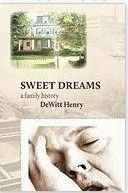
The history of a Main Line Philadelphia family in crisis.
Excerpt
From SWEET DREAMS: A FAMILY HISTORY by DeWitt Henry
Mom left us to go alone to Bermuda for six weeks on January 1, 1947. She left on Doctor Truxel's orders, I was told then and for years later, to recuperate from a nervous breakdown. Before leaving, she told me she loved me; she didn't want to leave, but she had to. And she'd be back just as soon as she could.
She'd always said my prayers with me and tucked me in (the "Now I lay me down to sleep,/I pray the Lord my soul to keep..." terrified me with its message that I could and might die in my sleep, that my soul was mine only on loan, belonged to "the Lord," and could be taken back at will.) We had never been separated before, and, according to Judy (I have no memory of it), for these long days, nights, and weeks, I cried myself to sleep.
A housekeeper, Mrs. Pinkerton, whom we called "Aunty Pink," was hired; Anna stayed on as live in maid and cook; Nana Henry visited; and Jack, as man of the house, was responsible for the rest of us. Sixteen, then, he was in his junior year at Haverford; Chuck was in his freshman year; Judy at The Haverford Friends School, and me in kindergarten.
Dad was absent not only to my memory, it turns out, but in fact, having been admitted to the Pennsylvania Hospital Institute in Philadelphia two days after Christmas, where he would board until mid-March. (The dates I know from the monthly hospital bills, which Mom kept and later showed me, along with other papers from then.) In reluctant and troubled recollection, and having "thought about it a lot over the years," Jack corroborated the adult facts that Mom has told, at my adult urging and since Dad's death. That Dad's "bad times" were off and on, from 1943 onward, but that the worst came after Grandpop's death the fall I started kindergarten and climaxed on that Christmas Eve, 1946. Before this incident, says Jack, the drinking had been private and secret, even within the family; but this night, downstairs, Dad was drunk and sitting surly during dinner; then after dinner as we trimmed the tree, kids from the neighborhood, Jack's, Chuck's and Judy's friends, came up the front walk, caroling, and Jack was too ashamed to let them in. But Dad jumped up, roaring, and came out on the porch yelling for them to go away. I remember none of this.
According to Mom, Dad had asked her for a divorce the night after his father was buried, July 14, 1946, and she had told him: All right, but not until he'd gotten himself straightened out first; that he was ill; that he needed a doctor. By then his affair with a girl at the factory had been open between them for some time. The girl had started as a clerical helper. She was a "beautiful young girl," said Mom, "not much older than Jack--she could have been Jack's date, when he was working in there." Before long, she had gotten "under [Dad's] skin"; he wanted Mom to find his fraternity pin and give it back, so he could pin the girl. He made her his private secretary, even built a private office for her after his father died. She called him openly at home: "He there?" at first pretending to be the real estate company, or on some thin pretense of business, but then with no pretense at all. He wanted to marry her, he'd repeat to Mom, and start a new family, since he'd "botched this one so badly"; other times, he was talking and thinking about suicide: "I should just go ahead and drive over a cliff. That's the only way I'll ever get over and out of this mess." The girl, meanwhile, just before he finally submitted to treatment, called up to threaten Mom, who had told her flatly she would never grant him a divorce: "Just tell him for me, the girl had said. “Tell him I said that he has compromised himself, understand?"
All along, with the drinking, once the children were in bed, or supposedly so, Mom and Dad would fight, Dad shouting, threatening, even hitting Mom. From the age of fourteen and younger, Jack would hear them and creep down the hall to listen outside their door (as would Judy, from the back room, without Jack or Mom knowing). Several times, in winter, Dad dragged, shoved and locked Mom out of the house in her nightgown, so that Jack had to help her up the porch and in through a window. Once Dad actually came at her with a kitchen knife; she knocked it out of his hand and shoved him out the door. "He could have burned you," Mom has told me, "chased you with a knife, urinated in an ashtray and up the wall, and next day, he'd have no memory; we'd all go for the Sunday drive, visit his parents..."
Early on, Jack began to sleep with his squirrel rifle ready under his bed (the gun that Dad had
given him), but only once, during one bad fight, did he intervene, aiming the loaded rifle at Dad and
telling him to quit, get out, or he'd shoot. "I would have, too," he said now, evenly; "I came that close to being a fourteen year old parricide." But Dad, speechless, wide eyed, had sobered at once, taking in
the boy and gun; then turned and left. Otherwise, Mom had handled most of the trouble herself.
But then that fall, 1946, the whole family had caught measles and Mom was run down from lack of sleep. She was taking B12 shots, sleeping pills, wake-up medicines; her teeth, hair, skin, everything had begun to go. She weighed ninety-six pounds. Dr. Truxel sent her to the hospital for a heart test, which showed arrhythmia. He told her she was "terminal"; she had a bad heart and couldn't live another three months this way. She had to get away, say, to Bermuda. She couldn't take care of four children, and she'd be away permanently if she didn't take care of herself. He asked her what was doing this to her, and then had guessed; so she had told him about Dad. At first he told her to get out of the marriage, but when she wouldn't, put her in touch with his friend, Kenneth E. Appel, a psychiatrist connected with the Pennsylvania Hospital. Appel refused to treat Dad while he was still drinking, and called in a Mr. Chambers, who wasn't a doctor, but was with A.A. Chambers talked and met with Dad; and Chambers was the one they called for help on Christmas Day and who took Dad into the Institute, where after drying out, he would spend nights, while continuing to work at the factory. Here, also, he would admit to alcoholism, see Chambers regularly, meet other alcoholics, and read such books as "Alcohol: One Man's Meat" (for which he was billed January 7) and "It's How You Take It" (February 18).
Mom, meanwhile, went ahead with her Bermuda trip as planned. She had made it clear, even before the Christmas trouble, that Dad could not stay with us while he was drinking. She had hired a housekeeper. He could go for treatment or he could stay at a hotel. Her plane left on December 29, and influential friends of her father's sent letters of introduction to influential Bermudians ("Mrs. Henry is the daughter of Mr. Jerome Thralls, a long-time friend of mine who holds a very responsible position in one of our important Government agencies the RFC. If Mrs. Henry is in need of any guidance during her visit I can think of no one who could be of more help to her than you"), though her father himself, guessing nothing about Dad, assumed that she was leaving the marriage for another man, and sent a Pinkerton detective after her. Years later, as executrix of her father's estate, she would be shocked to learn this, coming upon the detective's report in his files.
Aunty Pink I recall resenting as an interloper, who slept in Mom and Dad's room and who consumed all the chocolates that Jack could bring from the factory. We called her our "mickey mickey" after a demon in a children's book, who sneaked any candy in sight. Besides that, she was self-important, strict and humorless, so we banded together to tease and manipulate her, at least in little things. Says Jack, she learned not to tell us to go to bed, but to ask.
I got an ear infection, then, which confined me to bed and grew serious enough that they wired Mom to come home. (The family legend has it that I got sick to make her come back.) Dr. Truxel came and went. He told Jack and Chuck to punch a hole in the end of a grapefruit can and mount a 60-watt lightbulb inside; I was then to hold this can, with the bulb on, constantly to my ear, to keep the ear hot, which solemnly and scrupulously, I did. If this didn't work, I overheard him tell Jack, I would need an operation. My wallpaper, day after day, became oppressive: a repeating pattern of apple trees, ladders, men picking, and overflowing baskets, which I myself had chosen (come repapering time, I'd also been allowed to scribble and draw with abandon on my walls before the new paper was put on). Anna or Judy brought me food on trays; Judy sat with me, read to me, drew; Jack and Chuck stopped in regularly to cheer me. At the worst of my fever, they had brought me Mom's special picture, in color--a tiny oval, mounted in gold, covered with glass, and hooked in a wooden case that opened and had red velvet inside. I would take out the medallion, which felt smooth and cool, gaze at my beautiful mother with the brown hair, the dark eyes, then kiss and close it in my hand.
Mom, then, foreign in her suit, and tan, and groomed for the outside world, was suddenly, actually filling my door, coming in, taking me up in the bed and holding me--all in one delirious rush.
*
Summer vacations were part of the rhythm of our lives. Aside from Eaglesmere, in my earlier years, while the boys were in camp, we had been to Ocean City in 1944 and Minnewaska in 1945. Minnewaska, in the Catskills west of Poughkeepsie, was Mom's family's traditional resort.
But no place compares with Eaglesmere, where we returned, were all together, older, and felt the need, maybe, to put the "bad times" behind. This was our family place.
The trip took five or six hours, which seemed all day. Out Lancaster Pike, Route 30 (before there were turnpikes anywhere), through gentle, rolling Amish country, there were cities and towns all the way. At Harrisburg, we'd turn north up two-lane roads, no towns hardly at all now, only fields. We passed somewhere one long graveyard, miles long, too long for me to hold my breath at one gulp, and I tried to cheat, quietly breathing in or letting out breath without showing. We carried a milk bottle for me to pee in. We'd watch out for Burma Shave signs with their staggered messages. And I'd get cranky and restless, the seat hard; and they'd keep promising, I'd see the mountains soon. And then we'd come to a place called La Porte, where wooded banks rose from the road, and I'd crane to look out for the tops; and these were "mountains." They told me to yawn, so my ears would pop; and Judy, who always got carsick traveling, would start chewing gum, though the highest Pennsylvania mountain is 3000 feet, if that. But we'd be going up, the road narrowing, winding and climbing until we came out someplace where you could look out over the mountains and see the lake itself; and then, still longer, and we'd arrive at the far end of the lake and pass a motel called "Snow White and the Seven Dwarfs," where each cottage was named after a dwarf, then cross a bridge over an inlet choked with lily pads; then back into trees, around curves, and finally we were in downtown Eaglesmere, with its general store, sweetshop, movie theater and board sidewalks, like in cowboy movies. We turned right gently uphill on a potted macadam road, and to our right would be the lake and waterfront, beach, rafts, boat dock, changing huts, and a wide expanse of tree-shadowed lawn, like a park. Farther back in the trees, was the little theater building, and up from that, the bowling alley, and then dominating, at the end of the lawn, the long hotel, with its open, awninged porch. Here guests sat in deck chairs, gliders, or slatted rocking chairs, and looked out over the lake. To our left would be the cottages and yards and dirt side streets, and that was where our cottage was, down one block, right, and up a short way, on its own corner.
A shingle over the door read "Buzz Fuzz" in rustic lettering. A parlor, dining room, and kitchen were downstairs. Upstairs, I had a room to myself, next to Judy's, and we signaled and talked through the wall; Jack and Chuck were across the hall and Mom at the end, past Judy's door. Again, though Dad came up on weekends, I am told, I recall no joy of greeting, nothing we did together, no scene in which he figures.
Occasionally Mom cooked on the cast iron stove, which we fueled from a box of chopped logs and kindling out back, where there was also a trash box (bears, raccoons and skunks were said to forage there at night). But usually we took our meals in the big formal dining room at the hotel, where we had our table assigned, and Jack and Chuck tried to teach me to wet my finger and rub it around the rim of my water glass, making a high pitched ringing sound. Chuck was best, as always. For the various courses we had a complex array of knives, forks, and spoons, and I was told to use the outside ones first and work in. For breakfast, I'd get tomato juice, set in the same silver bowl-like things that Mom's or Chuck's grapefruit came in; then eggs and bacon or pancakes, either of which would arrive covered by a silver dome, which you'd lift up and they'd be steaming. For lunch were salads, fruits, and sandwiches, with soup. We had to dress for dinner, and the tables throughout the room would be busier and fuller than for any other meal. Our waiter, one of Chuck's friends, who was interested in Judy, took our order and disappeared through the swinging doors, then emerged with someone else's round tray on high, and we stared enviously as their plates were uncovered and set out. At last, then, came ours: roast beef au jus, mashed potatoes, and different vegetables; then ice cream for dessert, vanilla for Chuck, chocolate for the rest of us. There may have been finger bowls. Excused, we'd gather dinner mints at the door and head into the lobby, where groups of sofas and easy chairs were arranged like islands, and where, for evening entertainment, in the far corner would be the violin, piano and viola concert. Three white-haired musicians played music that was whiny and interminable.
Behind the hotel, alongside tennis courts and a deserted sawmill, were the riding stables, where Chuck took me for my first horseback ride. Wearing my Roy Rogers chaps, vest, bandana, hat with chin cord, and cap gun, I was granted a Western saddle (they only had two or three; the rest were English), which the stable master slung over the back of a "gentle" paint. He boosted me up, adjusted the sheathed stirrups, and told me that only greenhorns grasped the saddle horn. Chuck, meanwhile, boasting that he was as good a rider as Jack (who had worked in the stable), asked for Flash, a palomino, and the fastest and most spirited of the string, which only the stable master himself and a few others could take out. As soon as Chuck was up, the horse pranced, ducked, and wheeled. "Sure, sure, I can handle him," Chuck insisted, hauling on the reins. "Yeah, well, go easy," the stable master warned. "Don't get him worked up, okay?" Then Chuck took my reins and led me out at a walk, just us two, to the dirt and hoof-mulched trails through the woods and around the lake and back. I was shocked by the casual way his horse lifted its tail and dropped a stream of fresh, round turds, but otherwise, I was intoxicated by the realness of riding, the creaking leather, the sway and plod of living flesh, the shake of head, blow, twitch of hide and ears. I turned and propped myself, arm stiff, hand on the horse's rump, which was as broad and solid as a table. Then, half-way around the lake, Chuck handed me the reins and told me to wait; he was going to find out just how much his horse could do. With that he took off down the trail, crouched, kicking with his heels and slashing with the reins and disappeared around a bend; a minute, two, then they were coming back, breakneck, both horse and rider set, intense; then Chuck pulled back, and, standing in his stirrups, posted past me, the horse panting and shiny with sweat. "Jesus, he can run," Chuck announced, sweaty himself and red faced, as he came up to take my reins.
When we got back to the stable, the stable master was furious. "What've you been doing with him? Look at him! He's all lathered up!" Unsaddling Flash, he threw a blanket over him; later he would have to curry him down. He swore at Chuck, over Chuck's protests that he hadn't galloped much. "I told you not to gallop. Wise ass little rich kids. Listen, don't you come round again; you're not riding here again! You want to give him pneumonia?"
Chuck, my primary mentor now, with Jack working or off with Lou Kirk, also took me exploring down the more difficult hiking trails. There were three, all starting behind the hotel, marked with signs and periodic swatches of colored paint, as they led off into the woods. The red trail I could do alone, but the blue and yellow trails, steeper, longer, and leading through rougher terrain, were taxing even for grown ups. We had to pack a lunch and carry a canteen. We found a blue marker, a stripe on a tree or arrow on a rock, then searched ahead for the next. On the blue trail we found a cave under a hanging rock, which was supposed to be where a "hermit" once lived (I'd never heard that word and the idea scared and fascinated me). At some point on the yellow trail, we had to scale a cliff.
Another time, we explored the sawmill, around which logs were piled, with rusty grapplers lying in the weeds, and mounds of sawdust were heaped, and where, inside, once we climbed a chute-like ramp, the huge, rip-tooth circular saw stood frozen--I reached out and touched the teeth. Operating levers, the big motors and drive belts were nearby, and uncut logs were still on the conveyer. The mill predated the resort, which all had been a logging area once; narrow gauge tracks led from the mill back into the woods, where a small steam engine lay on its side. Even the horse paths originally had been logging roads.
The bowling casino, adjoining the hotel, was primarily a teenage hangout, as were the sweetshop in town and the barn-like movie theater. "Nature Boy" and "The Woody Woodpecker Song," that summer's favorites, played constantly on the jukebox, and there was a deep ice cooler, into which you plunged your arm to fish out Hi-C or some other soda. The six alleys gleamed, echoing with the rumble of balls and crash of pins; and the bowlers would grimace, leap and posture as their turns came to perform. Lane 3 was best according to Chuck. Games cost fifty cents, you rented shoes, chose a ball to fit your fingers (we each had numbered favorites, which we sought) and hired or supplied a pin boy, whom you tipped. Occasionally Chuck worked as a pin boy, and once or twice, later, I tried, while he, Jack, Mom and Judy bowled. It was hard work. The balls were heavy; you had to clear the fallen pins and stick them into the overhead rack, then lift and send the ball down the return track with enough force to carry it up the alley and make it climb into the bowlers' rack, clunk against the other balls. Then you scrambled up the padded pit back, out of the way. Chuck's dream was to bowl a perfect 300, and one afternoon he claimed a 290. He would swing the ball back high in the air, until his arm went straight up, then come looping down with his approach steps, a powerful swoop, glide and release, and the ball would hook or slice as he wished and smash into the pins, sometimes for explosive strikes, sometimes for splits, sometimes sending pins leaping and spinning into adjacent alleys. He and Jack always scored over 200, while I rarely made 100 and was usually beaten by Judy and Mom.
The more Chuck and Judy grew involved with teenage friends, the more they dismissed me as Tag Along and left me on my own, or with Mom, or with my "friend," Chip, the only boy my age nearby, whom I never really liked but with whom I rode bikes, swam, explored, and hiked the easy trails, especially the mile around the lake.
Most sunny days, the family went swimming or boating, or both. The beach was small, but sandy, with the swimming area divided from the boating by a floating walkway, which joined a diving dock twenty-five yards out. The diving dock had high and low diving boards and a life guard stand. To the left were the boat sheds and docks, where Jack worked, connected to a series of changing rooms, like a triple row of outhouses, each with a bench, coat hooks and a mirror inside the door. We'd take turns changing, Mom and Judy emerging in their bathing suits and caps, and each door locked with a padlock, to which you kept the key. We were a family of good swimmers, reputably. At that summer's waterfront festival, Chuck won the men's butterfly, Judy the junior freestyle, and I came in third in the small-fry race. Jack and Chuck took part in the canoe jousts too, with Chuck jabbing a padded pole at the rival canoes, while Jack maneuvered with his paddle; but soon they were overturned.
I went canoeing with Mom. If Judy came, she'd paddle on one side in front, I'd ride in the middle, and Mom paddled and steered on the other side in back. With Mom alone, I rode in the bow, trailing my hand, as she paddled first one side, then the other, and we glided away from the beachfront, out into the deep center of the lake. There would be just us, the water lapping, sky, breeze, distance, and the sun, and now and then the hotel launch might pass, leaving us rocking in its wash. When the day grew hot, we headed for a "cove" (another new word for me) along the shore, where pine boughs dipped over the water. The rocky bottom grew visible, then shallows, Mom shipped her paddle, and, holding or parting the branches, we slipped underneath, to eat our lunch, stretch out in the canoe and nap, eyes closed, canoe gently bobbing, swaying, and overhead the branches closing us from view.
Torrential rain kept us all in Buzz Fuzz one full day, reading, fly tying, playing card games, listening to the radio, or working on jigsaw puzzles. I'd heard the boys and Judy talk about other storms, other summers, when they had seen lightning "run down the street," something I could neither believe nor imagine, so as thunderclaps intensified and came instantaneously with lightning flashes, I kept my face to the window, holding aside a tasseled, crocheted curtain, and staring out into rain-slashed air. The gutters were pouring, hail pellets bouncing, when there came a flash and crash and I saw: the incandescent, dancing, jagged branch, like a neon scribble down the water-filled ruts out front; an instant, gone, leaving my eyes ringing from the flash as much as my ears and body from the noise.
That same afternoon, or one like it, perhaps after she had argued with Mom, Judy sat curled on the chaise in the parlor, beneath a reading lamp, and, staring off moodily, insisted that she had been an adopted child; she could never have been born into this family; but that I didn't have to worry, I wasn't adopted.
We crashed in heavy rain on the trip home, somewhere between La Porte and Harrisburg. The boys were an hour ahead in the Model A. I was riding in front and Judy in back, painting her nails, when Mom lost control on a curve, the car ran up an embankment into rose bushes, rolled over, and landed back on its wheels, facing forward. I remember the jolt, noise, and tumbling, then finding myself under the dashboard; a choir was singing (we joked later about thinking it was angels, before realizing that the radio had come on) and rain was drumming on the roof. Shaken and dazed herself, Mom demanded how we were, feeling us all over. She had hit her head and cut her arm, and Judy had sprained her wrist against the roof, but I was unhurt. Then Mom got out in the rain, climbed the embankment and disappeared to telephone from a nearby house. We were towed to a crossroads gas station, where after Mom called Dad and Dad had spoken to the mechanic, we waited all afternoon while they worked and banged on the car, up on a lift. We were back underway by nightfall. Jack and Chuck told us that they had skidded on the same curve, which was called "dead man's curve": and we agreed, repeating the words of the mechanic and policeman, that we'd been "very lucky."
During our time away ("the most enjoyable summer I can remember," Judy calls it in a Baldwin theme), Dad had a relapse. On into that fall, apparently, he was drinking again, involved with the girl still, and asking Mom a second time for a divorce, which she refused, all of which peaked by Thanksgiving. By then Jack had "flunked out" of Cornell too, and come back home, worried about Mom and the family. Dad told Mom that he was through with her, with Dr. Appel, everything; he was leaving, and had Jack drive him in town to the Warwick Hotel. Then a few hours later he called home and simply said, "Come get me."
The hospital bills show a second stay from Thanksgiving, 1948, through January, 1949, when Mom left for her second Bermuda trip. From Bermuda Mom wrote to Judy, "this time you must feel better having no Aunty Pink and Dad back in his own room again." Dried out, reconciled, he was staying with us, which I myself cannot remember. There is also a letter from Dad to Mom "The one and only time he ever apologized to me," she said. It is on Judy's blue stationery with the Bloomingdale address. He writes:
Dearest:
I am sitting on the edge of Judy's bed and it
is 5 a.m. I haven't been asleep. I don't know where
you will be when this letter is handed to you. Maybe
I will hand it to you myself, because I will be in
Bermuda where you are.
I hope you will forgive my
barging in on you like this, but I couldn't wait
until you returned to Wayne.
Kay, it has been a long, long detour, and I
have been badly lost on the way, but I now feel that
I have both feet on the main road for the rest of my
life. I believe that I am finally the man you
expected when you married me.
I hope I am not too late, because I love you with
all of my heart, soul, and body. I want the chance
to prove it to you "until death do us part."
John
P.S. I think maybe it was meant to happen this way
to make a man out of me.
He had been in full analysis with Appel and shaken by an EKG, which showed brain damage. Despite
his initial doubts, Appel was quite satisfied with Dad's progress and wired Mom in Bermuda on
January 27: "Things fine. Very pleased last visit and trip. Don't discuss past considerations. Best
wishes."
They bought the St. Davids house a few months later, as if to dramatize the new beginning and cut ties to the Bloomingdale past. Dad's cousin, Mahlin Rossiter, the carpenter, was working on the house by April and Alfred Reahm, the decorator, papering, painting and sanding floors in May. We moved in the fall, 1949, when I also started third grade, moving from the Primary to the Grammar school building, and riding my bike the mile to school, each way, or walking, since we still lived too close for me to qualify for the school bus.
I am eight.
At this point my memories of my father begin.
Professional Reviews
Boston Globe
Book Review
Memoir traces a sensitive soul’s bittersweet family history
By Steve Almond
February 1, 2011
E-mail|
Print|
Reprints|
Comments (0)
Text size – +
DeWitt Henry’s engaging new memoir opens with the most tantalizing of visions. Our young hero, whose father owns a chocolate factory, is set loose in the packaging department, its conveyor belts layered with booty. “We would take paper bags from the sample room and start working the belts and bins,’’ he recalls. “We bit into round, oblong, and square chocolates to find out what they were: nut chews, creams, marshmallows, mints (green, pink, orange inside), coconut, nougat, caramel, and syrupy cherries.’’
Tweet 1 person Tweeted this
Yahoo! Buzz ShareThis
SWEET DREAMS:
A Family History
By DeWitt Henry
Hidden River, 239 pp., $20
Talk about your childhood wishes.
But “Sweet Dreams: A Family History’’ turns out to be a bittersweet sojourn. As the scion of a prosperous Philadelphia Main Line family, Henry enjoys every material advantage growing up. His family, though, is in ruins.
Henry’s father — besides being “dogmatically racist, sexist, classist, capitalistic, patriotic, Presbyterian and Republican’’ — is a devoted alcoholic who abuses his wife, and harangues her for a divorce. Henry’s mother struggles to shield the children from this strife, but eventually suffers a nervous breakdown and travels to Bermuda for six weeks to recover.
As the youngest child, Henry is spared the worst of these turbulent years. His parents reconcile, but an uneasy mood settles over the family. “My own sense of Dad involved respect for his power and fear of his disapproval. But I also sensed that he was demoted somehow at home; that he had surrendered to rules and wisdoms beyond him,’’ Henry observes. “Mom’s job and ours was to support him with domestic order and to launch him each day, if not like Achilles in armor, then like an actor going on stage.’’
While his older siblings escape into unhappy marriages, Henry seeks a refuge in literature. By fourth grade, he’s printing a newspaper (the Swiftset Rotary News) for his classmates. He ships off to Amherst, studies with Eudora Welty, writes a novella, and dreams of being a published author. At the Iowa Writers Workshop, the novelist Richard Yates mentors him. He eventually finishes a doctorate at Harvard and settles in Cambridge where, besides teaching and writing, he helps launch the venerable literary magazine Ploughshares.
All around him, the ’60s are raging. Henry pursues doomed affairs and tomcats around town with a fast-talking accomplice. He goes to see Janis Joplin in concert, though, perhaps appropriately, the speaker system is broken. (“All that crowd eager to marvel at her, and here she was nothing, nobody, only some chick doing her gyrations way off out there, in silence.’’)
Mostly, Henry is focused on what he calls “my world of loneliness and ambition, of struggling under the idea that I could only be gifted, could only tolerate myself as an artist.’’ Any aspiring writer will recognize the symptoms: pretension, solipsism, a tendency to drive away potential mates.
His portrait of the artist as an aging bachelor gradually gives way to a more nuanced tableau: that of a sensitive soul who in seeking to escape from the respectable cloister of his past has deprived himself of a family. Although Henry finds a wife and settles into a literary life that is sustainable if not glamorous, he remains haunted by the sorrows of his legacy. “I don’t know how I choose or if I choose rightly, or what right is, honorably, or by nature,’’ he confesses at the end. “The examples trouble me, Mom’s of self-martyrdom and frustration; Dad’s of expiation for some natural monstrosity.’’
This is not a flashy memoir, written with Hollywood in mind. But it is candid, clear-eyed, and humble before the insoluble mysteries of the human heart.
New York Journal of Books
Sweet Dreams: A Family History
by
Reviewed by Frank Mundo | Released: January 15, 2011
Publisher: Hidden River Press (252 pages)
Digg
Facebook
Twitter
del.icio.us
Reddit
For a lot of readers today, the word “memoir” has become a kind of code word for dysfunctional family history: a portrait of a victim-turned-artist who overcomes tragedy and abuse to become the superproductive and somehow-still-sane citizen we all thought we knew and loved. Often titillating and always voyeuristic, these stories can be highly entertaining and even somewhat cathartic for those, like this reviewer, who thoroughly enjoy the genre.
But every once in awhile, a writer comes along and throws a wrench in system, sharing an unselfish and powerful family story that challenges the reader and truly demands to be heard, creating a literary event that is so much more rewarding than even the best of the typical memoir fare. That’s the best way this reviewer can describe Sweet Dreams: A Family History, the new memoir by author DeWitt Henry, founding editor and long-time director and editor of Ploughshares.
In the book, DeWitt, in astounding photographic detail and extraordinary prose, chronicles the first 50 or so years of his life, from his privileged post-war childhood and coming-of-age (as an heir to a candy factory) in Wayne, Pennsylvania, a wealthy suburb on Philadelphia's Main Line, to the self-imposed poverty of a literary academic in the 60s and 70s, and finally the “respectable happiness” that always eluded his father in the 80s and beyond.
Don’t worry. The dysfunction is still there, and still palpable: alcoholism, mental illness, infidelity, suffering, and physical abuse. But Henry, the youngest of four children, the one “unscarred” by his father’s alcoholism, reveals the details of these events as echoes of how they ultimately affect his family and their relationships.
In fact, DeWitt’s own story, his portrait of the artist, always seems tangled in the failures and successes of his family and friends—and reveal themselves in his own character (“a witness more than a participant”) as a son, a sibling, a friend, a lover, a husband, and a father by means of devastating judgments and critical concessions that fall as often on the author as they do on the others.
What was especially interesting for this reviewer is DeWitt’s portrayal of his experience of the 60s–70s, which is so different from the free love era of sex, drugs, and music we’re so much more familiar with that supposedly fueled the Civil Rights and antiwar movements.
DeWitt’s pre-birth-control-pill generation of cautious sex and academic deferments brought a new and fascinating parallel perspective. Instead of Vietnam, DeWitt takes us along on his tours through Amherst College, Iowa and Harvard Universities, elite worlds known by those other few good men and women who fought the good fight from the top down.
Bottom line: DeWitt is a writer’s writer, and his commitment to literary excellence alone will no doubt attract glowing blurbs of praise from literary bigwigs. Ignore this praise. Ignore this review. Instead, take a few minutes and read a few pages of Sweet Dreams to discover for yourself the rare and guilt-free pleasure of a compelling and unique memoir.
Reviewer Frank Mundo is a writer based in Los Angeles who has been reviewing books for over a decade. His award-winning book, The Brubury Tales, boasts a foreword by bestselling author and critic Carolyn See.
Through interviews with Lauren's doctors, along with those of other physicians, researchers, and clinicians who specialize in lung cancer, readers will have a better understanding of the disease.
With the same passion and honesty Lauren exhibite