|
Amazon
DeWitt Henry's website
Category:
Family
Publisher: MadHat Press
ISBN-10: 1952335167
Type: Non-Fiction
Pages: 150
Copyright: April 15, 2021
ISBN-13: 9781952335167
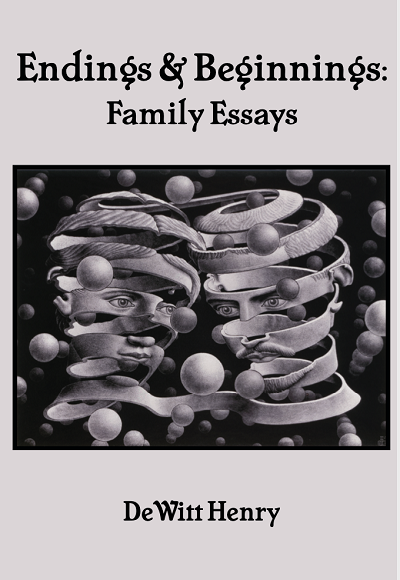
The third and concluding volume in DeWitt Henry's trilogy in memoir, which includes Sweet Dreams: A Family History and Safe Suicide.
"The present collection [is} the most powerful book of the three"--from the Introduction by John Skoyles.
"In these superb essays, DeWitt Henry shows himself to be a master of the form. Whether he is writing about his life-long experience as a golfer or with guns or having grown up in the shadow of privilege and alcoholism, one sense that Henry is stepping nakedly, and with a clear and unsentimental eye, into the abiding mystery of the decades of his life thus far: a son, a brother, a husband, and father, a writer, a teacher, a friend. But he accomplishes all this without trying to solve that mystery, but to simply live it. This is not an easy path, but perhaps it is the only path toward wisdom, which is abundant in this moving, deeply compelling, and indispensable collection."--Andre Dubus III, author of Townie.
More details at www.dewitthenry.com .
Excerpt
Four years after John died, I flew to Los Angeles to see Judy for the third time since our mother’s funeral. She was 59; I was just turning 53. I knew from phone conversations that she had continued in John’s place to collaborate with Lucia and that Friedericy Dolls was now an established, thriving business. Also that she had dedicated herself for the past two years as a volunteer in a “buddy” relationship with a young girl, Jessica, who had been born with AIDS, and who would die before much longer. She wouldn’t be in her Pasadena cottage to greet me when I arrived, but told me the key would be in the mailbox. How strange to enter her intimate world, the shell of her living with the opening of that door.
Paintings filled nearly every available portion of wall, foyer, living room, dining room, bedroom. Mostly the paintings were John’s, some original canvases I had seen in his San Francisco apartment, some I had only seen in slides, and now was startled by in full size and richness of color. Other paintings I recognized as my mother’s and Judy’s. John’s sculptures, too, occupied every available surface. Nudes, primarily female, were everywhere. Paper mache stylized birds of John’s hung on wires from the ceiling. Startling dolls peered from tables, corners, chairs, in size ranging from twelve inches high to some thirty-six (a Don Quixote seated on a horse, Quixote’s face resembling my brother Jack’s, stood before the fireplace). As I waited for Judy, I told her later, I didn’t feel alone. The house and its art told her silence over time, and told John’s. The walls talked, the corners, every table, every square and cubic inch. John’s art merged with my mother’s, with Judy’s, and with the dolls and sculptures that were Judy’s and Lucia’s. I felt as if death were no more than a continuum of absence in space and in time, like physical distances between the living.
Judy had a meeting of her “buddies” hospice group the next night and took me along. After John’s death, his lover Bruce, who had infected him, attempted suicide by jumping off a roof, only to end up maimed. Judy had taken care of Bruce until his own death from AIDS. It seemed to me that out of her love for John, her mission was to immerse herself in the problems of the gay community, especially the AIDS community. Not to flinch, as Hans had done, and turn away; but to immerse herself. And in the Buddies meeting this night, she tried to comfort another Buddy, a librarian, who had just been told by the social worker in front of us that her buddy/girl had taken a turn for the worse, and that the doctor had told her, the social worker, in medical confidence, that the girl would not recover and would die soon. The librarian had broken down in tears.
A spare bedroom was cluttered with archives of John’s work as well some incomplete mosaics and canvasses of her own. Within the creation of the house and its shown art, there was the so-called studio, where an archive of all John’s sketches, notebooks, letters, and other papers were stored in flat art drawers. Also where unhung canvases of his leaned against one wall, and where the entire original of a series of lithographs called Heron Dance was leaning on an easel (“I put up a new panel each week”). There were two mosaics messily in progress and abandoned on cluttered worktables. Of her own painting and sketching the canvas propped on one of those tables that gripped me was indeed a self-portrait. “I did that after John died,” she said. It was stark, all brown and white, a face contemplating suicide. Angry, empty, devastated, blank. The stunned, helpless, beyond howls and tears face of a Hiroshima survivor, or victim waiting for execution.
There was a nine- or twelve-inch doll on her dresser, in front of her mirror (a mirror stuffed with snapshots of family and friends and her buddy Jessica) that I took for another self-portrait, though she said it was not. This was a life-worn woman lifted young and shining, if those are the words, arched somehow, all alive, enthralled, as if in exaltation, out of her aging body and mortality, as if to greet the lost love found, the dead reborn.
I felt proud of my sister, who seemed to know more about the mysteries of grief than anyone in my life; and who, for me, embodied the triumph of love.
|