Don't let you true skills/talents go untapped any longer! Realize or
expand your entrepreneurial dreams. Go from start-up to finding
angel investors to franchising to taking it public! Eliminate the regret!
Make the leap from worker to entrepreneur and soar.
1st Book from the "Make the Leap..." book series
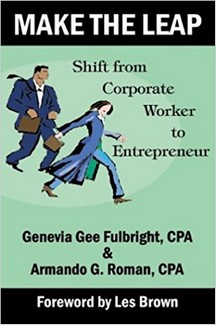
Make the Leap: Shift from Corporate Worker to Entrepreneur
Publisher Infinity Publishing
About the book:
Authors - Genevia Gee Fulbright, CPA and Armando G. Roman, CPA
Tradebook, under 150 pages in length, Release date: February 2003
Foreword by Les Brown / Edited by Donald Jay Korn
Authors plus 6 chapter contributors (including finance radio host, venture capitalist, international sales trainer, franchise expert, CFO)
Practical resource for both budding entreperneurs and seasoned business owners to help guide them through the difficult yet rewarding experience of starting and growing a business.
Guidebook filled with practical advice designed to help entrepreneurs:
- Market their business on a tight budget, consider franchising, buying a company
- Develop critical financial plans and define goals
- Transition from "employee" to "entrepreneur" including 50 tips for getting started
Written in "plain" English with user-friendly links to helpful websites, quick practical tips and checklists from experts who've "been there, done that"
Excerpt
RESPONSIBLE PARTIES
Self-employment is a state of being in which an individual devotes time, energy and resources to an income-producing activity while being either fully or partially financially responsible for the success
and/or failure of the enterprise.
Self-employment can take many forms: part-time, freelance, investing
in one or more business ventures, or full-time at one enterprise. In
general, the self-employed individual risks financial loss if the venture
fails and has a significant (often the only) interest in the success of the business.
WHO SHOULD READ THIS BOOK?
You will benefit from reading this book if you’re a:
* Part-time freelancer interested in freelancing full time;
* Corporate worker or other employee interested in creating a niche where you’ll be well-rewarded;
* Technical worker or creative internal advisor who already has a niche that needs further development;
* Individual hoping to create opportunity in an uncertain corporate environment;
* Entrepreneur who wants to improve his/her chances for success;
* Entrepreneur who wants to take his/her business to the next level.
Chapter 2. Your Business Plan: A Road Map to Success
What does it take to start your own business? A solid business plan is one place to begin. With a business plan, you lay out on paper what your business is, what it will do, and how it will do it. Remember, the most important part of a successful new business is its ability to fulfill a need. If there’s a need, you will have plenty of customers who will buy from you once your business is up and running.
Key elements of your successful business plan:
* Customer identification;
* Description of the products and services you will offer;
* A marketing plan that will attract customers;
* Projected costs for starting your business;
* Time line for cash to start coming in; and
* A plan for successfully managing your business.
Notice that you don't have to know where the startup up money comes from. Your business plan is a tool that will help you get this money from a bank or other sources. If you can prove to people that you have a good idea, that you know what you are doing and that you have done your homework (otherwise called "market research"), the money will come.
Professional Reviews
A Great Guide to Entrepreneurship
Make the Leap: Shift from Corporate Worker to Entrepreneur is a must read for individuals who want to make the shift from employee to self-employed. This book is a practical how-to guide, not a theoretical text book. It helps the individual recognize the need for personal scrutiny, aides in the evaluation of business opportunities, and delivers invaluable insight on how to avoid many of the potential pitfalls and costly mistakes that can be encountered when entering the world of entrepreneurship. Reading this 116 page book is equivalent to attending a series of critical seminars and workshops.
--- Ronald Patterson, Kayron Associates, Independent USANA Distributors
Blueprint for Starting Your Business
Make the Leap: Shift from Corporate Worker to Entrepreneur, by Genevia Gee Fulbright, CPA and Armando G. Roman, CPA, is a "how to book" that contains the "Top 50" things you need to do to start your business as well as tips on how to purchase a business or a franchise. I have referenced the book in my syndicated personal finance column, "Your Money Really Matters."
By Michael Shinn
Getting Started the Right Way
Becoming an entrepreneur after working in a corporate environment is more than a notion. The 50 tips for getting started is an excellent way to set up your business model, but more importantly, really decide if you have the passion and drive to become an entrepreneur. Genevia and Armondo's approach to getting started in business is very sytematic and one of the best approaches I've seen. Their approach allows you to lay your foundation without feeling overwhelmed in the process. Every step is designed to postion you to make the transition as smooth as possible.
Learn to profit from the Natural Cycles of the stock market.
An illustrated introduction to the relationship between planetary orbits in the solar system and periodic cycles in the Dow Jones Industrial Average.
Practical application
Don’t Wait, Lead Now is a must-read for emerging leaders and anyone in leadership that wants to up their game— full of practical, real-world examples that highlight the traits and behaviors that create high-performing teams.