The daughter of a retired official becomes the 4th wife of a man who dies before the wedding. She enters his household as a Ghost Bride.
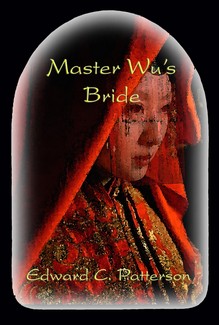
It is Chi Lin’s wedding day – an exciting time for any bride, unless the groom has died before the ceremony and the ceremony, as per contract, must proceed. Chi Lin becomes the Fourth Wife – the ghost bride in the House of Wu, a respectable Ming Dynasty household. But to keep her honor, Chi Lin assumes her role under the stern command of her mother-in-law and the disdainful eye of the First Wife. Still, as Mistress Purple Sage, Chi Lin survives, managing to bring fresh breath into this ancient household.
Women in Fourteenth Century China played a subservient role. Most accepted their lot and worked within a man’s world, supporting their husbands, revering their fathers and elders, and assuring their children followed the same dauntless path. Still, within the narrow confines of a subservient life, there was always a place to leave a mark and make a difference for the future.
Master Wu’s Bride is a journey seen from a woman’s point of view — a woman who held secrets and cultivated them to everyone’s advantage. From yesterday’s stale cabbage, Chi Lin manages to cultivate her world to bloom. Come take this journey with Mistress Purple Sage, the ghost bride. Come take this journey that many women in a host of cultures still take today in the shadow of inequality’s quagmire.
Professional Reviews A delightful and interesting book.
This was one of those books that you finish reading and then are sorry you finished reading it. The story of Master Wu's bride begins when Chi Lin is taken to her future husband's home for the wedding ceremony. Unfortunately, Chi Lin's husband-to-be died suddenly before the wedding could take place, but there is a marriage contract which must be fulfilled and Chi Lin becomes a "Ghost" bride. Already the lowest in status in the great house of Wu because she is a fourth wife, as a Ghost bride Chi Lin's status has dropped down even further. Yet Chi Lin is very intelligent and knows that if there is to be success in her new life she must follow the rules and obey the wishes and demands of her new mother-in-law, and so she does.
The story of Chi Lin is the story of a courageous and intelligent woman and how she manages to achieve success and becomes an asset to the House of Wu in spite of her humble beginning. The book contains fascinating historical and period information and will be a delightful read for anyone interested in the ancient land and culture of China. I enjoyed it thoroughly and plan to read more novels by this very talented author.
Interesting Story of One Woman's Rise from Exploitation to Influence
A historical novel set during the Ming Dynasty, "Master Wu's Bride" is the story of Chi Li, a young woman taken into the Wu household as a "ghost bride," the wife of someone who dies before the wedding can take place. As such she occupies a tenuous position somewhere between respected wife and lowly servant.
When we first meet Chi Li, she is unhappy about the marriage and acts in a fairly stereotypical "spunky heroine" fashion, meaning that she sulks and pouts and secretly does "boy" things; in this case, reading and writing. Since I consider this to be one of those tropes--and probably the most common of them--that are supposed to be empowering to women but in fact only serve to disempower them, I started off with only lukewarm feelings towards the book, but as Chi Li's character grew, so did my appreciation for her and for the story. She learns how to negotiate the byzantine and restrictive rules and interpersonal dynamics of her household and society, winning the respect of her superiors and eventually becoming a force to be reckoned with within both her family and her district. The traps around her are woven with skill, and her trials and tribulations become genuinely dramatic, so that by the latter half of the book I had a hard time putting it down.
The setting is described in a way to immerse Western readers in the society of medieval China without confusing them, and in this it succeeds admirably. Social customs, business practices, and native words are presented with a balance of closeness and estrangement that allows readers ignorant of these topics to have the sensation that they are learning new information about the culture without being overwhelmed by it. An interesting read about characters and customs that manage to be sympathetic and familiar despite their separation from their intended audience in both time and space.
The Ghost Bride - A Portrait of Women in 1300s China
After falling out of favor with the emperor, the Chi family is presented with a rare opportunity to once more regain their position - a marriage, one which would connect them with the powerful Wu family which controls the country's salt mine monopoly. Youngest daughter Chi Lin, fulfilling her duty and family obligation, leaves her family and home to become the fourth and lowest ranking wife of Master Wu. Her duty was to produce more sons, heirs for the master of the house given his second and third wives were unsuccessful in this charge producing only daughters. But fate would play her twisted hand and just prior to the wedding, Chi Lin’s husband-to-be dies. None-the-less, honor dictates that the wedding continue and Chi Lin becomes the Purple Sage, the Ghost Bride, and struggles to not just gain respect in her new household but heal the fractured bounds she finds within and transform the lives of all those she meets.
In Master Wu’s Bride, Edward C Patterson paints a detailed and complex world of obligation, honor, social norms, political maneuverings, and the role of women in China during the late 1300s. It some ways it is difficult to imagine how foot binding which left a woman crippled with a limited gait could become such common practice that those whose feet were not bound were not only seen as an unattractive minority but unworthy of a honorable match. Worse yet, educated women were seen as an embarrassment and soiled a family's reputation. Unfortunate, there are present parallels in which the education of women is criminal. The death sentence that looms over 18-year-old Nobel peace prize winner Malala Yousafzai is one such example.
But Chi Lin uses her intelligence, patience, selflessness and keen intuitive understanding of human behavior to… well, no spoilers here but rest assured that her journey is a fulfilling one. Patterson once again paints a vivid palette taking the reader into the richness of this world. As he does with all of his books his characters leap off the page and are so real that after you’ve closed the final chapter you feel as if you have lost an old friend. Readers of Asian historical fiction and Amy Tan are sure to enjoy Master Wu’s Bride.
An interesting and sensitive glimpse of an ancient society and its rules. Chi Lin and other characters become living beings the reader can connect with. It is insightful and inspiring to see the rise of one from the lowest family member to an integral, influential and respected part of Mr. Wu's family and society in general. A wonderful read, especially for those who enjoy historical novels.
I had the honor to read this book for a review. Though not a subject I usually would seek, I found myself immersed in a period of time set long ago in China. I'm an avid reader and was intrigued by the customs, hierarchy, and traditions of this period. The author had a unique writing style, developing Chi Li into a complex, interesting and true to life character. I felt amazed by her patience and dedication to honor her new family, despite the First Wife's attempts to keep her in a lowly position.
I felt her heartbreak in wanting to have normal, married life, but having to live vicariously through rituals, being obedient and learning to become an integral support to her new family.
The author has a way with prose that gives you a wonderful, imagination filled picture window into the beauty of China. But also the appalling poverty that existed.
Excellent telling of history that informed and entertained at the same thime. My only complaint was the opening where she is daydreaming of the past and then it dips into the story from there. I got a little-lost keeping track of the characters, but the author tied it up quite nicely in the end. It was hard to switch between personal names and the house names.
Despite that, it was an excellent read with characters I became quite fond of. I highly recommend this read.
Book I of Southern Swallow Series – 12th Century scholar Li K'ai-men takes command of his first official assignments during a time of political unrest and barbarian invasions.
Third Book in Five Book Series - Southern Swallow - a tale of 12th Century China. Li K'ai-men becomes entangled in an intrigue that becomes his undoing.




I felt her heartbreak in wanting to have normal, married life, but having to live vicariously through rituals, being obedient and learning to become an integral support to her new family.
The author has a way with prose that gives you a wonderful, imagination filled picture window into the beauty of China. But also the appalling poverty that existed.
Excellent telling of history that informed and entertained at the same thime. My only complaint was the opening where she is daydreaming of the past and then it dips into the story from there. I got a little-lost keeping track of the characters, but the author tied it up quite nicely in the end. It was hard to switch between personal names and the house names.
Despite that, it was an excellent read with characters I became quite fond of. I highly recommend this read.