Category: Children Publisher: Fiona Ingram
Type: Non-Fiction
Pages: 164
Copyright: November 2013
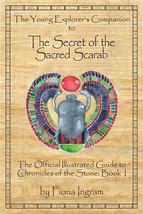
Discover the secret behind the sacred scarab and meet the real life boys who inspired the book. Free download on www.chroniclesofthestone.com
Discover the story behind The Secret of the Sacred Scarab and meet the real life boys who inspired the series. Find out who was the Scarab King, and learn the secrets of Ancient Egypt. Tips on creative writing will turn kids into budding authors. Visit Egypt with cool class activities. Take the quiz and find out how much you really know about Ancient Egypt. Pictures include drawings by real-life hero, Adam Sinclair. Bonus material includes the first chapters of Book 2: The Search for the Stone of Excalibur and Book 3: The Temple of the Crystal Timekeeper. Join Justin and Adam in their search for the Seven Stones of Power.
Excerpt
THE RIDDLE OF THE SPHINX
The Sphinx was just a short distance from the pyramids and was equally magnificent. The bus parked quite far away from the actual area and the tour group had to walk some distance to get to the Sphinx. They found themselves looking down into a kind of valley. Below, on their right, were the temple buildings forming an entrance. They then walked down a sloping stone walkway, through a narrow stone corridor and columned courtyards, then up a steep ramp and onto the high ridge closest to the Sphinx. There were crowds of tourists of all nationalities; everyone bumped and jostled as they hurried up to the viewing area. When they reached it, a large group of tourists was already gathered there, admiring the ancient stone beast.
Justin and Adam elbowed their way forward until they were standing near the edge, right up close against the safety railing. Their aunt and Gran followed behind. The rolling sand dunes in the distance looked like an endless golden sea with sandy waves. On all sides, the desert stretched away until the shimmering sand seemed to meet the azure sky in a hazy blue line. The sunlight was almost blinding. The gigantic Sphinx lay crouched below them like a strange, mythological creature. It had the body of a lion and the face of an ancient pharaoh. The nose was broken, partly from erosion and partly—it was said—from soldiers firing at it for target practice several hundred years ago.
Laila raised her voice so that everyone could hear: “Gather round everyone! Now, the Sphinx was originally sculpted from an enormous, naturally occurring limestone outcrop. For most of its history, it has been covered up to the neck in sand. Limestone is a very soft rock so the poor old Sphinx is in very bad shape from erosion. In fact, renovations have been going on for a few thousand years. These began with the first recorded clearing in the 18th Dynasty, around 1,400 BC. A prince, who later became the pharaoh Thutmosis IV, ordered the sand to be removed. Apparently, the prince had a dream in which the Sphinx promised him kingship if he cleared the Sphinx. The dream came true and Thutmosis kept his promise. If you look closely, you’ll see a commemorative ‘stela’ or pillar, called the ‘Dream Stela,’ recording the event. Thutmosis placed it between the paws of the Sphinx.”
“How old is the Sphinx really?” Adam asked.
Laila sighed and stared out at the huge beast. “There’s such controversy about the age. Some scholars say four to five thousand years old and others say it is at least ten thousand years old. But one thing is for sure, it is at least four thousand five hundred years old. No one knows exactly whom the face is supposed to represent. The accepted thinking is that it is Chephren, although it could just be a royal head.”
She pointed to the Sphinx’s massive head. “Look at the headdress extensions on each side of the ears—that’s part of the royal ‘nemes’ or striped head cloth. Then there was the ‘uraeus,’ the rearing cobra headpiece, which would offer protection from evil forces; and there was a royal beard, but nothing remains of that now except fragments in the British Museum.”
“Is its name just the Sphinx?” Adam asked curiously.
“It’s interesting that you ask that question,” Laila replied. “Actually, it has quite a sinister Arabic name: Abu el-Hol, which means ‘father of terrors’. Originally the Sphinx was called Hor-em-Akhet, which means ‘Horus who is on the horizon.’”
“Wasn’t the Sphinx quite a gruesome beast long ago?” Justin asked.
Laila laughed, but the boys could see she was impressed.
“You boys have done a lot of reading. Well, the word ‘sphinx’ comes from the Greek word ‘sphingo,’ which means to strangle, or ‘sphingein,’ meaning to bind tight, which is what the Sphinx was supposed to do to its victims if they couldn’t answer a riddle. In Greek mythology, the Sphinx sat outside Thebes and asked a riddle of all travelers who passed by. If the traveler failed to solve the riddle, then the Sphinx killed him or her. However, if the traveler answered the riddle correctly, then the Sphinx would destroy itself.
The riddle goes like this: What goes on four legs in the morning, on two legs at noon, and on three legs in the evening?
Oedipus solved the riddle, and the Sphinx destroyed herself.
The answer is a man, who crawls on all fours as a baby, walks on two legs as an adult, and walks with a cane in old age. Of course morning, noon, and night are metaphors for the times in a person's life.”
Gemma succeeds in starting a girls' football team at her new school, but bitter rival Tyrone does everything he can to stop the girls playing. So begins a battle of wits between the girls and boys, and also between Gemma and sports teacher, Mrs Lawfo
Alisha is shocked when she learns her seizures can send her back through time. With the meddling of Selene, Goddess of the Moon, and Iris, Messenger Goddess, she finds herself transported to ancient Sparta, where Helen is desperately trying to escape
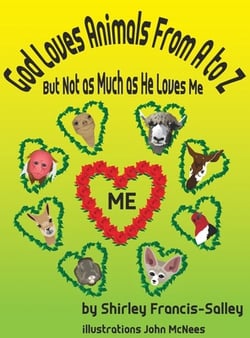
Colorful interactive book for teaching children the ABC's using God’s creation of the animal kingdom and featuring some of His most exotic creature. More importantly the book segues into the very special love God has for children.