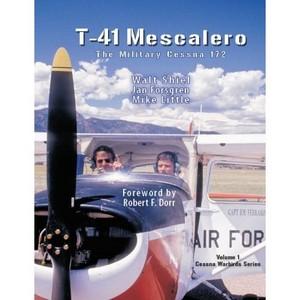
Category: History Publisher: Slipdown Mountain
ISBN-10: 0974655333
Type: Non-Fiction
Pages: 216
Copyright: Nov 1, 2006
ISBN-13: 9780974655338
History of the Cessna T-41 Mescalero training aircraft
The Cessna Model 172 is the world's most widely produced lightplane and it is hardly surprising that it has found its way into military service. The T-41 program came about as the result of the USAF's attempt to go to "all-through jet" pilot training. The T-34 was phased out of USAF service in 1961, the theory being that the mild-manneredT-37 Tweety Bird was as easy to fly, and since jets were the wave of the future anyway a propellor-driven trainer was no longer necessary. However, what had not been taken into account was that some pilot candidates were simply incapable of flying, and it was becoming expensive to waste several thousand pounds of jet fuel to discover this. A cheaper means of sorting out the hopelessly inept from the reasonably promising was needed. The USAF issued a Request For Proposal for a new trainer, selected a basic model of the Cessna 172 to fulfill the requirement, and took delivery of the first aircraft, all in 1964! Not that they were in any hurry. . . .
The initial T-41As were essentially model 172Fs and Gs, with only two seats, a fixed-pitch propellor, and day-VFR instrumentation. Later contracts used the same designation but the aircraft themselves were model 172Hs and Ks (the latter for foreign air forces). All of the rest of the T-41 models were based on the R172, which had been developed in Wichita for production in France by Reims Cessna. Its primary difference was in the power train, which featured a more powerful engine and a constant-speed propellor. The T-41B was purchased by the US Army as its fixed-wing primary trainer, the T-41C was obtained for the US Air Force Academy (it kept the more powerful engine but did away with the constant-speed prop), while the T-41D was intended for foreign military forces.
Over forty years later the T-41 is still in service around the world.
Excerpt
Unlike most military aircraft, which tend to be scrapped or preserved in museums or as “gate guards” at the end of their service lives, Cessna 172s/T-41s have often been sold on the civilian market or passed to flying clubs. As a result, although many have survived relatively few are on static display. A prime example is the T-41A; of the 200-plus built, only four are known to be displayed in the US. This is better than the T-41C, of which none are known to be preserved at all! US Army T-41Bs are represented by four examples, one of which is still on flying status. Overseas, a small number of T-41As, Bs and Ds and a handful of civilian-model 172s are preserved, often in the national aviation museum of the country that operated them.
This is the story of the author’s great great grandparents, Edward Lewis and Sarah Crosby, who were convicts transported to Van Diemen’s Land in the 1840s. It is told from the perspective of a detective agency searching for what happened to Edward, w
325 letters my father wrote to my mother during his time in World War II.
Woven together in a timeline of events of three of his brothers, 5 brothers-in-law, and one cousin, all 10 of them were in WWII at the same time.