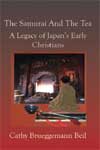
Michael, a Japanese Amerian boy of mixed ancestory, wants to be strong as a Samurai. When a mysterious Tea Ceremony set carries him back in time to the days of the real Samurai, Michael learns there is more to the Samurai than he'd ever imagined.
Michael longs for the set of samurai swords owned by his grandmother. He's humiliated when instead, he receives a Tea Ceremony Set. But the first time he uses the chawan he’s transported in time to the Internment Camps of WWII. From there he travels to sixteenth century Japan and befriends Thomas Kozaki, a young Japanese boy who was among the first 26 martyrs of Japan. In 1865 he accompanies the first group of “Hidden Christians” to reveal themselves after nearly 250 years of persecution. He meets Fr. Maximilian Kolbe in his Garden of the Immaculata. He’s in Nagasaki just before the bomb is dropped. Michael's travels lead him on a noble path of Japanese history and in the footsteps of his Catholic ancestors. He learns there is more to the samurai than swords. The Samurai and the Tea is the story of Japanese Catholics in history; a story for our times, accenting honorable people.
Excerpt
The crowd continued to surge against him, trying to reach the bodies of the martyrs. A woman was hit and fell to the ground beside him. It was Anthony’s mother. “Are you all right?” he asked.
“My son has been put to death,” she said simply.
“I know. I am sorry,” Michael said.
Her husband reached out for her and said, “Come, we will pray with the others.” The couple approached the area where many had already fallen to their knees. The guards wouldn’t let them close enough to touch their loved ones, but many were tearing bits of cloth from their kimonos and soaking them in the pools of blood.
“Ah, this broken chawan is like ours,” he heard someone say. A woman knelt beside him and helped him to pick up the shattered bits of clay.
“You mean to say this is not the only one?” Michael asked.
The woman stood and pointed to the man who hung upon the second cross. “Kosuma Takeya, the sword maker, he was my brother. He made four of these chawan. They were his last pieces before he was captured along with Father Martin.”
Michael wondered if the other pieces held the same power to send him back and forth through time. He looked past the sword maker, down the long row. He saw that Thomas’ father had died on the fourth cross. Louis and Anthony were right next to one another on the ninth and tenth crosses.
Thomas had been far removed from them on cross number twenty. He had not even been permitted to die next to his father or the other boys, Michael thought. He wondered if Thomas had looked for him in the crowd before he breathed his last. But he had been at the other end of the crosses when the lance had pierced Thomas’ heart. Not even he was near Thomas when he died.
Michael moved away from the woman, not waiting to learn if he could hold her chawan in his hands. He walked the line of dead martyrs until he stood as close to Thomas’ cross as the guards would allow.
“Good-bye my friend,” he whispered to Thomas. Then he dropped to his knees and began to pray.
Interesting excerpt. We live fairly close together. I am in Ohio, and originally from southern Kentucky. You go girl.
Reviewed by Stephanie Brooks
12/14/2002
The Samurai And The Tea is a wonderful book. Not only does it help us to see all the sufferings of the early Christians in love for God but iy also helps us to see the importance of the little things we sometimes miss in our daily happenings. In The Samurai And The Tea, Michael does not see the importance and significance of the CHAWAN, and we too may not see the importance in "little thinhs" such as prayer and the rosary. I, being a convert to the Catholic religion, sometimes forget the importance of these "little things". But this book has helped me to see that even though we tend to see things different and dont understand the importance of them we shouldn't be too quick to dismiss them. Instead we should strive to see the significance of these things and hold them most dear. I think Cathy Brueggemann Beil is a wonderful author and a sincere Catholic. I would love to read more of her interesting ideas and i wait for the opportunity.
Reviewed by Ellen Tanner Marsh, New York Times best-selling author
11/4/2002
This is no ordinary tea set; rather an ancient and mystical family heirloom, and when Michael first sips from the chawan, the bowl in which the tea is seeped, he is instantly transported back in time.
In depicting the humiliation of Japanese-Americans in the interment camps of WW II, the valor of the Japanese American Unit of the 442nd Regimental Combat Team fighting the Germans on Suicide Hill, to the dropping of the atomic bomb on Nagasaki, Beil paints a horrific picture of prosecution and pain. Her ability to empathize with Michael as he calls upon strengths he didn’t know he had make for a moving portrait of a young boy ’s coming of age. Back in his own time, presented with the swords he had once yearned for, Michael rejects them in favor of the tea set.
“It is not in being ready to kill that a man shows his strength,” he tells his grandmother, “but in being ready to die for peace.”
Cathy Brueggeman Beil’s slender novel packs a lot of information into its tightly paced pages. Michael’s travels take him to pivotal moments in Japanese history, centering on Japan’s long and often ruthless persecution of Christians, particularly in Nagasaki, a city on the island of Kyushu where Christianity first took hold.
“So long as the sun shall warm the earth, let no Christians dare come to Japan,” proclaims
Iemitsu, the most powerful man in Japan, in 1635.As a warning to others, 26 Franciscans had been executed in Nagasaki earlier, their crucifixion witnessed by an uncomprehending Michael, who has largely ignored his Catholic upbringing until now.
With Christianity banned, Japanese Catholics spend centuries practicing in secret, and Michael bears witness to the abiding faith of these Kakure Krishitan, the Hidden Christians, in the face of oppression, humiliation and worse at the hands of officials from the Christian Suppression Office.
From the building of Nagasaki ’s Oura Cathedral to a meeting with Father Maximilian Kolbe, a priest who would attain sainthood following his martyrdom in Auschwitz in 1941, Michael struggles to understand the unswerving faith in God demonstrated by the people he meets. More difficult for him to comprehend is their accepting attitude of shikata ga nai, it cannot be helped.
In The Samurai and the Tea, Beil presents a fascinating glimpse of a feudal Japan that goes beyond the swordplay and bushido of samurai history. Readers unfamiliar with Japan’s martyred Christians and the intricate culture of the tea ceremony will come away with a new understanding of the legacy that influences the nearly two million Japanese Christians living in Japan today.
Reviewed by Lisa McConnell
9/12/2002
There are books out their that have the ability to draw you into their story as soon as you open the cover and I honestly feel as though this book has this ability. I was standing beside Michael when I read the excerpt from the book. This book is definately a must and I can't wait to purchase it so I can once again visit the world that Michael is in.
Reviewed by Susan
9/8/2002
This is a wonderful book written by a fantastic author! Hope to see more great books like this from Cathy Bruggernman Beal.
Reviewed by Anna Wilson
9/7/2002
This facinating story gets a grip on you and won't let go. Michael isn't the only one being transported through time here. I feel a current flowing through my senses. I must have this book! I am about to embark on a most amazing journey!
Reviewed by Gayle Parish
8/30/2002
the excerpt captured my imagination and I can't wait to purchase the book.
Reviewed by Violet A. Kikiloi
8/30/2002
This is a "gotta have" book. I will be in the bookstore this morning.
Reviewed by Bashir H. Samma, MD
8/30/2002
"Samurai and the Tea": Great fantansy spiced with time travel, true history and reality. I'm certain this book will make great sales.
Reviewed by Judy Vinegar (visitor)
8/30/2002
A popular description of a Samurai is a Japanese warrior who can enter the moment of "now" in total surrender to that moment. This is how I felt as I read
Cathy Brueggeman Beil's excerpt from the Samurai and the Tea. For a brief moment, I was truly transported into the "now" of 16th century Japan. I am
looking forward to "being present" as Michael journey's through time drawing strength and inspiration from the Samurai warriors.
Reviewed by Carol Walker
8/29/2002
This book captures my imagination. I'm off to the bookstore to find it.
Reviewed by Tak D. Nomura
8/28/2002
All the components of this story seems to be creative and witty by taking the reader through the war years of WWII, and transporting us back into the chaotic world of Japanese Christianization since the mid-19th century Japan. The idea of time travel back to the days of the samurai will be an added dimension to this story. I'm look forward to reading it.
Compelling historical fiction that traces the life of a young English immigrant woman who travels to America at the turn of the century to start a new life for herself. Encountering danger, romance, heartache and tragedy, she strives to fit into a
Marooned is the 1860's saga of Justin Radcliff, a young American, who is beaten and thrown overboard by his evil twin brother, Edward.
Kolya, a handsome Black man and new leader of the transplanted Zulu tribe there, finds Justin caught in hi