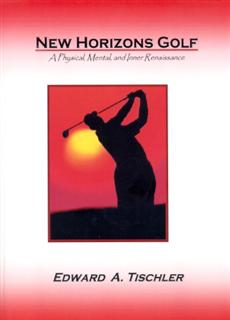
New Horizons Golf is ideal for golfers that want to develop a greater understanding of the mechanics of the golf swing as well as improve the mental and inner sides of their game. It focuses on creating the total package of skills needed to be a competitive or low handicap golfer. It includes to chapters dedicated to my coach, Fred Shoemaker (Author of Extraordinary Golf), and Michael Murphy (Author of Golf In The Kingdom), who was one of Fred's mentors. New Horizons Golf includes over 200 instructional pictures demonstrating the drills and exercises offered.
Part of Chapter One:Putting It All In Perspective
As you embark on the adventure we call golf, consider the possibility that golf is a continual test of awareness, character, and presence of mind. Every round of golf challenges your physical, mental, and spiritual conditioning. The intricacies of your swing will test you physically, the ever changing relationships on the course will challenge your mental foundation, and the game's rules and rituals will test your inner resolve. It's this chemistry between your physical, mental, and inner relationships that give golf its true character. Although scoring as low as you can is the obvious goal, the ongoing challenge will be to maintain a perspective that will allow you to be the type of golfer you want to be. In this way, golf is a continual test of your focus, your perception, and of maintaining an awakened state of mind.
Even though accurately and honorably recording your score is an integral part of the game, the essence of the game is rooted far beyond the goal of scoring well. Try to imagine that golf started very different from the game you know today. Maybe it started in ancient Roman times with curved sticks and rocks. Maybe some Centurion found a long staff with a curved, gnarled-up end for a clubhead. Upon swinging this primitive golf stick, he found that the weight of the gnarled head created some flex in the arm of the staff. He may have found the feeling quite intriguing, and wondered how well it might fling a rock. Through practice and experimentation he found that the stick created quite the majestic feel when it was swung just so. And when swung through the rock, well, it caused the primitive ball to fly on the most amazing trajectory. As he showed his friends his new findings, they too, became intrigued by this new test of eye-hand coordination. As a group, they desired to play together in an organized fashion. They chose targets to play their rocks towards. Maybe they started by aiming at boulders, or trees in a field. Eventually they stuck poles in the ground at predetermined distances and started to play towards them. They called their course, "the playing field," and they decided they would bet on who could reach the poles in the fewest number of strokes.
Being an organized and advanced society, they realized they needed rules to govern their play, just like other sports of their day. If this game had originated in ancient Athens, it might have become an Olympic sport. Although, most Olympic sports of the day involved feats of eye-hand coordination, strength, agility, and speed needed for combat. And since they already had the sling, swords, and bows and arrows, the evolution of warfare had certainly traveled beyond what this primitive version of golf had to offer. Thus, the game would have been more for leisure, a way of passing time when not at war. Anyway, my dream began in Rome with a Roman Centurion. He did find his new pastime a good way of developing greater eye-hand coordination. He also found it an appropriate game socially. Over time, the game evolved, and as the Roman Empire spread, especially with the efforts of Marcus Aurelius, the game spread as well. It traveled to Germania, and those small isles off the western coast of the Roman territory. Eventually, the Roman Empire fell, and the game was forgotten with it. However, in some remote parts of the fallen empire, the game stayed true, and it continued to evolve. With this evolution, the experience of the game reached the inner depths of those who played it, and it took on new meaning. It became a gentleman's game, and even became more popular than archery. It took on a fascination. It had a mystery about it that seemed almost unexplainable, yet very reachable. It eventually became golf, the game we know today. And it found its ancestral roots in Scotland.
I read once that there was such a game in ancient Rome, and they called it, I believe, Paganda. There is also evidence of the game evolving in Holland, and within the Germanic tribes. Therefore, there may be evidence that the game could have evolved from the primitive Roman game. In Michael Murphy's Golf in the Kingdom, there is a part where he and Shivas Irons use old Seamus McDuff's ancient shillelagh to play some golf. The image of them swinging Seamus' "baffin' spoon," as they called it, creates an image in my head of the Centurion swinging the same type of gnarl-headed staff. Throughout my studies I have found that such games seemed to have evolved spontaneously throughout many cultures whether they were touched by the rise and fall of Rome or not. No matter what your theory might be, it's generally accepted that the modern game sunk its roots in Scottish soil; at which point the essence of the game became much more than simply trying to complete the round in the fewest number of strokes.
It's important to keep score though, because it helps establish the parameters of the game. It's simply part of the rules that bind us to the reality of playing the game. And it's one of those rules that show us the reality of our humanity. In some way, it shows us a part of our lives we cannot escape. That is, if we want to play physical games, then we cannot transcend the physical world. However, it also shows us the duality of our lives, because we want so badly to be free of the chains of life. We want to transcend the ordinary, thinking it will give greater meaning to our lives. Yet, one of the most extraordinary feats in life is being able to perform ordinary physical tasks extremely well. When you're able to find your place in the world, and focus your attention on being aware of each and every task to your fullest ability, life becomes a series of extraordinary experiences. And the rules of the game bind us to the physical world so that we can show how well we can express our inner selves. What we're all trying to do is to be the type of person we feel we are inside. We want to express this inner being. We want to be that person. I think this is the essence of sport. It affords us the opportunity to express our inner selves.
Thus, with the rules defined, you can put the game in motion, where the character of the sport can be encountered. Along the way, you'll have to face your emotions, fears, and doubts. You'll face the competitor in yourself as well as the spectator. You'll become student as well as learn to be your own best coach. You'll face the coward in yourself and you'll learn to have courage. You'll try to be an intellectual yet will find yourself "intellectually challenged." You'll persevere and learn patience, and you'll eventually learn confidence and trust; otherwise you'll settle for the ordinary, or at last resort give up the game. Thus, the rules of the game will test your mental and inner resolves, because to deal with the ongoing activity of the game, you'll have to learn to keep your composure. For losing your composure, is losing your resolve. As a result, you will not be able to focus on being the type of golfer you want to be.
Every golfer who perseveres will at one time or another experience the soul of the game. They'll come face to face with some inner quality that leaves them searching for more. They generally don't know why it happened, nor do they know when it may show itself again. However, they know for themselves that it does exist, and that the experience is out there, waiting to be found. The mere possibility that they'll one day find the secret to its existence keeps every golfer hopeful of their golfing future. With every little taste of the experience, each golfer finds a way to subdue their hunger until they can once again find their way back to the experience.
There's a sense of connectedness with the purest golfing experiences, an inner connectedness, you might say. Where everything has its place, and everything exists for the moment, that moment we call THE ONE. You know what I mean, you've all said it before, "That's the One!" And if you ask yourself honestly, "Why do I play this crazy game?" I'm sure you'll find that there's something more waiting for you than the final score on your scorecard. This is why we say, "That's the one that'll keep me coming back for more." By one, do we mean the shot, or do we mean the experience we associate with the shot? I think it's the latter. And this experience, is it simply the feeling of a well struck shot, is it the look of the ball in flight, or does it have more to do with the feelings we have inside ourselves during that moment when everything comes together? Is there an inner sense there? Does your inner golfer experience the sense of connectedness? Is that why it's so special? Can it be that there is a type of connexion that brings our mind, body, and soul together in one unified action? Is this experience that of being aware of such a connexion? If you haven't noticed by now, I use the British spelling of connection (connexion), because I want this type of connexion to mean a unique sense of inner connectedness, a sense of being connected to the world through awareness. And I hope that by using this unique spelling you'll more readily remember its importance to the experience of the inner game.
Therefore, to play golf well, you cannot escape the reality that the game means much more then simply shooting the lowest score. When we say, "I played good golf today," don't we mean our experience was good, that we were being the type of golfer we want to be? Not only did we score well; we played with the appropriate focus, and executed our play properly. If you skull the ball onto the green and make the putt, you don't say you played well, you say you scored well. If balls bounce off rocks and trees and end up on the green, you don't say you played well, you say you're lucky. Therefore, to play good golf, you must experience good golf. You must be a good golfer.
All golfers have good days and bad days. The golfer who places greater emphasis on the score will find it harder to reach consistency than those who focus on the experience. The golfer who focuses on the score, lives and dies with each shot. This makes each round of golf an anxious roller coaster ride. Even when playing well, you wonder when the next pit-fall is going to come along. In contrast, the golfer who focuses on the overall experience of the game will not worry about the bumps and curves along the way. He'll simply ride through them enjoying how they make the ride more full of experience. So, you must learn to take the good with the bad. The more you adhere to this idea, the easier it will be to learn from your mistakes as well as your successes.
You've all heard this before, it sounds like a good idea, but what does it really mean? Since you're going to have good days and bad ones, learn how to turn all days into productive days. Learn how to get the most out of your experiences, each and every day of your life. You may not win them all, but you can continue to give every effort your greatest attention. No matter how many times you play poorly, you can recommit to the possibility that your next effort will be magnificent. Therefore, create an approach that focuses on maximizing what's possible for your game. Focus on being aware of what you're doing so that when what's possible happens, you'll be aware of how it works. You all have the feeling that there is so much more possible for your game. It's waiting there in your future. It's waiting for you to become aware of how it works. However, the only way you're going to find it is by opening your mind to new possibilities. You can't focus on the same old swing-thoughts in the same old way. You can't simply wait for the transformation to happen. You're not going to fall into that one simple swing key that'll bring it all together. The answer isn't hiding among the multitude of swing-thoughts you continue to shuffle and re-deal to yourself. You need to change your outlook, and you need to keep things in perspective. It will become apparent, the more you fight yourself and the score, the worse you'll play and the more frustrated you'll become. Accepting that you'll have poor scoring days will help you get over the fear of playing badly. This will help maximize your chance of enjoying yourself. It's all about keeping things in perspective.
Part of Chapter Eight: Exercising Your Inner Eye
Once you've acquired the awareness necessary to perform the fundamental skills, you're ready to develop the use of your inner eye. Your inner eye is the eye of your inner golfer. I know this concept might sound abstract, and abstract concepts won't help you become a better golfer. So I am going to give you exercises to help you experience how this works. For now, consider the possibility that your inner golfer sees through your inner eye, and the mode of vision your inner eye uses is imagery.
We all know we need to focus in order to play well. But what is focus and where does it come from. Furthermore, what is the specific type of focus you need to play golf? Throughout this book we have committed to the imperative that we must focus outward on a target. Therefore, your basic golfing focus is a target-oriented image.
Earlier in the book I stated that imagery is an application of active-awareness. So what is imagery, and how do we use it actively. Imagery is a process in which your inner eye captures the look and the feel of a given activity. The process of imagery is a creative process, and the actions we perform through imagery are artistic in nature. Therefore the process of imagery is much more an intuitive activity than it is a thinking process.
Consider also that playing golf is a creative process. It's an artistic endeavor. This means you must learn to use your creative mind to direct your action. It is my belief that we see the images of our creative mind through our inner eye. And we use these images to direct our artistic actions. Just like a painter expresses the images of his inner being through the strokes of his brush, the golfer expresses his inner desires through the strokes of his club. Both activities express our inner creativity, so both actions are artistic. All artists imagine, and what they imagine, they express through their art. The form of expression does not matter. The fact is, the artist had a real image to express.
The key point here is that the image is real. It is real because it is an expression of the artist’s inner being. Since it is of the inner being, it "is", which makes it real. In other words, the artist is not just fantasizing about something. For the artist, the expression is real, and it was experienced through imagery. So, what's the difference between imagery and fantasy? I believe that images have a real connexion with our being alive. They are connected to our experience through awareness. More so, they are an expression of what we are aware of. Fantasies, on the other hand, do not have a real connection to our world. Fantasies are the product of the thinking mind, and although they may be a type of creation, they are not the type of creations that give birth to real experience.
We all know our minds have a creative side as well as an analytical side. Your thinking mind is your analytical mind, and your imagining mind is your creative mind. Although we think of both these processes as being mental, I'd like to suggest that the creative side of you has a connexion with your inner being. Your inner spirit has a direct link with your creative mind, a link that opens the doors of your inner world so that you can express your inner understanding outwardly. This process links you to the reality of the moment. I'm talking about more than mere fantasies here. I'm talking about the image of what is truly possible for your future. Though fantasies are creative, they are less than real. They are detached from the reality of our lives. Imagining what's possible, imagining what works is not fantasy. It is real. It is a possible reality, not just a nice idea. Thus, thoughts and fantasies are not as much experiences as they are ideas, where as images have a real experience attached to them.
Images have, as an integral part, sensitivity, and it is this sensitivity that connects us to the now, to the real. So, images are not just thoughts, they are a projection of our possible realities, and they are based on the awareness we have acquired through our experiences. The mental dramas we discussed earlier in the book are thinking dramas. They are fantasies. They may be exciting fantasies, sad fantasies, fearful or anxious fantasies. They may be frustrating fantasies, or any other type of fantasy you can think up, but they are just fantasies. My coach, Fred Shoemaker, expresses this point quite clearly. In his book Extraordinary Golf - The Art of the Possible, he writes, "There is a difference between possibilities and fantasies, and I think we all know what the difference is. Real possibilities inspire us to action, while fantasies tend to make us mere dreamers. If a future has real possibility, it pulls us toward it. If it is just fantasy, it has no real connection with us. If a future truly enlivens and inspires us, then it is the right one."
I believe fantasies happen in the thinking brain, just like mathematics does. To me mathematics is as much fantasy as a dream is. It is just as abstract as our dreams. Deduction and reason are also types of fantasy. They may describe what happens, or what happened. Yet they are still just theories. Logic is the fantasy of the reasoning mind. Just as the types of fantasies you can have are unlimited, so are the types of scenarios you can produce with the thinking mind. Such mental dramas are truly fantasy. They do not keep open the real possibilities that exist for your future. I believe it is imperative to become aware of the distinction between the two. For the type of focus that will enrich your life has a connexion to you, to your experience. It has real possibility that can be expressed through action. So, the reality is in your experience, not in what you think about the experience.
At this point, some people may consider that what I am describing is right-brain left-brain theory. However, this is not what I am intending. Although there is definitely a link, the inner experiences I am describing encompass your whole being, not just your brain. What I am saying is that we cannot ignore golf's fundamental trilogy. Remember, your inner game brings the mind and body together through experience. So, this process involves all of who you are, not just your brain.
As we talk about the inner golfer and how the inner golfer sees through its inner eye, we are traveling into a world of expression, not a world of dissection. These inner worlds have been experienced throughout the ages, and they were explored long before science dissected our experiences apart. Science begins searching for answers by dissecting the physical world apart. It even tries to understand the workings of the mind by dissecting the physical brain. Thus, science searches for a physical explanation of the mental processes that allow us to be conscious beings. However, science finds it hard to explain the inner worlds that connect us to our experience. It also finds it hard to explain the spirit. There seems to be a mystery there, one that the analytical mind cannot explain. Since the analytical mind cannot explain the source of these inner worlds, it prefers to call them fantasy. Our experience proves to us otherwise.
Experience is a mighty teacher. It can teach us to have faith in what we cannot explain, yet know inwardly to be true. So listen to your inner golfer and try to see the wisdom it provides you. Therefore, I challenge you to take the journey inward, to seek the expressions your inner golfer provides you. I challenge you to focus in on the images you see in your inner eye, and I challenge you to go into the experience these images are tempting you to have. I challenge you to explore the experiences your inner golfer expresses through instinctual awareness. I challenge you to use your inner eye to imagine what it is your inner golfer desires to express.
Excerpt
“Golf is a fascinating journey. It challenges us to master our physical, mental, and inner games. Along the way each one of us is certain to experience those private moments when we become one with the game. I hope New Horizons Golf – A Physical, Mental, and Inner Renaissance will help you enjoy those moments more often.” E.A. Tischler
"Consider also that playing golf is a creative process. It's an artistic endeavor. This means you must learn to use your creative mind to direct your action. It is my belief that we see the images of our creative mind through our inner eye. And we use these images to direct our artistic actions. Just like a painter expresses the images of his inner being through the strokes of his brush, the golfer expresses his inner desires through the strokes of his club. Both activities express our inner creativity, so both actions are artistic. All artists imagine, and what they imagine, they express through their art. The form of expression does not matter. The fact is, the artist had a real image to express."
Professional Reviews
Endoresements:
“Ed Tischler has a firm understanding of the golf swing and the feel for the game. I’m confident that players from all levels can benefit from his coaching and take their games to a higher level.” Dean Wilson (2000 rookie of the year, Japan Golf Tour & Winner of two Japan Golf Tour Major Championships)
“Ed Tischler is an outstanding teacher of the game. He is also an accomplished player and an excellent teacher of the mechanics of the game, but I feel his major strength is in his ability to blend the mechanics of the game with the “inner game” approach to learning. He has a passion for education and helping people, and he has a real gift for communicating this to golfers of all levels. Greg A. Nichols (Director Of Golf, Ko Olina Golf Club)
“Ed’s book is filled with innovative, creative methods which enable the average golfer to experience the magnificence of well-executed golf shots, and it is filled with structured drills which enhance the golfer’s ability to repeat those shots consistently.” Larry Miller (Holographic Golf & Beyond Golf)
Ed Tischler ‘s knowledge of the game is thorough. I turn to him for answers to questions regarding the swing, its mechanics, and specific fitness for golf. He has an ability to explain the “why” to almost any question. His enthusiasm for the game is contagious and comes through in person, and in his books.” Larry Stubblefield (Former PGA Tour Player, Class “A” PGA Member)
"I have known Ed Tischler for fifteen years. In his books, I see him use words such as magnificent, extraordinary, committed, integrity, honesty, honorable, trusting, confident, innovative and imaginative in regard to the game and the student's of the game. These words barely begin to describe the man who has authored this exceptional series of books. Ed has tapped into the universal wisdom found in the great philosophies, sciences and religions of the world and has applied this wisdom in simple and effective ideas, theories and exercises useful for students of all levels of the game of golf and the game of life."
Kim Kokoska, Los Angeles, California
Want to review or comment on this book?
Need a FREE Reader Membership?
Reviews for "New Horizons Golf - A Physical, Mental, and Inner Renaissance"
Reviewed by bill skowronski
9/1/2003
I really enjoyed reading and studying this book of Ed's. I have been scoring around 90 for the past several years and set a goal of averaging about 80. Thanks to Ed's approach at the mental side of golf along with his tips and drills, I have finally achieved and average of 80. At the age of 54, I'm playing the best golf of my life and enjoying the sport more than ever. Thanks ED!!
Reviewed by Larry St. Regis
8/8/2003
This is the book that put enjoyment back into my game. After frustrating and fruitless encounters with other teachers, Ed and his books have truly helped me to re-gain my confidence in my swing.
By focusing on the mental aspects of your game, Ed takes the constant review of mechanics out of your mind. A lot has been written about visualization as it relates to other sports, but Ed is one of the first to articulate what it means to the golfer.
I'm having fun again on the golf course, and this is due in large part to Ed's sound teaching.
Thanks!
Larry St. Regis
San Jose, CA
Reviewed by Jeff Beacon
8/6/2003
Becoming involved in the New Horizons Golf Approach has been a life changing experience for me. Not only has it helped me find the physical skills that suit my particular body type, it has also helped my understand how my beliefs, habitual thoughts, and choices influence my game. I now believe that my conduct and disposition are the most important factors with regard to how well I play. My physical skills, although necessary cannot be applied if I do not have my inner needs in order. Thanks for helping me transform my game and my way of living.
Jeff Beacon
Kansas City
Reviewed by David Elaimy
8/5/2003
The game of golf needs more voices like yours.
David Elaimy
Lead Golf Instuctor, University of Washington
Seattle, Washington
Reviewed by Mayumi Sato
8/5/2003
I had the honor of being coached by E.A Tischer when he was coaching at Oak Village Country Club in Japan. He is a wonderful coach and we able to help me lower my handicap by 7 strokes. After making the improvements I have seriously considered playing professionally. His book, New Horizons Golf has helped me stay on track with strengthening my competitive skills. Thank you Mr. Tischler, and I hope to be able to meet with you soon.
Mayumi Sato
Ichihara, Chiba
Japan
Reviewed by Royden Heirakuji
8/3/2003
After meeting Ed in '94, I was impressed at how much information he possessed. His philosophy on the golf swing is simple yet effective and his mental approach unmatched. After reading "New Horizons Golf-A Physical, Mental, and Inner Renaissance" it has not only reinforced what I have learned but has opened New Horizons to the constant search for perfection. I cannot praise him enough and recommend his books and teaching to golfers of all levels.
Royden Heirakuji
Maui, Hawaii
Reviewed by David Rice
8/3/2003
Every golfer has their guru, Ed Tischler is mine. I have had the pleasure of being one of Ed’s many students. Ed has helped me not only with the physical side of the game, but just as important the mental side of golf. In his books, Ed provides you with physical and mental drills to improve your game and become aware of your untapped potential. From beginning golfer to tour pro, I strongly recommend any of Ed Tischler’s books. If you have the opportunity, take some lessons from Ed and be prepared for a New Horizon in your world of golf.
David Rice
San Diego, California
Reviewed by Johnny Rieger
8/2/2003
Ed Tischler was my personal coach for 4 years while I was a touring professional. With his help I was able to develop a competitively sound game. He is the most insightful professional I've ever met, and his books have made it easy for me to maintain my competitive edge. New Horizons Golf is a must for competitive golfers. It will help you develop the skills you need to be a competitive golfer, and it will help you develop good mental habits as well as inner strenths. If you have the opportunity, I recommend you visit him in person. Until then, read and study his teachings diligently! I guarantee they will make you a better golfer.
Johnny Rieger.
L.A. California
Reviewed by creighton Aotani
8/1/2003
I've read all of Ed Tischler's books, and I consider them the finest instruction books I've ever read. The drills are easy to understand and put into practice. I've used Ed's teaching for over 7 years, and they helped me reach my golf of achieving my Japan Golf Tour card. I have also had the pleasure of working with Ed personally, and he is the most knowledgable coach I've ever worked with. I highly recommend his books and his coaching.
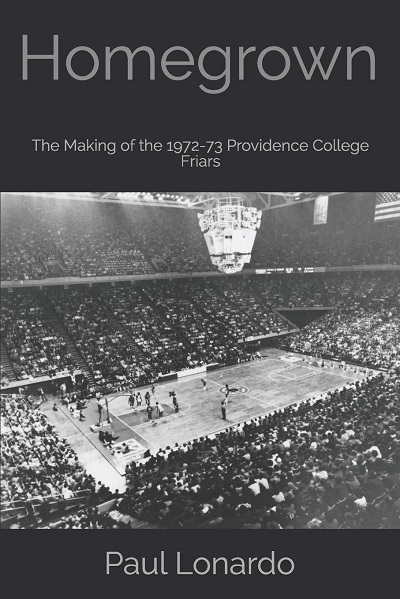
"HOMEGROWN: The Making of the 1972-73 Providence College Friars" is a retrospective of that remarkable season as well as a history of the school's basketball program, which was responsible for drawing the local talent that propelled that team to succ
"HOMEGROWN: The Making of the 1972-73 Providence College Friars" is a retrospective of that remarkable season as well as a history of the school's basketball program, which was responsible for drawing the local talent that propelled that team to succ
"HOMEGROWN: The Making of the 1972-73 Providence College Friars" is a retrospective of that remarkable season as well as a history of the school's basketball program, which was responsible for drawing the local talent that propelled that team to succ