
Get your Signed copy today!
Kindle Edition
Amazon
al-strunk-pacific-saga.com
https://www.facebook.com/Pacific-Sail-a-novel-by-Alan-E-Al-Strunk-202228626857652/
Category:
Historical Fiction
Publisher: Alan E. Strunk
ISBN-10: 1790806100
Type: Fiction
Pages: 264
Copyright: December 31, 2018
ISBN-13: 978179086102
Price: $13.95 (eBook)
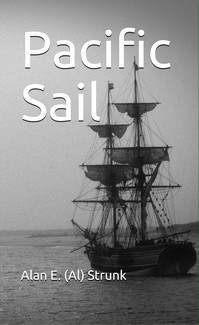
Through stormy sea and doldrum Pacific Sail takes its reader on a voyage to adventure and romance in the mid nineteenth century.“Told with insight into maritime detail and human nature.” Linda Collison author of “Water Ghosts”
It is 1848; there are rumors of gold in the Californias. The sailing brig Azalea carries young Charles Hagglund to adventure and first love’s bite. Shanghaied in Yerba Buena, Richard Taverner finds himself aboard a whaler bound for the Arctic. A refugee from Ireland’s starving shore, Mary O'Connor sails to Australia as a contracted bride. In the Caribbean, freeborn Afro-American Sea Captain Samuel Adams leads his shipmates in bloody battle to rescue captives destined for the auction block. In bush country, Koori native Avoca Bunjil fights for survival and freedom. Adventure and romance rule as brave men and bold women face the challenges of sea and shore, life and love.
Excerpt
Scuttlebutt, a sailor’s term for rumors at sea, moves faster than a cook’s cat pouncing a rat. Slaver! The appellation worked its way through the forecastle reaching as far as Hagglund’s lair on the foredeck.
Rusty, Samuel and, uncharacteristically, Simon, had joined him in the darkness, the ship’s topside and navigational lighting having been doused.
“Thought slavers were outlawed,” Hagglund said.
“True,” Simon answered. “England led the movement for abolishment after reaping its profits for centuries. Slave trading and transporting is against our law and that of most European countries, but the practice thrives making maritime laws ineffectual and often conspiratorial.”
“Can’t the captain do something?” asked Hagglund.
“What would you suggest Charles,” asked Samuel. “Chase her? Board her? Fight her?”
“Well, something man. Not just ignore her.”
“You, whose biggest battle resulted in giving bloody nose and saying prayer speak of boarding and fighting?”
“Yes Samuel. I’d fight. You of all people should…”
“Me of all people, Pissant?” Samuel laughed. “Why is that? Oh, because I am of African stock? I’ve news for you lad. The men who captured those souls, held them in captivity, starved them until they sold them to the slavers were African black then and will be African black tomorrow. Learn this boy. The evil in man bears no particular color, though our American cousins in the south have shown a definite proclivity towards the darkness.”
“While you two are making a sport of ethic and spouting a fountain of perspiration proving who is most righteous, I’ve been more constructive by logical consideration,” Simon offered. “Your point is moot Charles as we cannot catch the culprit. But still, the captain chose to turn away from the slaver to open range, not close it by maintaining course. I am curious as to why?”
“You calling the captain a coward Mister Harrington?” challenged Rusty.
“No Robert. I’m merely making an observation and posing a question. Why turn away?”
“We are a ‘merchi, not a goddamn man-o-war,” offered Rusty.
“It is every man’s duty to fight against slavery be he merchant or Man Jack,” argued Hagglund.
“Easily enough said Charles, but what about our Southern kin? Samuel’s point is well taken as to their own evil, yet I didn’t hear tale of your mounted charge against ‘ol ‘Virginny,” challenged Simon.
“Damn your eyes, Simon!” Hagglund released his inner tension and regained a grin. “You’re right, of course. Slavery in someone else’s back yard is conveniently ignored. But it’s somehow different when a slaver manned by sailors just like us crosses your bow!”
“Then why, Charles, did the captain turn away?” Simon insisted.
“Tacora,” Samuel whispered.
Silence settled upon the darkness of the foredeck save the sound of waves against the hull. Samuel’s broad features and penetrating eyes reflected the pale light of the stars.
“Tacora. A slaver out of Lomboko, a slave quarter out of Hell. Portagee she was, ship and shore. Still is according to some. Packed hundreds of ‘em, chained, crammed below her decks, stacked nearly atop ’o one another, lying in stench with barely room to breathe, in darkness, in a pitching, rolling ship. Frightened ‘til panicked, angered ‘til blind with rage, hands bound up short to feet and neck so bracing against the ship’s stir was like to impossible. Those who would starve themselves were force-fed ‘til spume mixed with gruel. Those who would fight back were hacked to death on the spot ‘til bilges sloshed red on living and dead. Many broke loose to throw themselves into the sea trading life for the end of suffering. The dead and dying were disposed of over the side as part of morning watch routine, lighting ship and easing the strain on consumables. When another ship threatened approach weighted chains dragged the living overboard. Other slavers, when approached by strange sail, learned from the lesson of Tacora to cast their cargo into the sea, chain-weighted to assure quick sinking, ridding them of living evidence and chalking the price to the cost of doing business. No doubt our good captain chose to avoid being responsible for the murder of innocents by closing on the slaver. Blood money flows whenever profit rules morality and slaving proves a lucrative venture for traders, ship’s captains and aye, Charles, sailors. So you see Charles, I of all people do know of slaving having been born free spawn out of those who had not been free who managed, with the help of folks like you, and Simon and you, too, Robert, to escape northward and by God’s blessing remained together to survive the passage.”
Simon broke the weighty silence. “Since my first encounter with Captain Seabaugh I’ve been noting our heading as part of a silly game between us. Not welcome on the poop deck at the beginning of the voyage I became habit-bound to stroll the main deck after the evening meal whenever the weather was receptive. I began to recognize stars, oh, not by name and such but rather by brightness, color and their position relative to each other and to the center axis of the ship.”
“This is really fascinating Simon, but does it have a point?” Hagglund asked.
“Quiet, Pissant, and listen to the man,” hushed Samuel.
“Thank you, Samuel,” Simon continued. “This morning, upon my sighting of the strange sail, we had just changed course to west of south which was noted by the captain as a riposte for my edification. After a short conference with the captain, Mister Merrick changed course again, this time to the left, which I take to be towards the east.”
“ ‘Yer point sir!” interrupted Hagglund.
“Shut up Charlie,” Rusty admonished.
“Thank you, Robert. And, Charles, as I was walking the main deck after supper, I noted the position of those stars with which I had become so familiar. And, Charles, blow me down, if you’ll pardon my nautical whimsy Samuel if we had not shifted our heading again! This time we were once more heading west of south. Indeed more westerly than before the sighting of the suspect vessel.”
Samuel turned his gaze skyward facing the port quarter in search of the Big Dipper whose ladled cup points towards the northern sky.
“Well, I’ll be a son of a suffering sea cook. He’s right. There’s Polaris, the North Star to you Pissant, right where she should be on a heading of west by south.”
“I’d be obliged to you gents if you’d share with me what the ‘uck is going on,” challenged Rusty.
“What is going on, my dear Robert”, answered Simon with a grin, “is that our gallant captain is following yon slave ship!”
|