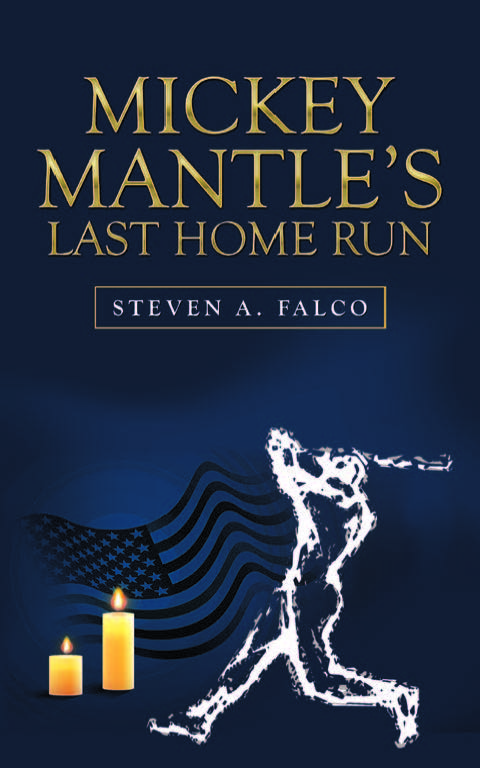
T.J. and Jonathan are teenagers, one white one black, and teammates on the JV baseball team. Can their friendship endure the tragic events of 1968 that tear apart America?
T.J. and Jonathan are teen-age friends and teammates on the JV baseball team. Like many young people growing up in America in the late sixties they have heroes. For T.J., who is white, it is Mickey Mantle, the aging star of the New York Yankees. For Jonathan, who is black, it is Martin Luther King Jr., the leader of the civil rights movement. Unfortunately 1968 is a bad year for heroes and—America. Their friendship is strained to the breaking point when Martin Luther King Jr. is assassinated. Jonathan, who is devastated by the murder, blames all white people, T.J. included. T.J. then has to struggle through the challenges of the JV baseball season in his racially-torn town, without the support of his friend. Is there anything that can repair their broken bond? Would it take still another American tragedy? Combining the heartbreak and hilarity of teen-age life in that tumultuous year, this young adult novel provides a perspective from which to understand the racial issues that still prevail. It appeals not only to young readers but also their baby-boomer parents and grandparents.
Excerpt
Chapter 1
Number 535
September could be a lousy month for a baseball fan, especially for a baseball fan whose team was twenty games out of first place with only nine games to play. But that was how it was for Yankees fans that September. Even so, I decided I had to go to one more game. I wanted to go with my girlfriend, Maggie, but she had color guard practice or something stupid like that. I knew she didn’t really like baseball, but well, I’d kind of hoped she’d make an exception. I knew my friend Frankie was too busy getting into trouble, and my genius friend Phil was too busy studying. My friend Jonathan was noncommittal.
Still, I had to go. I had to go to one more game to see the Mick. Now, I wasn’t saying the Mick wouldn’t be back in ’69. As a matter of fact, I was sure he would be, and he’d probably double his home run production. But I knew I just had to go to one more game.
I’d listened to yesterday’s game when I got home from school, and well, I didn’t like the way the announcers were talking about the Mick. I mean, yeah, it was great and all that—he hit his 535th home run and surpassed Jimmy Foxx for third place on the all-time home run list. Only Willie Mays and fat old Babe Ruth had hit more home runs than the Mick. The broadcasters said that Denny McClain, the Tiger pitcher, grooved the pitch for the Mick to hit out. After all, the Tigers were winning the game 6–1, they had already clinched the pennant, and McClain was on his way to winning his thirty-first game of the year, which sure as heck was enough wins for anybody. But I didn’t even care if Denny McClain grooved the pitch. What really bothered me was how the Tigers fans gave the Mick such an ovation. Heck, no one had to tell me that the Mick was great and deserved an ovation, but they said on the radio that the fans were cheering so much because they thought it might be the Mick’s last appearance at Tiger Stadium and that McClain grooved the pitch because McClain, who deep down was really a Mickey Mantle fan, figured the Mick might not have many more opportunities to surpass Jimmy Foxx’s record.
I thought the big fuss was all pretty stupid because the Mick would be back next year and maybe he’d even catch up to good old Willie Mays.
Well, I was going, and that was that. It was a nice, warm Friday night. I ate a quick supper and told my parents I would be going to the game with Jonathan and Frankie. Of course, I lied about Frankie, whose interest in baseball seemed to have faded and who was planning to go to some dopey Iron Butterfly concert with Murray and his gang. I only half lied about Jonathan, because Jonathan had said he wanted to go, but he had to help his father with something, so he’d meet me there. I told him I’d be getting general admission upper-deck seats, and since the crowd probably wouldn’t be very big, I’d get a spot behind home plate. I was counting on Jonathan to show up because it would feel a little funny going all the way to Yankee Stadium alone—but I could have belted Jonathan when he said he wanted to go only so he could pay his respects to the Mick. Jonathan said that 1968 was a year when everybody did a lot of respect paying, so he might as well do it for Mick’s playing career. That statement made me sick to my stomach. I even called up my brother at college to see if he’d like to take a trip home to see one more game. Now, there was no doubt I would have belted my brother for what he said if he hadn’t been seventy-five miles away and on the other end of the phone line.
“So you want to see the great Mickey Mantle one more time before he hangs up his spikes.”
Bam! My brother would have been missing some teeth if he’d said that to my face. Oh, and besides, my brother was too busy with more important stuff, like burning down the college administration building. Somehow, things were different with my brother those days. In fact, everything was different those days.
I hopped the ole 145 bus at 5:40 and headed on out to New York City. I always liked the bus ride to New York. I liked to gaze out the window and check out the scenery. It was a heck of a lot more interesting than the boring scenery on my family’s drives out to Pennsylvania to visit Aunt Tillie. It was amazing how many things I could see on the bus ride to New York City. I liked to check out all the little stores, used-car lots, and cozy houses. A lot of the houses were real close together, and I wondered how people could stand living jammed next to each other. Of course, the best part of the trip was the New Jersey Turnpike. It was fabulous. Seriously. The bus passed by all the factories, with their grimy windows and tall smokestacks. Then there were the junkyards with smashed-in old cars and beat-up yellow school buses all piled on top of each other. I could see it all from the turnpike. There were truck yards with row after row of truck trailers parked but ready for action, and there were railroad yards with tracks leading all over the place. There were junky old freight cars, big black oil cars, and boxcars, just like in my old train set. Then the bus passed by the old Budweiser factory, with its flashing neon sign that changed into an eagle flapping its wings, and of course, there was Newark Airport, with the big, loud jets roaring right over the bus. Then came my favorite sight of all: the Pulaski Skyway. We used to take it when my father took us to Yankees games. I kind of missed riding on it, with its heavy iron railing that seemed to disappear as I peered through it while going fifty miles an hour. From the turnpike, I could see how long the old Pulaski Skyway was and how it spanned the roads, truck yards, and murky river inlets on its way past Jersey City to the Holland Tunnel. It was a real sight. Seriously.
The other thing I liked to do on the bus ride to New York City was just sit and daydream. This time, I couldn’t help but think back to last spring. I’d known back then that things were gonna be different. I’d just never expected all the yelling, crying, bleeding, and dying, and I’d never expected to be right in the middle of it.
Professional Reviews
Nostalgic take on turbulent times through a young baseball fan's eyes. Review by Tom Kranz
Teenagers in a New Jersey high school navigate the racial and political upheaval of 1968 through the nostalgic lens of baseball. Best friends TJ, who is white, and Jonathan, who is black, speak to each other about their differences in a way that is refreshingly honest and which ultimately bonds them through the tense times triggered by the assassinations of Martin Luther King and Bobby Kennedy. Author Falco is obviously a fan of the minutia of baseball as it is draped over much of the narrative in his descriptions of the characters' exploits on the little league field. This provided a frequent distraction from the more interesting parts of the story as described above, thus four stars vs. five. In the end, the story about lasting friendship is worth the read.
Clarion Review
Mickey Mantle's Last Home Run is a tribute to childhood—and the draw of baseball—in the late 1960's.
Kirkus Review
Falco’s (Grandpa Gordy’s Greatest World Series Games, 2002) coming-of-age historical novel blends baseball and the social upheaval of the 1960s. New Jersey teenager T.J. plays shortstop on the high school baseball team and is an avid fan of the New York Yankees, particularly Mickey Mantle. However, as the story begins in early 1968, T.J. is reluctant to admit that his hero’s career is coming to an end. T.J., who’s white, hears of the assassinations of the Rev. Martin Luther King Jr. and U.S. Sen. Robert Kennedy, and his closest friendship with classmate and fellow ballplayer Jonathan, who’s black, is tested as racial tensions escalate in the community. The boys fight for their spots on the field, test their limits on parent-free trips to games in New York, and learn the limits of sociocultural expectations. The metaphorical role of baseball is evident from the opening pages (“Jonathan said that 1968 was a year when everybody did a lot of respect paying, so he might as well do it for Mick’s playing career”), and Falco writes excellent, detailed scenes of the characters observing and playing the game, which will appeal to fans of good sportswriting. He also does a good job of depicting the boys’ day-to-day relationship (“Jonathan was the king of goofing off, and Frankie was the prince of shooting the breeze”). The book is a bit uneven in its treatment of races, though; one section, for instance, intriguingly describes how Jonathan uses a technique that he calls “blacknosing” to deal with white teachers who are uncomfortable with black pupils, but most observations about race are presented from T.J.’s white-centered perspective (“When Jonathan came over that Saturday afternoon, it must have been the first time a black person other than the garbage man ever walked through our neighborhood”). For the most part, however, this is an emotionally satisfying story of friendship and a well-written sports tale.
A solid novel about baseball and growing up in a time of change.
Want to review or comment on this book?
Need a FREE Reader Membership?
Reviews for "Mickey Mantle's Last Home Run"
Reviewed by rebecca Nicole
7/22/2025
Absolutely enjoyed your story loved the characters and the flow.
I'm not a baseball fan. But from that excerpt, I'm a fan of your writing. It's as though you lived that year, 1968, in that vicinity, going to Yankees games. I was working as an engineer in the San Francisco Bay Area that year, and wasn't paying attention to baseball at all, even when I went to NYC to attend my cousin's wedding to a Manhattan girl and Robert F. Kennedy was lying in state at St. Patrick's Cathedral. My father was a big baseball fan, sometimes watching one game on television while listening to another on the radio. He was a big fan of the Milwaukee Braves and Hank Aaron.
You are very courageous to write about the mixed feelings everyone had at that time between what had been establishment black-and-white positions in society, rapidly changing. I love history and we need to learn from it. By writing this book for young people, they can get a feel for what it was like for young people at that time with some of the same questions haunting society still around.
Bristlecone Magic is a YA Christian fantasy about family, friends, neighborliness, love, magic and yes, even tragedy. The story takes place in Clinton County in upstate New York.
There is more than one kind of Magic! Contact me if you'd like an au