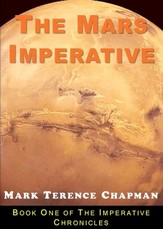
If young James McKie can survive the trip to Mars, there's a major discovery waiting to be made, one that can open the planet to colonization by humans, if it doesn't kill everyone first!
From the author of the #1 bestselling Military Sci-Fi novel on Amazon (My Other Car is a Spaceship):
Mars is a frontier town, filled with prospectors and mining camps. It’s a place of deadly dust storms and near-vacuum atmosphere. And then there’s the terrorist.
When James McKie leaves for his first job in space, he has no idea what he’s getting himself into. Traveling to Mars is harrowing enough. Surviving once he gets there is another matter entirely. Yet there is a discovery waiting to be made, one that could open Mars to human colonization—if it doesn’t kill everyone first.
(The Mars Imperative and The Tesserene Imperative can be read in either order, or individually. They are stand-alone stories, along the lines of McCaffrey's Brainship series or Saberhagen's Berserker series.)
For more about the author and his books, see his website at:
Excerpt
Read the first 10% of the book by clicking on Amazon's Look Inside feature: http://www.amazon.com/dp/B00LTATR22
Professional Reviews
The Mars Imperative (Novelspot.com)
The Mars Imperative, by Mark Terence Chapman, joins the long list of speculative fiction about our planetary neighbor, Mars. C. S. Lewis, Ray Bradbury, Robert Heinlein, Kim Stanley Robinson, and a dozen others have been fascinated by the Red Planet. Chapman, like Robinson, produces hard science fiction using the narrowest of definitions of SF. Nothing written conflicts with current scientific knowledge; any advanced technologies are theoretically possible.
The Mars Imperative, set in 2176, begins on an Earth that is over-populated and running out of natural resources. This is no dystopia; science and technology have opened up the solar system to supply the minerals Earth's industry requires.
Twenty-three year old James McKie, with an MA in aerology (Martian geology) accepts a job on Mars, mapping mineral deposits to be exploited. McKie lives in a future where both the science and the society are very similar to Earth 2008.
If the attention to science is like Robinson, the society and characters are pure Heinlein: technology, character and true grit conquer all. James McKie is individualistic, well educated, clever, brave and unassuming. His initial work experience requires successfully confronting both sabotage and the harsh conditions of Mars and he does.
Unlike Heinlein, this is hard science fiction, with no McGuffins to take care of unpleasant science facts: no warp drives, wormholes, FTL, teleportation. Transportation is a major preoccupation in the book; McKie spends 112 pages just getting to Mars. He takes sub-orbital transport to one of Earth's space elevators, the space elevator to an orbital docking facility, the Nautilus, then a cargo space ship (the Barsoom) to an orbital docking facility circling Mars and a final space elevator going to the planet.
Each of these means of transport, plus the orbital docking station, is briefly described in the text and early chapters of the book begin with quotes from the Encyclopedia Solaris, 2176 edition, which explains how they work and how they're constructed. (A note at the end of the book discusses theoretical space elevators and actual work towards building them.)
During this initial long trip, James meets two major characters, Daniel Lim, spatial engineer, and Kim Cappelletti, astronomer. Like James, both are beginning their first year in work. The time spent actually getting to Mars allows solid friendship to develop. During the trip, threats, both natural and engineered by wicked fellows, challenge the three.
After James lands on Mars, Chapman provides additional threats, a villain and a romantic interest. It's good, exciting stuff with likable characters and the continuing scientific and ecological realism are woven naturally into the action.
This is traditional science fiction, describing the future in terms that emphasize the possible. I enjoyed it. If you like Robinson, Heinlein and hard SF, you'll probably like The Mars Imperative. If you like William Gibson, Neil Stephenson and cyberpunk, you probably won't.
Reviewed By Wenonah Lyon
Meet the Im-Crowd (Tower of Light online fantasy fiction magazine)
The Mars Imperative, Book One of The Imperative Chronicles, is a contemporary science-fiction story with strong potential, although I had to read through the first 60 pages before there was even a hint of the conflict. The plot is rather simple, without too much in the way of sub-plots or other complexities, but this only makes the text easier to read rather than diminishing the effect in any way. It doesn't get into mind-numbing scientific themes or theory, either, although there is plenty of science to occupy the die-hards. For all of this, it's still a good book and I enjoyed reading it.
The story is about a young man named James McKie—an "areologist," or a geologist of the Martian surface—who leaves Earth for a three-year stint with a mining company on Mars. Mars is still mostly unlivable and the process of terraforming is in the early stages—even after nearly a hundred years of human occupation.
Although there is little crime in space, there are rumors of unexplainable "terrorist incidents" that begin to occur just before James' arrival and escalate soon after. James then experiences a number of adventures, beginning with an escapade through space with his friend Lim in nothing but EVA suits. He also endures the harsh reality of life and work on Mars and barely survives each event. Then, after accidentally discovering organic matter, he deals with the evil machinations of a man determined to get rich—even if it means committing murder.
The characters seem alive and three-dimensional from the very beginning, which is what kept me reading despite the slow start. James and his friends Lim and Kim are very likable and often just plain fun to read about. In one passage, Lim playfully refers to the group as an exclusive club called the "Im-Crowd," since all of their names end with "im" (Jim, Lim, Kim). Then, at times when they're lucky enough get together, they continue to joke about it and play on words with the prefix "im."
The antagonist is somewhat flat, but since his protagonists are portrayed so well I think Mr. Chapman can be forgiven for that.
The author doesn't disappoint when it comes to the science, either. His descriptions of space elevators, space travel, the conditions on Mars, and the possibilities of extraterrestrial microbial life are exquisite and well researched.
Personally, I was delighted that James didn't stumble upon an ancient Martian city hidden deep beneath the surface. The idea was interesting the first few times it was used, but now its about as trite as two moons in a fantasy world. What James does find might be more realistic in light of current theory, and might have almost as far-reaching an impact on humanity.
The Mars Imperative is a serious science fiction with excellent character work and dialogue, and a thrilling adventure into the not-so-distant future. It's easy to read and will keep the reader enthralled to the very end.
The Mars Imperative (Static Movement magazine)
James McKie, Daniel Lim and Kim Cappelletti, are three characters that the reader will grow to care about.... Mark’s easy writing style makes these characters come alive.
For the science part of this Sci-Fi novel, Mark Chapman uses excerpts from the fictional Encyclopedia Solaris.... This fictional Encyclopedia works well for this book as it doesn't seem like it’s interrupting the story, it fits well within the plot.
I found this novel to be an excellent blend of science and reality, and the fixes that the characters find themselves in to be sometimes humorous, and suspenseful, but always believable because this writer has a great imagination and is able in every way to deliver.
I highly recommend this science fiction novel to readers who just want to escape into another world where you can easily root for the heroes.
(c) Chris Bartholomew (editor)
Want to review or comment on this book?
Need a FREE Reader Membership?
Reviews for "The Mars Imperative (Second Edition)"
Utterly Fantastic Occurrences is a collection of 20 science fiction short story novellas existing in hardcover, in paperback and in Kindle and Nook e-book formats.