Category: Fantasy Pages: 280
ISBN-13: 9781732549982
Price: $4.99 (eBook)
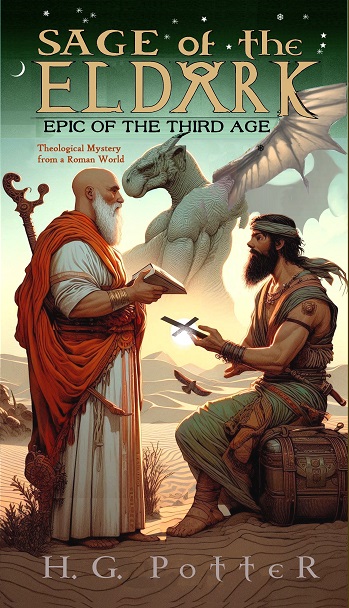
A cerebral dark Mystery of the Third Age..The serenity of a Roman statesman is interrupted by a wild-haired wanderer. The zealot seeks refuge from the powerful demon pursuing him, and not only that, but tries to recruit his host to patriotic self sacrifice in the name of restoring the free Republic.Yet there is a price.
"Best written fantasy; definitely a rival of the famous fantasy authors." jacobitewiseman3696, April 2025
On a lost continent during Roman times, Epinanaus, a renowned historian, upsets the Emperor Bolgud by rebuking the decadent palace and carnal indulgences. Enraged, the Emperor sends him on an impossible military expedition into the lands of the Centaurs. Although assumed to be dead, the historian survives and decides to retire, dwelling on the outskirts of the Empire where he studies philosophy, becoming a Sage and contemplating the existence of the All. He establishes a solitary hermitage in the desert: "The Well of Souls."
A traveler arrives one night seeking shelter. Against his better judgment Epinanaus lets him in. The unexpected guest, having traveled the continent, speaks of mysteries, of great deeds, bizarre cults, terrifying creatures, and political intrigue. He wishes to convince Epinanaus of an ancient conspiracy still at work.
It would take Faith for Epinanaus to believe the secret history. If he cannot, as it seems, the cults and forces of darkness will enslave all. The guest is Hepthe, a Christian hunted by the powers of Hell for his sins, and a insurrectionist. With a plan to convert his host from Rationalism to Faith, and to the righteous revolution, he seeks Epinanaus' help to overthrow the Emperor Bolgud. But it cannot be done without trust in a subversive organization: "The Mad and Scared Dogs" whose dealings are quite shady. Hepthe adds that Epinanaus must give his life to restore the old Republic. Hepthe tells why this sacrifice should be made and why only Epinanaus can do it. To show him, he prays for prophecy and communicates with the angels...foreseeing the sinister plans of the Emperor Bolgud and his loyal wizard Zuphagen... The prophecy reveals something unexpected. If Epinanaus will not be the hero, then God has another chosen one: The Emperor himself. For the mind and heart of that man will change when he meets the love of his life...
Excerpt
After the Ocean swallowed Atlantis,
the few survivors found a refuge
on a continent lost to time.
There were men already there:
descendents of Noah the Antediluvian Patriarch, the sons of Maceon.
The Atlanteans founded fortresses in their midst, in the land they called Atalur.
So did they rule with an iron rod.
And yet desirous of the many Egyptian commodities
they once enjoyed, they invited the Egyptians
to settle nearby, in the land Gohha,
whose flooding river reminded the Egyptians
of their homeland.
Then came the Greeks and The Romans,
whose fierce independant minds
would not submit to the Atalurans.
They founded their own cities...
the greatest of these being Regulum,
whose Roman army defeated the Atalurans in war.
Eventually the Regulians declared their independance
from Rome, and founded a Republic.
Here now is the only surviving history
of that lost civilization of Regulum the great city,
and how they struggle to preserve their Republic.
AFTER ATLANTIS: Sage of The Eldark
I Dragon-Sage
Only an examination of the unfinished researches of the renowned Epinanaus can illucidate the dark mystery that was born of the ages, for his antiquate history alone is all that is left of those days.
Let the words reveal the dimness of my soul, nay of every soul, and all the civilization that was under destruction before the holy one delivered it unmerited Unto the True Knowledge. These are the various trials and follies from the time before I relinquished my former course and steered for the eternal passage instead.
In those days, the time of my youthful corruptions in the great cities, an unhealthy curiosity tyrannized over me. I loved many gods, and many books, and through these things I hoped to exalt myself in the eyes of the scribes and pharisees of this world. So I entertained a thirst to record the vain histories of men and unravel the iniquious mystery of the powers of old.
One year I was elected as tribune in my beloved Regulum, and weeks would pass until the fasts of the Hyperlyptic Alignment concluded and oaths could be uttered. So I retired to my coastal villa near old Allapis.
On a certain clear night, when a strong breeze blew upon Vastess Ocean and many stars were dotted like milk-spray across the celestial dome, I went with the dog along the lane of sumac trees. I happened to arch my back to look straight up above.
After a moment of viewing the heavenly bodies, I noticed stretches of star-clusters in the Constellation Perseus blinking in and out in succession, and then also in Capricorn. Something substantial was moving across the stratosphere. I strained my eyes. I could discern the silhouette of vast featherless wings outstretched, gliding upon that high ring of breezes that the elves used to call Elmalmere-lok.
The conceit that such beasts were mere fiction was finally extinguished from my mind. The sighting I took to be a sign from the gods. The monsters of yore still patrol the worlds, but keep hidden from sight.
That very night there came an unexpected pilgrim knocking at my door seeking food and shelter. It was a monk from the Monastery of the Weeping Brotherhood, that mysterious isle of desert seclusion located in the Dry Blood Dunes.
Some power, I know not what, urged me welcome the wayfarer. I could have him stay a few weeks and assist me in copying certain books. He might even add to them, drawing from the fragile urn of his memory. In that clay vessel, everyone admits, some monks preserve nectars of good tale which are mostly forgotten, not to mention rare histories.
So, if the divine race wills it, let the winds whisper the truth of things in my ears; of what was, of what is, and even of what might come.
Open thy mind for the sake of recording things which may pass entirely from human familiarity. Rare is the codex or rimestock in our city that men have saved from Time, devourer of all things. Therefore I am hold nothing back and favor no powerful princes as I recount the passing of ages and struggles of men in this world.
How should one unthread the secret warp of ages, all the generation since Anathron the first man? Are we not struck with wonder, how the furthworld entire has so passed over the lapses of centuries, and there now remains little of what was...
The Christian monk, who came that night carried in his mule-packs a number of priceless codices. He presented them to me, explaining that he had heard of me in the Bibliothek Rumiliad, that he might find work from me in making copies, since I am a well known collector and the last of the Rumilian librarians.
Notably, he carried with him Epinanaus’ famous long lost work: The Twilight of the Republic. He described how difficult it was to choose which books from his own great monastic library to take with him, to save rather, since the heretical monks of his own order had determined to rid the monastery of any writing that points to right doctrine. Nefarious, he said, were those monks who, by means of artful rhetoric, made novel teachings appeal to the otherwise truly religious and devout. In their success, they designated that many precious books must be destroyed, including pagan writings. The sight of the desecration drove the faithful monk from his own beloved desert monastery.
He was an outcast who held onto the old ways. So we had something in common.
I myself once was a great voice of the worldly city, Regulum, mighty governor of Illystran provinces, in the days when it was safe within the walls. Those days have fled away, and it is now better for men of good will to live apart from those workers of corruption and sin who dwell in her dismal streets.
My own loyalty even now remains with the Regulan Principality, for six hundred years Empress over all Maceonid kingdoms.
In this little shore side villa, upon my desk, the pages of a great text are caressed by the evening's seaward breeze. It is strange how on this very night when I begin my undertaking, the moon becomes reddish under some numinous eclipse. The gently crashing waves roll upon a shore not distant. The ocean’s resounding calms my soul.
The Christian monk worked assiduously with me in preparing a new manuscript of The Twilight of the Republic, but before we had completed the first chapter, he vanished without explanation, leaving behind his mule and many scrolls and books. Suspicious, I immediately hid away Epinanaus’ decaying leaves. The next day imperial officials showed up and required the monk’s texts, confiscating them.
That is when my legal troubles began. When I demanded as tribune if the monk had been arrested, I was met with an illegal silence! So I refused to tell what I knew about the monk and his trials.
I was summoned to appear before the Imperial Hegemax Bolgud himself to answer charges of conspiracy. This suspicion of course was built on lies which in turn were built upon deeper lies, which in turn were built on some assumption or conviction crucially mistaken. No doubt some evil gnome had his ear.
I was said to be an outspoken opponent of the impious new regime.
Some had accomplished enormous interference with our cult of the imperial gods. They had turned our sacred shrines into feasting halls and our liturgical rites into drinking parties, ignoring the austere customs of the ancestors and tossing out all traditional incantations.
All manner of depravity and vice reigned in our temples.
“I have come before thee, great Hegemax, and serve at your pleasure. If you will, do accept my unworthy head lowed down and forgive my tardiness.” I bowed before his curile seat in the Hall of Venerable Maceon. There was a brief silence, which lasted far too long as he stared down at me.
“Accept your head? Should I not remove it from your torso? What if that were my pleasure?!” he snapped, “My pleasure!? Obviously my pleasure means little to you, since being without much pleasure yourself, little motivates you to be on time before this assembly. What of pleasure, you say? You have not yet joined us in the righteous bacchanals and solemn rites of Venus, tribune. I cannot imagine that you would think yourself above the gods, with all your austerity.”
“Your Magnitude, I must keep myself from partaking in such pleasures which the gods have deemed restricted, in accord with the true understanding of the ancestral wisdom.”
“It is also forbidden by the gods to hold in contempt your lord’s wishes. Where is wisdom in that defiance? Do you imagine that you may dictate morality to the senators? Do you say that your flesh--“ (he coughed terribly at this point) “--do you say...Do you say that your flesh need not be satisfied? You are a liar. You even lie to yourself. You hide behind the so called wisdom of the ancestors because you are afraid of letting yourself live, truly live. You spend your time reading books and scrolls as if the mind would show you what’s true. The moment to live is now. There is no worthy reflection, what is past is gone forever, and the future is nothing nor can it be known. You must find “salvation” in the time-stopping ecstasy that only our devotions can give you.”
“Has not my loyalty to the imperial seat been to your satisfaction?” I asked, “Why must devotion to the old ways, the blessed codes of Ptoleus and Zorcades, be a burden to the state? Have I not in every way carried out all your commands, save to participate in the rites which I hold to be in need of reform?”
“You think they are beneath the dignity of our people. No, counselor, your thoughts are imprisoned in the old regime and the glories that can never return. You learn many things, but you have no true pleasure. No pleasure that can transform you, which can make you a demigod in the state of Cathartic Titan which I myself am about to reach!” His face turned red with rage. “The Red Asceticism now rising will never--!“ He coughed again. His absolute devotion to the new religion of carnal indulgence had taken a toll on his health) “The Red...The Red Asceticism now rising will never fade from the world, it has been long in the making. Miserable superstition has too long shackled men to wretchedness and made them unable to live!”
“It is the sublime peace of wisdom that I seek, my Hegemax, not the pleasures that lower men to the level of the beasts, without love and the consolation of true friendship. Do you ever consider the sad and abused state of your many pleasure slaves?”
“You dare accuse the Imperial Hegemax of not caring?!!” He bellowed. “I am most kind! I could have you ripped out of your skin.”
“Forgive me, Son of the Principate, perhaps I have spoken without proper restraint. Consider that I do not fear death, and so I speak freely and do as the gods see fit. Let me narrate for you a little fable writ by a famous priest of far away Delphi, the man Aesop: A jar of honey happened to tip over. Out spilled the golden delight. A swarm of flies settled to immediately disgorge themselves. So sweet was the feast that the flies couldn’t pull themselves away. Soon this became literally true, as their legs stuck in the mire of spilled honey and held them fast. The flies were in despair of ever escaping. They bemoaned their fate, crying: ‘Oh how unhappy we are for a brief bout of pleasure we must now perish.’ So it will be with those of your sect who wallow in the decadence of the new carnal licence. Nature’s laws shall somehow hold you fast. How appropriate it is that for the new imperial shield device you have your praetorians depict the black swamp fly against a red field” .
“You dare prophesy our demise?!” He bellowed.
“I have said what I have said. We who pursue wisdom know that the pleasures of this life distract us from the truth. It is what we spend our time preparing for, entry into the upper world, the aetherial realm of the gods. There by the power of our contemplation we shall be enveloped in light and withdraw forever from the turmoils of the flesh. We shall merge with the soul of All. This is why I may not participate in the rites of your mystery-cult, for I make no provision for my flesh.”
There was a most disturbing silence.
The dreadful prince looked over his assembled court, to see if anyone would speak. Finally Bolgud himself made utterance.
“And that is why, fool, you are accused of conspiracy. Your “philosophy” is an elaborate conspiracy to keep men under the yoke of superstition. My informants tell me that you are counted among the pernicious fold of so-called wise men, what is it they are called? The Eldari? A secret society of the Kutaal meant to subvert the mental health of the citizenry? So have you secretly hoped for my demise ever since I took the curile seat. How do you answer the charge?”
The emperor took a deep draught of his wine and thrust out his great cup for the slave to refill. I took a foolish chance to give so bold an answer.
“I hope and pray that the true gods will draw you out of ignorance and bondage to pleasure, into the light of reality, and wisdom of the Republican system. May they grace you to know the freedom of your own human life, and the acknowledgment that your body is a sacred vessel not to be abused. It is true that I walk with the Eldari, but our discussion is only upon knowledge of the good.”
A look of distant sadness seemed for a moment to betray the Bolgud’s inward thoughts. It was as if he suspected or even knew that what I had said was true, and secretly desired my peaceful walks with the Eldari. He was deathly afraid to ever give heed to the warnings of the wise, as if such actions would topple the worldly power he had so recently, after so many years of struggle, at last acquired. His sadness turned to resentment and envy against the simple joys of the wise.
“Republican system…” He declared contemptuously. His voice was magnified now, as a titan. “Enough, stubborn old man, you have not heard a word that I have said. I might as well be a fly on the wall. I am your Hegemax. I am your divine lord! You will pour libations to my divinity and pleasure yourself on the slaves that I send you. That is the good!”
“You are not a god. Nor are you acheiving the lasting good, but only ephemeral goods. You merely convinced the Regulian populace that the traditional ways of disciplined life which they once kept were clever means for subjugation. Then you promised them what they thought they craved: a utopia, but when that didn’t sound real enough, you promised a utopia of pleasure, under the aegis of the Red Ascetic. Now that you are Hegemax, do you concern yourself for the good of the Regulian populace? Or is your concern for your own good, and thereby set up tyranny? Our sinful people deserve such a master. I will obey my Hegemax in all things save any sinning against our ancestral gods: I will never utter falsehood by refering to you, mere dust like the rest of us, as an immortal deity. No, you are my Hegemax, godlike, but not a god. Nor will I offend the divine gift of bodily delight, prepared by the beneficent maker. I will not commit carnal acts in the name of an erroneous ideology.”
“Then the state must execute, since that is your pleasure. I do command this because I pity you.” He coughed again.
So ended his rampage against the scribes and philosophers. He announced to everyone that, were he less nice, he should have me executed. By Regulian law it is not possible to have a magistrate executed on such grounds. Moreover, at that time I was an esteemed member of society. In those days, the Red Ascetic, a heretic whose magic had kept him alive for four-hundred years, had still not fully consolidated his political hold over the hegemony, and he might have feared the populus would turn on him. So he prevailed upon the Hegemax to spare my life. I was publically shamed and almost went into exile. There is no doubt however that, in these years today were I to use the same words and provoke him so, I would have been executed on the very day.
Within these pages you will find much that I must confess, good friend, and an entire secret history my pen will lay out. I do so hoping for wisdom, for an answer, for both myself and the darkening world, or rather that conspiracy that has made me its dupe.
The history of Epinanaus is introduced with these lines from one of the scholasts:
It was in Regulum, the city of earthly delights, that the history of the conspiracy was first recorded. It is the first known history and concerns only the northern aristocracies, and by the time these very passages are in their first revision, only broken gestures of sorts will have been comprehended.
Let us imagine how this history is sown inwardly together from sundry fragments. In origin one Epinanaus of Asosmos set it down, the Archscribe of the Pellemant and the Magistrate of the Hill Cults of the Timoh region, (an important responsibility, though unmentioned in any of his works).
I have read through Epinanaus' collection with great care and courtesy to the delicate papyrus, as well as the first revision, found by the tomb raider Kruthulus: a manuscript centuries old and partly devoured by Time, left in the basements of a remnant library in Ancient Rises of Nystol. They were forgotten, in the place where once of old many a sage and adept assiduously kept pristine texts.
Urguard and Orusca, bright cities founded by Itrurian colonists, Allapis the vanished empire of the Atlantean hegemony, and our own city Regulum, of Latin origin, though they might seem long established, are but an afterthought of the gods. The streets of Nystol, Vesulum, and Authapis are much more ancient. The original inhabitants of those lands never abandoned their homes, and their libraries of strange languages, whatever remains of them, have been closed off to the curiosities of men by Time’s judgement. But through an unusual caprice of the gods this text came under my hand and I shall present.
My hope is to append unto Epinanaus' work the recent fragments and recoveries of Kruthulus who entered Nystol's labyrinths of spirit infested libraries in the fifth year before this scriptolem, and recovered the only translation of these ancient histories from the Oruscan proto script, along with his famous excavation notes. Here then is the only surviving history of the old order The Twilight if the Republic told by Epinanaus of Asosmos.
Anonymous Commentator
(likely Epinanaus himself)
EPINANAUS OF ASOSMOS:
THE TWILIGHT OF THE REPUBLIC
May it please the Father of All that Epinanaus of Asosmus, his servant, here sets down a history of the Republic for preservation, lest the frail memories of men lose knowledge of how the world past unfolded, and how the free Republic governed the furthreaches, be it in exploit of war or abundance of peace, or in failure of both want or of excess. Be it writ in hope that the grave slip of free civilization into disastrous tyranny be recalled, especially the warp of centuries unfolding and so unto due course by the will of the gods bring to restoration all confidence. Know thou therefore how the realms came into conflict and by what secret discord became they the prey of the fell races.
The lore of Maceon and his sons has been entrusted to me by Annio, scribe of Vesulum, a sacred town of the Kutaal. Annio is he who recorded it with precision on Outhapian papyri. He did this in the days when he had audience with Jah Thal, saga sayer of the first order of Ammouri (the Kutaal descent) who could recite by memory the story of the five tribes and foundation of the All Law.
The work that was not destroyed, (the migration of the second tribe, the sons of Elod, into the northern coasts of the High Gohhan Sea) is recounted in detail. Jah Thal had received these stories from his father who had in turn received it from his father and so back for uncounted generations.
The recording by Annio was left unfinished, but the inquisitions of the Red Ascetic came the following year. Thal was imprisoned. He had voiced a lack of interest in defiling his body with unholy pleasures. In the end, he and his entire house were buried alive, and all his memory perished with him.
Annio, upon hearing tidings of an inquisition, hid well his transcripts, being wise to the hatreds of the Red Ascetic.
On this I spent all the remainder my inheritance. I employed nigh all my wealth, save for the ancestral plantation, to acquire those precious books from Annio. It seems that some evil god does not want the lore to be heard. Oh that the Lay of Xilmuria writ in full was not forever lost, the rimestock being impossibly scattered: the dream of an entire Age. What happened to those originals of Annio’s? Only the frightened donkeys that ran off with them will ever know.
The terrible bloodshed unleashed by the Centaur-raiders in the Andolyn mountains was the principle incident of our loss. The famous half horse men are usually associated with the southern lands, the forests and hills of Illystra. They are seen patrolling their conquered domain Mahanaxar and terrorizing enslaved humans, or slipping into the foothills of the Antelynk range, like bandits waylaying travelers and looking for booty and glory in war. These kind are armed with either bow or spear, but their favorite weapon is the whip.
The centaurs took my servant Hepthe, a man of solid character. Hepthe had been captured in the Ataluran wars as a youth and for two years labored in servitude on my lands. Being thus later stolen from me he did finally escape his captors, those savage beast men centaurs. Lost in the East, Arraf, for many years he took service in the 12th Regulian Legion, the Ataluran Cohors, later recovering the thirty third tome. As I herein recount, Hepthe would return to me years later, bearded and weather beaten, with long whitened locks, a wild man taught by formidable adventures.
The severe mishap, the ambush that was our undoing all those years ago, will not rest in my memory. We were deep in the cedar forests of Echorias heading southward and east to Nystol, for the Rumilians had granted us monies to journey to distant Nystol that we might hire scribes to make several copies of the Illystran books. This was in accord with the treaty signed by all the civil lands, a treaty made with Nystol during the Ataluran Wars: every kingdom and principality must at once submit all their precious and ancient writings to Nystol for copying, (paid for by the owners!) The war magics of Nystol had crushed the terrifying Ataluran tyranny, where the alliance of Maceonid sword could not. So the many kingdoms were more than willing to fulfill their side of the bargain.
An unusual set of tomes bound in black elephant hide was also entrusted to us for this purpose. Slave girls and monks copy such valuable works in fine handwriting and the artisans of Luz and Xasbur illuminate them with elaborate traceries.
My new boots caused me discomfort, for I had not yet broken them in, and there were few stops. Our guards were the Pikeman division of the Third Regulian Legion. They did not even have full leather boots but instead wore those special military sandals which prove better for a long hike in hot weather. They carried all their equipment with them on back frames, and wore their typical banded armour.
The mounted officer was a Vrynth noble of the Rumilian militocratic family Arvidae, (his full name escapes my memory), but he was well mannered and exacting in discipline (I had heard that he had attended the same nomotorium as myself). He often would ride ahead to reconnoiter with the two hawker scouts (since it was well known that these forests were entirely dangerous and unexplored, and rumoured to conceal a bandit army. Nevertheless the path departs from the Serrian Way in the north where it begins to deteriorate. Often taken by pilgrims to Vesulum, it is the oldest known road through the Antelynk range. For this sake it is patrolled often by Edolunt Riders, especially during the festival season. The road crosses the Washir and passes through Aquilaris and the forests of Echorias, where it climbs the foothills of the Andolyn mountains and turns south to run the pass of the Vale of Chymera, finally turning into a mere forest path.
The uphill route into the Andolyn Mountains exhausts even the Hurth horses of the Echorian Mountaineers. We took many breaks, for it was not considered a high priority mission by the Hegemont. The trail is deficient of reasonable campsites. On two occasions, since the upper forests became exceeding rocky and steep, we made a hasty camp on the path. It took us a whole day just to descend the first major foothill, with the pack mules constantly halting and turning back, and we could not yet even see the distant Andolyn mountains looming high into the atmospheres.
It was during the noon hours of the following day, when we were nearing the falls of the river Murmrik with the Echorian verges below that a sense of being irretrievably distant from the civil order crept into me. The bird cries were different, more musical they, and the crows now were seen with greater frequency, bearing wings larger than northern kinds, and they kept just ahead of the party, cawing loudly.
I took the noon meal with the Rumilian officer and the high of rank. My talk turned toward how darkly thick the ground brush and grasses were in these hills, easy for concealing foes. The officer said nothing, being a neophyte, but the old leathery faced centurion spoke up, agreeing.
“Bloody handed bandits,” he said, “foxes laying in wait for pilgrims, their archery being most deadly, swift death for the unwary. But there are worse dangers here.”
“I assure you it is not possible,” the neophyte officer claimed, “it is not possible that any half provisioned band of forest-thieves would dare go after a detachment of the famous Third Legion, ...no matter how fast of foot or bow shot.”
With stern brow the old centurion, forgetting rank, offers a look of trepidation.
“Why have we no heavy armour in land that is beyond the frontier?
“Do you think that our numbers are insufficient?” the officer retorted. “Even to keep back a band of outlaws?”
““They have never sent so few into the high Echorian wilderness alone. It has never been this way,” he muttered. There is something amiss, I suspect it were not merely the typical cheat of senatorial coin. I tell you. There are black motives among the syndicated gentry, whispered plans, sinister things of greed or other sin. We are an offering, we are not meant to return.”
Surprized, the young officer paused his eating and looked at the centurion. Being gentry himself perhaps he knew that it were true, or at least suspected as much. It seemed he had suddenly put a few things together in mind, that he had just discovered why he had been chosen. He starred off elsewhere with the look of one who has been given a death sentence.
The centurion could be speaking in earnest. It was to be a lengthened journey through perilous and uncharted regions and we should have been augmented more troops. The sergeant had some scouts go ahead and search out the rocky path which passed through the over grown ruins of eld Azerdon, a route which has been held by outlaws in the past.
Sixty light infantry marched in two columns. Picture the glint of the forest sun blessing their helms, (their diamond shape shields slung over back) Little do they percieve how swiftly death is nearing. How like shadows and dust we men. If the flesh recoils at such slight injury as a pin prick, how will you, oh hero, hope to persevere Mahark fire or Ataluran sword slash? Should not then every man make preparation to soon breathe his last? Consider, I pray, how great the confidence in these men to soon see again their wives, children, and homes. Yet that very day will deny them even of again seeing the sun's gentle decline.
The next thing my memory keeps is pulling on my boots on in the morning; there is a sense of being watched, someone notes, and that encompasses my mind. We make ready to pass through the ruins only a furlong distant, in order that we might make Fort Flammelstag in the Chymera valley by the third hour.
For almost half the previous day we’ve heard great horn blasts some distance off the old forest path. Yet the commander and other officers take no cautionary measures. The funeral beat of the infantry drum is steady, unrelenting.
Then as the sun rises into the late morning, pack mules and hirelings and troops cross a grassy forest opening. We are at once hearing horn blasts on all sides, and next bestial roars of an hundred unseen enemies.
Of the Regulian soldiers, some are spooked by the haunting war cries of the savage. At first they look about perplexed, unable to spot the enemy. Of a sudden they fall beneath the hurled axes of the savages before they could even muster a line and unsheathe their short swords.
The mounted officer in his noble cape and raiment, the neophyte, is immediately struck with many arrows. He and his horse fall to earth, they crash into the brush.
Many of our lackies and supply troops, seeing this, flee into the woods. The centauri are waiting for them with nets. One centaur, eager for war, races toward the legionaries makeshift formation, some of whom are still struggling to throw off their backpacks, while others stand fast and ready their pikes and swords. The galloping centaur is impaled by a well placed Regulian pike through the neck, it was the first engagement less the centuar’s advantage of surprise. The point is to no avail in diminishing the morale of the enemy. In the chaos a line of centuars rushes in, and a beastly lord gallops up and succeeds in depriving the same pikeman of his helmeted head.
The two men next to me, hired muleteers, both at once are struck by arrows. One dies instantly. The other lunges forward with only his dagger but is straightway trampled by two horse beasts. The forest keeps pouring forth centauri, their torso tattooed over with colorful designs of savage aspect.
Twenty-seven or eight of the remaining infantry form a circle and with a poorly formed shield wall fend with their pikes while the swift-hooved centaurs circle round and round loosing shafts of death. It was clearly to become a massacre. Having grabbed the short sword of a fallen soldier, I could not determine what last intention to make, to die in war, or, not actually being a soldier, to flee and die alone starving in the wilderness. The speed and ferocity of battle were things still unknown to me, being a mere indentured scribe.
Before my mind directs itself out of confusion, a centaur's club must have knocked me unto the head, compelling my frame to the ground.
I do not know how long I was knocked cold, but my sight returns and I look up. From the grassy earth I watch two book laden donkeys moving off into the wilderness. Then the blackness overtook me.
Not until hours later does an awakening come for me, when the sun had curbed his steeds now descending. My face and hair steeped in blood, my companions are dead or have lost contact, the soldiers are laying about on the grasses and boulders, cold and dead. There is now only myself. Great dread fills me.
As a blessing for the many slain I offer my prayers to the gods and cover handfuls of earth over those stripped by the ambushers. I am able to notice that those who were seriously wounded but not at once slain were tortured by the savages while they lay bleeding to death. (their Atlantean armatures, loricas, swords and blankets were also taken). And all this is a tearful thing to see.
I am strong enough to make way to the house of the Old Budderham in the foothills of the Andolyn mountains. The old man cares for me and the after the third day we ride back to the trail in order to bury the dead.
Two days afterward that, when my recovery from wounds is certain and my horse found, the Edolunt rangers that keep Fort Flammelstag ride out with us to search river beds for the mules bearing the precious books.
The Regulian Principate tolerated such provocations less and less, and finally retaliations were administered. Even so, the centaur-bands became more and more bold and finally waged war openly on all humans, claiming for themselves all the arid grasslands of Mahanaxar and part of the Echorias. All this could easily have been avoided by honouring the treaties, but those with financial interests in expansion prevented it. We were as bait, as the sinister beaurocrats calculated, acquiring a causa belli against the Centuar tribes. And how cynical those wicked nameless plotters, politicians simultaneously stirring the indignation of the people while ridding themselves of political rivals in the military, a ploy that cunningly kills two framexes by means of one arrow stealthily sent.
With much of my fortune lost and no longer favored by the lords of Vrynth, old Buderham offered to train me in the way of the Ammouri, provided that my submission to him in all things be absolute.
After seven years of training, my thanks to the Patriarch was heard in the Citadel of Ammouri. However, I publically declined adherence to the superstitious faith and refused the priesthood. The next seven years saw me in Azerdon teaching Neoplatonism and working as an Eldark thaumaturge instead.
Suddenly the All Being called me to desert seclusion and contemplation of the deep mysteries.
Would that the One might soon draw my spirit out of the shifting dusts of this world. Retired life now continued in a peaceful hermitage east the southern Canyons of Hermius, just north of Garmsir, in this place known as the Well of Souls. It is so titled because our blessed water is a refreshment for thirsty souls in the desert, not because there is an actual well containing souls, at least not that I know about.
The lapse of three years had slipped by. They were mostly spent on gardens and contemplations. My only contact with others was this: every new moon I am brought news of the distant wars, and this compels me to write tractates against the errors of the Red Ascetic.
Yet much more remains to be told. My account shall not neglect to unfold it. The famous 33rd tome may indeed hold the key to the undoing the rise of the great sorcerers like the Red Ascetic. For example, there is an order descended from the Eldark, the ancient circle of the “long robes of Azerdon,” of which only three souls remain. Two of them, Zuphagen and Adeuces, have taken oaths to the Red Ascetic, and the third who refused, Arizel, was left in a maniacal state near death. He had purposely burned down his entire library, envious that any other should learn his supposed arcane secrets after his passing. Though barely able to rise, this Arizel disappeared into the wilds of Mahanaxar. The three had been meeting in Azerdon, it has been reported, to discuss the situation of Nystol and make plans. Neither Adeuces, Zuphagen, Arizel, nor the Red Ascetic could agree as to how and when the state of “Cathartic Titan” is reached in the human soul (or is it the body?). They spent many months debating this and plotting their plots.
Yes, the arcane art was permitted to a very few for a time, (lest the Northing prevail entirely). But men began to abuse it. They began designing illusions or speaking with spirits and turning power toward themselves. Only these reversals of order can explain how it is that a band of rustic centaurs dared to attack a Regulian line within the imperial regions of influence. The Mahanaxaran King no longer patrols his lands, infatuated as he is with Red Asceticism, “the Unknowing” and the “pools of Emptiness.” What is more, his love for the strange sorceries of Nystol and their libraries has compelled him to issue a most novel decree. Contrary to ancient restrictions, the princes may speak with the dead and even take unto themselves the infamous occupation of Sorcerer. False interpretation of law such as these have even fooled those rare and well intentioned scholars.
The spirit Ambrosius, diviniton and oracle of the All Knower, when asked (by certain half learned men), how the knowledge of a heretic like the Red Ascetic could be so luminous replied thus:
“How is it that he can have the key of knowledge who doth deny the author thereof?”
Here in the desert hermitage new depths of meditation concerning the unbegotten reality had of recent given me much consolation. I had endured the crucible of the Second Quietude, at last, after years of concentrated work and study. My preparation to enter the veil of the remote Third Quietude was near complete. One night, as the supreme hour approached for this interior bliss, there was a sudden knocking. Someone was at the hermitage door, sole entrance of that little cottage.
Such a clamor was a powerful disruptive to the fabric of reality, my meditative state. A fear flashed through me: understand that the soul enters a delicate transition at this advanced stage. The sages warn that any disintegration of silence could all but tear the superstantial realization! (Of course you recall that true metaphysic assures us such a disaster is impossible).
How could any unnecessary being thus disturb me so? To that question no answer came to mind. The noise jolted me back into the waning sub realities of this transient world. Of course, the ritual demands utmost attention. My response was not to ignore but to answer the knock with a commanding tone.
“Hold; wait ye a few moments you must...” (I no longer had familiarity with my own voice; that also unnerved me).
The ritual ended. My slippered feet carried me to the door, to discover what sort of uninvited guest would dare disturb, for all know that the few inhabatants of that barren land dwell there so as not to be disturbed. Even so it is not permitted a hermit to treat anyone dismissively. It is our custom to first welcome and dine guests, then ask questions; but these were dark days…
So I open the door of my hermitage. I see a slight man with near-Eastern visage, his eyes cast upward to the heavens. He lets down his glance from the above and looks upon me standing there in ceremonial dress. He presented a wild, untamed expression, as did his array; unshod and outfit in camel hair. He was aged roughly in latter middle years, and stood like an ancient, as if suspended in time. He was of formidable bodily frame, and the sun had darkened and thoroughly wrinkled his skin, but yet his spirit shon luminous by facial expression and from radiant eyes. He immediately bowed and, esteeming him a poor suppliant, I raised my hand to grant blessing.
“I will bless you of course, now. But you must then depart at once, unclean one. For I have nothing else to offer save water or tea.”
I lifted my hand to make the nine-fold sign for benediction but to my dismay he immediately motioned away so as not to receive it.
He stood with an unusual confidence for a transient, and it was incredible to see a man dare refuse the blessing of a 7th level sage of the Eldark.
“It seems you are a wanderer of many wildernesses,” I said. “Perhaps too much so, for I do not often receive men of another fold...” This ragged loner, desert storms etched on his face, stood there as if he were some god disguised as a man. So I awaited his explanation, whether he sought refuge, star wise direction, or victuals.
Perhaps indeed one of the gods roamed the earth disguised as a beggar to in order to deem men worthy or nay. With a peculiar and rough expression of words he now opened to me his purpose.
“I have come from far across the desert waste, kind sage, on pilgrimage unto true understanding. I have just this night heard from wayfarers that you are just, renowned among hermits, and that you might take travelers in for a spell. I am in pressing need, for the desert night is some cold.”
His bright blue eyes darted about in a worried manner. Brushing aside his wild mane, he added:
“They said that you are a high sage, and I glean by your well combed beard and dress it should not be doubted. I myself have sought a life of simplicity, but I am driven by the spirit to announce the day of righteousness come.”
“You are an Ammouri?”
“I am, and I have wandered far and wide. Forgive my disturbance of your silent contemplation. I thought to offer some toolwise instruction to avail in building your Solomon’s temple.”
“Our cultic traditions are not at peace, but the one sternly contradicts the other. Wise was Solomon to build the temple of his deity in absolute silence, as the Eldark say. But your faith has rejected important axioms of wisdom. You should return some night when I am away camping in the hills gathering berries. You are clearly no savage, so you are welcome to use the hermitage any time when I am gone, provided you wash regularly. You are doubtless a God fearer. As for tonight, I am sorry...discussion is not possible.”
I began to close the door, but he placed his fingers upon the lintel and spoke.
“Please…since when have the Eldark failed the practice of hospitality? Do not your Neoplatonic scriptures command you to receive the alien? Surely you confess that all men are made in purpose of like dignity, for the All being’s delight?”
“We do teach a doctrine approximating that,” I answered. “Although be informed, the All is indifferent, the All has not delight as men conceive it.”
“Will you turn away one of his own children?
“We are sentient beings who adhere to law. Your kind do not carry this wisdom, nor the succession of righteousness in law.”
“But would the divine being not, in generosity, invite those who are outside into his house, as if children adopted? Will not your deity take note of your abandoning me to the night and darknesses of desert, to grow cold and be devoured by framexes? Will the judger of souls not avenge this strictly?”
To this I knew no certain answer. Indeed the Eldark also did teach this, in the primitive and symbolic way of seeing the Godhead as a person. But it is not found in the Neoplatonic wisdom.
“I think the divine essence cares not for the anguish of us sinful men, for how could pure spirit gaze upon our corrupt flesh? Nevertheless, perhaps if I deny a stranger the lesser gods will be disturbed and my heart will be tormented and I will be punished, as the myths warn. Therefore your point is well met, worthy of consideration.”
“And what a benefit of company I will provide.”
“What benefit, unknower?”
“I have stories to tell, and a certain wisdom to expound that would not be averse to a Neoplatonic sage. Kindness covers many sins.”
Now I considered this for a moment.
“It is in sooth against custom...however...I confess that it is true, the desert night is ruthless and cold. Therefore you should come in till morning. But hold, these are strange times, and it is night, so I warn you in a way my ancestors would not have comprehended or thought necessary: remember pious fear and offer no violence to a welcoming host, lest the gods instead turn on you with sevenfold fury. There is here a bowl for washing.”
The powers seemed not disagreeable. I gestured a welcome and sat him down near the fire where it was enough warmth for him to rest. My eyes picked out a strange yellow dust on his fingertips as he offered them to wash. To this day my heart repents that I had not encouraged him to identify it or say anything of its meaning while I was pouring the water. I did not remember to ask later and forgot about it, forgetting till the dreams of my old age and the writing of this account have reminded me. I have suspected that it be the yellow pollen of desert croccus, but now it is impossible to have any certitude.
“Many thanks...” the stranger said, apparently quite relieved, “I came once before, years ago...your memory must surely recall. . .?”
“I do not. Perhaps you are thinking of a time when old Epinanaus dwelt here, but he has committed his flesh to the earth and gone to the One.”
“It is a name that I somehow recognize...but now I must admit ye this: It were not cold airs that concerned me enough to seek shelter from the desert night, rather it were freezing airs.”
There was an abrupt silence, as he wished me to consider his words.
“Your meaning intends something hidden...do you suspect that we are not alone? Why do you not speak plainly?”
“I have enemies, and words are known to echo easily in the desert, especially when the wind is freezing.”
“Your wording has an obvious exaggeration and seeks another meaning, for the breezes are everywhere mild tonight. I glean that you are a traveler “upon the spirit,” as they say, so my guess therefore is that you speak of the things of the wind, and of freezing inhospitalities, or powers that have no warmth and whose freezing nature does damage to the mind.”
Suddenly from just outside the dwelling I heard a great howl. It was not a framex. It sounded more like a dire wolf; a howl truly frightful.
“What kind of beast has been trailing you?” I asked, now rather alarmed. I reached for my only weapon, the quarterstaff. “If it gets in I will punish it dearly, and if it does not retreat, it will die.”
“What mean you, sage. What has caused you this upset?”
I looked at him with incredulity.
“You did not hear that with your ears?”
“Did you hear something? I heard nothing.”
“What do you mean?! How could you not have heard it? You must be almost deaf, or…”
“Ah, no doubt the desert wind howls and plays tricks on your mind.”
“The desert cannot trick his own child. If that is so,” I warned, “then it is best that you depart from here. If you say it were the wind, then you will be unafraid go out there.”
I looked and saw that my strange guest had suddenly fallen asleep. As I waited an hour or so for him to awake, I heard the howl again. This time it was out beyond the fence, not so close to the dwelling. It was surely some kind of dangerous beast. I opened the door and saw a man standing not far off partly in shadow. His face was not bestial, but gentle.
“Who are you?” I asked.
“Just a man who hopes to obtain comfort from the night’s cold.” he said. “Your guest; he didn’t tell you did he? I am his slave. He makes me sleep outside. He is embarrassed of me. Will you bring me a blanket?”
“We shall see. I will not permit a man to be left outside like a dog. I must talk with him first. I do not know if you are some bandit. Remain where you are and I will return.”
I returned inside and closed the door. The sound awakened my guest. At once I demanded.
“Who are you and what is your business in these parts?”
“hmmm? I am a pilgrim to Argunizial, good host. May I learn also who you are?”
“I am Epinanaus of Asosmos, scribe of the Pellemant and Archsage of Eldark mysteries. But you have not in full answered my question, and I demand an answer. Pious pilgrims do not keep slaves, and if you do not tell me the truth at once about your identity and business, this quarterstaff will be the next interrogator.”
“Do be rash, friend.” He said. “There is no need for alarm. I have no slave with me.”
“You have no slave? Then who is that man I just saw outside?”
The “pilgrim” stood up.
“There is no man outside.”
“Again, you are false.” I said, quite irritated. “Just as you were false about the howling that we heard.”
“That YOU heard. You must be having hallucinations.”
Then suddenly again I heard the frightful howl again. It must have come from the man, or else a beast accompanied him. The guest just looked askance at me.
“You stand there and tell me that you did not hear that? I know in certitude that I am not mad. But I just met you. I have no reason to trust you. Beware, if that man outside dies from exposure, I will call out the Edolunt Riders to track you down. Nay, perhaps I will blow the Gruu-horn and summon them this very night, for it is illegal to impersonate a pious pilgrim. If you are not frank with me at once, you will be arrested.”
“No, please,” he said. “Do not call the rangers. I will be frank with you. I did hear the beastial howling. Yes, I am sorry that I was not forthright. I did not wish to alienate you by the strange circumstance of this visit. The howling is from a starving beast which trails me.”
“And the man?”
“There is no man.”
At once I stepped forward toward him aggressively, so as to threaten with my ashen staff.
“Please put down your staff. I tell the Truth. The howl that you heard, that was a beast. But the one you saw, that was no man.”
“What?” I said. “Not a man? How can that be? I saw a man with my own eyes and I spoke with him. He requested a blanket. I wish to have him come in. I will not permit slaves to suffer.”
“Good sage, that is commendable; But hear me, you must by no means invite him in, or you will jeopardise your own soul, and at the same time cause my demise, for I say to you: that is not a slave. If anything I am his slave. That is a creature whom you heard howling. And as I said, that is no man.”
“What sort of creature? Your answer had better be a good one.”
“They are unmentionable,” he said in a near whisper “so I mention them not, and I suspect that he inspires my brain to fancy many unknown dangers on the night air. But a spirit may be able to manifest in physic force. I fear his cruel assault and still do, at least his hands, or claws rather. By a relentless fury, such a creature can drive a man to real madness. I came here for this reason: there are no Ammouric shrines to sleep beneath around here, so your dwelling must do. I must have protection of a pious dwelling, even if not full in agreement.”
“I never hear much of spirits anymore,” I said. “We hold that such things be a primitive myth. I wonder if your Ammouric doctrine has caused you the same madness that the rest of the civil world suffers from: a strange fixation insisting upon the correctness of doctrine, even to the shedding of blood. Perhaps...but please do not ask me to accept that the poor man outside there is a demon in corporeal form. You will put me in dilemma, for if you are merely under delusion, a man could die in the cold.”
He stared at me as one who is in both rage and fear at once.
“I TELL YOU. HE IS NOT A MAN. HE IS A DEVIL.!!!”
I was soon very concerned that I had made some poor judgement in estimation of this stranger and should not have let him in. The worried look he returned did not much comfort me. Perhaps this wanderer was indeed wild, but was he insane? After an uncontrollable silence I pointed out another concern.
“I am sorry, stranger, but a certain thought about your story concerns me. Although something about you seems familiar, I know that if you were a pilgrim and stayed at hermitages before, you would surely have brought offerings this time, as is right custom. Even a desert flower would have sufficed.”
He responded with the typical saying.
“The Eldark surely fear the gods and would not turn even a foolish suppliant away. . . I am a man who is being hunted, and in my panic I forgot.”
I can defend myself. Part of the Ammouric teaching that I studied under Old Budderham was the usefulness of the quarterstaff and the various techniques, that the staff can even be used to drive off demons. I never did accept that such entities existed.
“He wishes to remind me how I have become a slave of the devil,” he said.
I explained to him that I could not accept the doctrine that posits demonic powers, but only gods. He claimed that the demons and devils are not just for stories, but real fallen entities, spirits turned of malice. In our Neoplatonic opinion if anything is like that, it must be understood as abstraction: the only genuine evil is to be found lurking in men’s hearts, or in the forests of the brain, such as what error filled superstition constructs. On this exception he vehemently disagreed, citing several of the superstitious Ammouric texts, of which we also have familiarity.
“They were created at the beginning, pure spirits,” he argued.
“That is not written in the holy texts.” I countered.
“But it is your own! Your Eldark traditions also teach this lore.” He countered in turn.
“One must distinguish our oral tradition from what the eld texts intend. The war between demons and angels is merely a morality tale, unworthy of scripture. Nor have I ever seen a demon.”
“Just because you do not see them, does it mean they are not there, or that they are abstracted? Can you see the air you breathe? Yet it is undoubtably around us and moving within us. These beings are invisible minds, but no human thoughts have they!”
This argumentation was, in my esteem, uncanny and caught my attention. In my youthful days as a plantation owner I had often asked my slave if it were possible for him to see the workers of the harvest “really and truly cutting the stalks in those tall sunflower crops,” for the work went too slow indeed. The house slave’s answer was always the same: “...but dom, just because you can’t see them (the workers), does not mean they are not there...else wherefore do the seeds in your cakes arise, out of air?”
I was beginning to think of him as not insane. However some concern for the man outside remained in me.
“I will therefore not invite him in, as you request. However I will offer him a blanket. That is just. It is not too cold. He will survive.”
“NO!” he cried, even getting on his knees to me. “Don’t you realize, that if you give a gift to a devil, it is almost the same as inviting him into your home? Please do not.”
I pushed him away. “I will not be told how to treat guests in my own house, or to whom I may give gifts. Your proposition that the man I saw was not a man is something that cannot be proved. I will not live under the tyranny of your superstitions.”
I grabbed an old Kutaal blanket from the hutch and stepped outside onto the poarch. I saw no one. I stood a moment in the windstorm and waited. There was only the blowing wind. The quiet was terribly broken once more by the howl, desparate and remote now, even perhaps as far as the foothills of the great mountains. It sent a chill up my spine.
I set down the blanket rolled it up on the poarch. I stepped back inside and closed the door. The stranger was still agape with trepidation.
I spoke with him more, but saw fit not to pry or ask his very name. While this went on my thoughts turned up an unexpected plethora of old memories. My ears recognized something in his voice and my eyes saw past the shaggy beard. To my utter dismay I became aware of the fact that I somehow had some previous acquaintance with this man. Then suddenly it dawned on me. He was the head slave of my former life! (He did not at first recognize me, perhaps because of my shaven head).
I did not wish this revelation unto him until I learned that he was not resentful, and why he claimed to be enslaved to a devil. I tried to steer my questions toward his past, and mentioned the slave war, hoping he would confess either hatred or forgiveness.
We talked on into the late hours. I was keeping my revelation hidden, and tending the cinders.
Hepthe was his name, no longer the youth once known to me, but quite worn and wrinkled by years of wandering. He told how he had come to a constant sense of distrust. He feared blades in the dark. A rejecter of the Regulian reforms, he was a wild man with an uncut beard, wandering the earth and calling men to renounce civilization, to cast off the sinful customs of the age, and make straight the way of the Lord. So I revealed to him my own name. I was shocked because he could not put it together that I was his former master. I mentioned the fearsome ambush of the centaurs all those years ago, but I would not in full relate my own story unto him, of how of my own life unfolded since that mishap so long past.
He recently left off sojourning in the southern wastes among the Zerbi nomads in the Deadly Hills, ten leagues east and south of Nystol's rise. Uncertain as to how he might react, I finally revealed to him that I was his long lost master.
To my surprise he was glad to learn my identity as his former master, and that my condition was good. He cried out and grasped my knee, for he had feared that I was slain in the ambush. My years of having treated him with kindness and generosity in his servitude had not been in vain. Most Regulian slaves would have at least maimed their former masters if given an oppurtunity. Nevertheless he would never trust me as an equal friend. He watched me closely. Did he suspect that I might again attempt to subject him to servitude? He did not know that we who take on the Eldark cord could never again return to worldliness and treat an intellective being as property.
He often went back and forth from the door peak and glanced out the hole, feigning concern about the slave outside, suspicious that he were being watched. Someone or some thing must have been, for later we heard the howling deep in the night again.
Hospitality for the man Hepthe was a meaty fare (desert hare stew) together with some dandylion wine. My comfort and sage taught courtesy in this way gained of him new trust. This however was not enough. From his pouch he produced a package wrapped in fine linen, which, unraveling, displayed a thousand little twinkling nuggets of incense.
“Please, let this incense of highest origin be offered up,” he said “else I will not be at ease or safe from any spiritual aggression. There walk angels of evil in the night. If wisps of smoke from this kind do not wrap like holy armour about us, I shall have a great deal to dread.”
“I am even now burning the best incense from Luz to fortify our spirits. Therefore take heart.”
“But you are an Eldark...” he countered boldly. “I however am an Ammouric and have much different requirements as affords pneumatic protection.”
“You exaggerate. Devils, if there be such powers, can easily slip past such incense.”
“They cannot, they must needs flee. It is a special proportion of frankincense and other aromatics, the prescription of St. John. It is terror upon them, they cannot remain.”
“How are you so certain?”
“The principles of your own philosophers affirm it: nothing contrary can occupy the same space: nihil contrarium in eadem re.” Where the Goodness itself resides no evil can remain.
“A misapplication of the axiom, since spirit is not a spatial reality.” I said. “However, if you must, you may burn it upon the skyward ledge above, but please do not profane this sacred home with your superstitious faith.”
“I am not offended by that statement, since it comes from one who remains asleep. Our faith is not superstition, though it seems so to many who are of uncircumcised heart. I give you this assurance: that the crucible of The Furth High King thus burning with fragrance pleases the divine nostrils. No spiritual entity stained with the privations of unreality can prevail to trespass beyond the threshold.”
“Yet I still may need to invite him in, if the man knocks.”
“DID YOU NOT HEAR ME? I SAID, HE IS NOT A MAN. If you do that, we shall both perish!
“I have never been troubled by devils, for they do not exist.” I remarked.
“Of course they have not troubled you. What interest do lions have with old bones, whitened by too much desert sun. There is fresh meat to be had.”
“Freedom has made you arrogant.” I snapped.
Hepthe did not understand or even acknowledge my skeptical discipline. After he lit the incense in the little brass crucible he sat down and continued our discussion with greater ease, but I noted something which he had kept hidden under his cloak. He kept close his short sword. He spoke the words of a man who knew no home, not fully describing his wanderings.
“If you wish to stay here,” I said, “You must describe your wanderings. I will record them in my journal. This will be in exchange for room and board.”
Nor during his whole stay did ever the fingers of his right hand not return to rest upon the minor hilt of the Gohhan dagger hanging upon his waist. He perceived my notice of his nervous habit.
“Of course I hope you do not mind my fingers always resting upon the blade of Caeculus, a friend who made the great sacrifice for me.”
I did not care, even were he a bandit, I was glad to have had some company.
The night revealed galaxies. Sleep overcame us.
Hi Author!
I just wanted to say that I really enjoy your work, your story is amazing, and the characters and plot are so engaging! I'm a commission-based artist specializing in manga ,comic, and webtoons, and I love helping authors bring their stories to life through visuals. I think your work has great potential as a comic or webtoon. If that's something you'd ever be interested in exploring, I'd be happy to chat and discuss your project. Feel free to reach out anytime. Looking forward to hearing from you!
Reach me at: peachypixelgallery.gmail. com
Instagram: peachy_pixel_art
Cetronia Strikes Back is the fifth book in the fifteen book series, The Adventures of Lord Belmundus, a remarkable tale of others worlds, strange customs, beauty and warfare; and, in its grips, lands a young celebrity, who has the chaps to play the m



I just wanted to say that I really enjoy your work, your story is amazing, and the characters and plot are so engaging! I'm a commission-based artist specializing in manga ,comic, and webtoons, and I love helping authors bring their stories to life through visuals. I think your work has great potential as a comic or webtoon. If that's something you'd ever be interested in exploring, I'd be happy to chat and discuss your project. Feel free to reach out anytime. Looking forward to hearing from you!
Reach me at: peachypixelgallery.gmail. com
Instagram: peachy_pixel_art