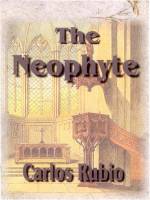
The Neophyte, first of a trilogy of satirical novels, traces the early years of the main character, from the moment he floats in a locked trunk -- after a flood -- onto the confines of the Convent of the Righteous Path. Sheltered by the nuns and Father Gideon, we watch his struggles with his endocrine demons and the secret desires that accost him.
Eventually expelled from the convent, he meets with SinSemilla, a former flower child who runs an auto-repair shop. It is through him that The Neophyte finally begins to realize his potential as a mechanic and as a man. He comes out of his shell.
Excerpt
As he filled the carved-marble receptacles with holy water, an ecclesiastical carafe, holding the yet to be consecrated wine, captured his attention.
He attempted a few feeble steps towards the altar, telling himself that he was going to place the container out of sight in order to minimize the temptation.
He realized, as he reached out, that his hand was trembling.
The contact with the glass sent an unexpected shiver through his arm, ultimately metamorphosing itself into a thousand yearning needles that exploded in his parched brain.
With a quick motion, he removed the glass stopper. "No one will ever know," he told himself in his feverish rapture as he poured himself a generous portion in the golden chalice.
In one gulp, and with closed eyes to enhance the ecstasy, he drained the cup.
Professional Reviews
The Neophyte
A novel entitled The Neophyte could be about a number of different things. Perhaps the story centers around someone recently ordained a priest or simply about someone starting a new profession. The back cover narrows the scope somewhat. "[...] Sheltered by the nuns and Father Gideon, we watch [the Neophyte's] struggle with his endocrine demons and the secret desires the accost him [...]." But it is this frivolous aura that makes the novel by Cuban-American Carlos Rubio a recommended read--The Neophyte goes beyond the expected. It is a spontaneous journey that is surprising in story and frolicsome in its execution.
This coming-of-age novel, the first in a trilogy, follows a young Georgian gypsy known only as "The Neophyte." Locked in a trunk while trying to avoid the ravages of a flood, the boy floats into a convent where an obese albino nun and her novices discover him. The convent's father Gideon decides to make the Moses-like child a convert in training for the priesthood. As the novel unfolds, The Neophyte is irresistibly driven by his inner desires and, after a series of unhallowed escapades, is ultimately banished from the Convent of the Righteous Path. Eventually, the once shy and enigmatic boy blossoms into a virile and brazen young man. What matures him are not, of course, the church's teachings but his own life adventures away from the convent. These adventures take place mainly in a tavern called The Fetal Attraction, where an encased fetus floats by the bar; in a sex club ruled by an emaciated masochistic crone named Firgid Brigitte; and in a garage run by an ex-hippie and his soda-drinking monkey. As unexpected and ludicrous as these scenarios may seem, they are not just random assortments of incidences. Rubio masterfully weaves together an entertaining story with marked satirical themes. These themes, many of which involve the church, are rendered through vivid and highly technical descriptions reminiscent of those concocted by internationally known writers, such as his compatriot Severo Sarduy.
At times, the imaginative symbolic imagery conjured up by Rubio involving the church are enough to make even an agnostic blush. At one point in the novel, The Neophyte, in desperation, fliches a bottle of the Father's communal wine: "He took long gulps, without pausing to taste the fine vintage. The twin rivers, from the corners of his mouth, fell onto his bare chest and made their way south. They joined readily on his belly button, as if in previous accord, and joyfully continued on their journey. At the tip of his flaccid penis the river became a red cascade." It is easy to imagine what Rubio is trying to say about the church. He is definitely poking more fun at the church than reveling in it. One could certainly write an expansive essay on his satirical bent, but the real feat of the novel is the manner in which this humorously critical novelist presents the tale he has imaginatively crafted.
The Neophyte is in line with a tradition of storytelling that spans many works by many prominent writers, including Rubio himself. Rubio is best know for a hedonistic style of storytelling that is inspired by the Neo-Baroque. A writing movement associated with Latin American and Caribbean literature, the Neo-Baroque is characterized by a manner of writing that avoids the utilitarian in favor of a more playful, ironic and embellished style. It is not just the story that is affected by this mode of writing, but the actual words and structure of the text. For example, Rubio favors naming characters and places so that their names in themselves feed on their literal meaning--the Filipino owner of the Fetal Attraction is cleverly named "Phil E. Pino."
Structurally, Rubio will often write a passage and use it again later, worded exactly the same, but used in a completely different context so that the passage takes on a new significance. These passages are often just descriptive events devoid of dialogue. This is not unlike the typical Neo-Baroque narrative. In a way, The Neophyte is a series of carefully embellished descriptions that are rendered in a manner that suggests narrative continuity, like the successive images of a movie that, when expertly edited, make a compelling story. At times, The Neophyte reads like the screen directions for an avant-garde film: "Lying on the bed, wrapped in the striped blanket and with the woolen cap pulled over his ears, the boy resembled a hybrid pupa in a dormant state. [...] Sister Gravity, coming closer--her massive, milky-white body, like a malignant nebula, momentarily occluded from view the figure on the bed--placed the broth on a night stand and grabbed firmly the protuberances corresponding to the shoulders. She shook him gently."
Neo-Baroque writers also use a lot of hyperbole, parody and phallic imagery. As exemplified by the wine passage included earlier, Rubio uses these common elements in his novel. To English readers, the text is delightfully distinct since the Neo-Baroque is exclusively executed in Spanish. Not only did Rubio write this novel in English, it also takes place in Georgia. What materializes is a kind of new-fashioned novel in that the author creates for the reader an all-American story that is still exotic and almost foreign in its implementation. His use of the Neo-Baroque style of storytelling with the American south as a backdrop is unlike anything else out there. Anyone who is in search of a stimulating read should pick up The Neophyte. If the story fails to intrigue, Rubio's uncommon writing approach will do the trick.
Justin A. Ulloa
Tisch School of the Arts
New York University
Want to review or comment on this book?
Need a FREE Reader Membership?
Reviews for "The Neophyte"
Reviewed by Vickki Allen
7/18/2002
way too wordy and artsy to be worth reading. I had to choke through it. Really bad attempt at writing. Sorry, but it's true.
The deep-dive literary meditations presented as stories, poems, and essays in The American Poet Who Went Home Again, A Mosaic of My Soul at Work, have captivated and inspired readers ever since its first paperback publication in 2008.
Imogene, a country-bred girl, longs to make a life for herself in New York City. She joins forces with her former college roommate to start a movie production company in the big city.