
Get your Signed copy today!
Kindle Edition
Download to your Nook (eBook)
Barnes & Noble.com
RockHill Publishing
RockHill Publishing
Category:
Science Fiction
Publisher: RockHill Publishing LLC
ISBN-10: 1945286180
Type: Fiction
Pages: 194
Copyright: July 28, 2017
ISBN-13: 9781945286186
Price: $3.99 (eBook)
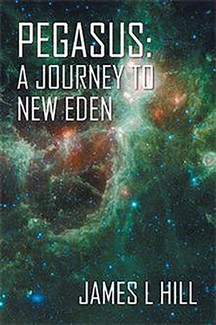
Pegasus is the symbol of wisdom and inspiration. This book, although a dystopia, is meant to inspire people to search for a greater future through wisdom. We have the technology to create a Garden of Eden here on Earth, if only we are wise enough to put it to good use.
PEGASUS: A Journey To New Eden has only a handful of characters. It is a dystopian future where the two main characters find themselves alone in a post-apocalyptic world. Unlike other Sci-Fi’s of this genre, Zack and Zuri are not struggling to survive. Pegasus, the starship they are on, provides everything they could ever need. Zack is a black man who traded his freedom for a chance to colonize another planet far from Earth. He would not be able to go through all of it if not for his fiancée, Zuri.
Zuri is a strong and capable woman, who has been on her own for most of her life. The daughter of an African diplomat from the United States of Africa, she had to live a nomadic life. She would like no more than to settle down with Zack and build a family, community, and peaceful world. But in the world they live in, peace is not something that is easily obtained.
Maybe the third most important character in this story is Pegasus. The ship has an A.I. that monitors and controls all life onboard. Zack and Zuri struggle to take control of the ship that was launched with only them on board. The ship’s Artificial Intelligence does interact with them like in so many other science fictions, but you get the feeling that it has its own agenda it needs to keep; it helps them and responds to their needs, as long as it does not conflict with its own.
Excerpt
CHAPTER ONE
The start of another twelve-hour work day was nothing to look forward to, Zack thought.
‘Welcome to the Twenty first Century’ the old sign on the work station greeted him, as usual, and the shuttle ride from the U.S.I Colony 5 was as quiet and boring as always.
As he passed by the U.S. Space Defense Station, he ruminated, “what a waste of time. An hour in flight, another half to suit up, and now they have me doing antennae work. Nearly ten hours of checking circuits… something a computer can easily do in one.”
But as far as the Company was concerned, his time was cheaper than computer time. After all, they did not pay him. At least he would see Zuri on this trip, as she was working a split; one of the beauties of being a free worker, none of the straight twelve-hour work days. Zack almost envied her position with the Company, because although her ties were nearly the same as his, the Company did not own her, as it did him for the next seven years.
“Welcome to the Twenty First Century, what a joke.”
All the hopes and dreams of Utopia people had had, evaded them still, some fifty years past its start. People had traded their freedom, religion, and self esteem for the promise of a bright and glorious future. But now, instead, that future was like looking at the sun through black glass. Not as bright as one would want, and if you stood looking long enough you would surely go blind. Zack had already gone blind to his situation. All that mattered now was marrying Zuri, and settling the colony.
‘And why not,’ he thought, ‘that means freedom, the end of my contract with United Space Industries.’
The Company was the biggest and the best, and if anyone could start a colony around another star, they could. Also, ten years of room and board was better than any other company was offering. He signed up, also knowing ten years would be impossible to endure, if not for Zuri. In retrospect, five years dis¬tance from Earth was not nearly far enough, but he settled for it anyway.
United Space Industries was the first to conquer space. They saw the endless void as a place to grow unchecked; and still unhampered by political constraints, they redefined the meaning of automation the way information had been redefined by the computer. That new definition was the Space Spider, and as their name implied, they spun webs in space.
The body consisted of a laser fusion reactor connected to appendages that secreted crystal steel frames, or poly-plastic streams that they wrapped the framework in, forming great cocoons. Additionally, space spiders could synthesize compounds in various states. One spider, for example, could lay a conduit and the wires that filled it. And they were fast, incredibly so, thanks to electromagnetic propulsion.
Mag-pulsars were volleyball-style spheres filled with liquid nitrogen and a super conductor core. The hexagons comprising the outer shell, were composed of electromagnetics that could be toggled on and off and their strength varied, dotting the spider’s body, some large, some small, to drive the spiders in any direction. Every spider had two gigantic mag-pulsars, one on top and one on the belly, but they didn’t drive the spider, their job was to create the enormous pressure inside the fusion chamber that produced temperatures as hot as the surface of the sun.
On Earth, maglev-made cars and trains travelled at bullet speeds, in space, the spiders were a hundred times faster. Speed was a necessity, as the materials they extruded solidified instantly in the cold darkness of space.
Always on the pioneering front, U.S.I. developed breeder spiders, which were sent to the asteroid belt. There, they used the plentiful materials to build other huge spiders; the kind they needed to manufacture metropolises. To U.S.I., bigger was best in the void. The Company topped the Fortune 500 with their Space Spider in 2023, before Zack was born. They had been growing unabated ever since.
Zack knew why. Business had a much simpler language than politics, religion, or even science. To a company like U.S.I., there were only debits and credits. U.S.I. took jobs that increased profits and eliminated unnecessary losses.
The United States struck the first deal. During debates over death sentence for terrorists, Congress tried to side step the issue by granting U.S.I. permission to build U.S. Penal Colony I. The colony was a giant cocoon type, designed to hold a hundred thousand Lifers.
It was run entirely by robots and monitored from Earth stations. It was a hot issue, which only got hotter. Originally, only terrorist, hijackers, or repeat serious felons were supposed to be imprisoned there, but as riots flared up in the early decades, the distinction faded. More and more people were banished to the colonies a hundred thousand miles out in space.
The prisoners were on their own once processed. The colony was totally self-sufficient; solar panels provided energy and farming decks provided food. Even if prisoners didn’t work the farms themselves, robots and automated systems kept them producing ample supplies of nourishment. The joke shared by the inmates was, “it’s a Garden of Eden in the middle of Hell.”
|




This story started with some interesting true facts about war and technology and slowly wove in the fictitious world of Pegasus. It was obviously sort of far-fetched. (That's okay because it's science fiction.)
The beginning was very, very boring to me. It was like reading some manual on a foreign world in a foreign language. All the things explained I found very confusing. Now the actual "language" in the book was not confusing at all. There was plenty of it in practically every sentence.
It did pick up a little later on. I could almost see it as a Star Trek: Voyager offshoot.
I did not enjoy this book, but maybe you will. It is an interesting read for science fiction lovers.
~I was sent a free copy of this book for an honest review~
Your introductory chapter reads well and your professional reviews are very good.
I wrote about a similar journey to a star in my second novel, but without the drama of earth being endangered, only the positive, expansive knowledge, that the future will bring. Currently I am serializing my latest novel here on AD. It is a dystopian scenario where a man believes that he is the only survivor on earth, recovering from major man-made total destruction of the ecosystem and most of life.
Ron