Category: Fantasy Publisher: Codex Intermund
Type: Fiction
Pages: 282
Copyright: April 21, 2026
ISBN-13: 9798243589680
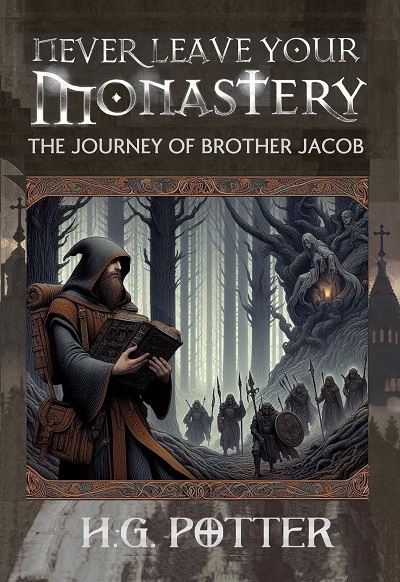
AGAINST THE ARCHONS With the Valraphs, Brother Jacob goes on a dangerous journey across the lost continent in order to confront The Dire of Melancholia. Guided by a Lizardman Sahkah, he finds himself at one time in a vast underground cult complex, at another time in the secret labyrinths of the Arc du Baffay, grand fortress of DIRE.
BOOK 2 of Never Leave Your Monastery: Brother Jacob has lived his life in the quiet cloisters of Whitehaven, trained to defend the sacred mysteries of his order. But when a forbidden miracle erupts in the mountains beyond the monastery walls, Jacob is sent on a clandestine mission… and into a realm where the powers of Heaven contend with Shadow for the souls of men. He is secretly dubbed a quest-knight
Now Jacob travels beyond the cloister as an Ammouric Knight and encounters:
– an ancient wizard of mysterious Egyptian lineage,
– a king who has resisted the prince of darkness,
– a team of deep-trackers who journey into the depths of earth,
– and an ancient evil called the Dire of Melancholy, whose dark magic spreads across the land.
Pursued by uncanny forces and drawn into the intrigues of hermits, warriors, and wandering saints, Jacob must discern whom to trust—and what it truly means to keep the sacred faith when the world itself seems to be unraveling.
Part spiritual epic, part medieval fantasy, and part journey of the soul, Never Leave Your Monastery invites readers into a world where miracles still break through the veil and the final battle between light and darkness begins in the heart of a single monk.
For readers who love:
– J.R.R. Tolkien and C.S. Lewis
– Dante’s Divine Comedy
– Umberto Eco's Name of The Rose
– Spiritual fantasy and medieval imagination
– Deep, symbolic, character-driven storytelling
Enter Whitehawk.
Follow Brother Jacob, quest-knight
And discover what lies beyond the monastery gate.
Excerpt
Overthrowing powers and principalities—the dark thrones of wickedness in high places—is never an easy thing. In fact, the task is quite horrendous. Nor is it strictly reserved for nobles or the high-born heroes of old, remembered only in wizard tales and outlandish sagas. All too well did my companions and I learn this. For us it became a game resolute, a bloody hunt even, involving skilled men of common stock. From experience I will tell you: even with every good will and united effort, the risk entailed is real, and failure may cost you more even than your mortal life. You will awaken that which should not be awoken. Therefore, make ready all things before you set out. First, accurate intelligence must be had, with no scruples against the use of espionage. Also, the evil power should be declared as such, and its malice exposed, for certainly the entity will mask itself as beneficent, having assumed sway over innumerable souls. And do not neglect to persuade your superior or royal lordship to your plan; approval from above means favor from on high.
To confront such evil, be it a prime sorcerer, spirit incarnate, ingenious archfiend, or some other minion, one must be purified of any selfish motives, being armored thus with integrity. To get to that point is in itself an epic struggle. A fearless and chivalric team must be recruited. That will be tricky. Do not mention glittering gold to be had, and be honest about the known hardships on the way. When the enemy falters and all looks to be achieved, things can still get pretty dicey. Even with the sanction of the Church, the final assault may not bring what’s desirable or expected. We put down several great vassals of Hell, and even though our deeds were prodigious and noble, some crowns of Whitehawk, as well as imperials, became alarmed, conscious of their own vulnerability. They did not give thanks to Heaven for their deliverance. They saw only that a monk had deprived them of their favorite melancholy angel.
A monk should pass happily from earthly existence to his eternal reward, retaining no personal notoriety whatsoever, his name lost “in blessed obscurity.” Usually this is how his last years find him, but there are unfortunate exceptions. Take my case: most assuredly, such a blessed departure is now become impossible. Far from returning to my anonymous monkhood, several kingdoms have been petitioning for my arrest and trial. Therefore I say to you: let the realms curse my name, but pray, brothers, henceforth have this testimony read aloud in sacred defiance of the powers of this age.
Flee, ye monks, the wicked city. Enter not her unguarded gates, nor take any solace in her soft caresses. Rather, find satisfaction working with your hands. Instruct men in the simple techniques of the staff, fortifying them against bandits and demons, preparing them for true knowledge.
Tien Joshur
Winter Instruction for Wayfaring Monks
The Wicked Cities of Men XIX
Brother Jacob Magister, shawl-knight; wandering monk, hereby supplies this testimony to the Holy Inquisition concerning the chivalric enterprise upon which Abbot Cromna sent him.
They girded me with Ammouric Knighthood in conformity with lawful provision, and dubbed me Sir Hortezan. Perhaps I had not all the trappings of a knight, but the title might avail some.
So I did not fail to correct my habits. But even with so elevated a title, one may be humiliated and overthrown. The first thing to defeat me was no spell but something natural, “all-conquering sleep.” And with sleep, dreams do come rushing. I dreamt another mysterious dream. It was the dream of the fair maiden. She appeared before me again holding the gift-book of the knights. With her lovely eyes she was gazing, as it were, out to distances. She did not call my name, as before, but asked a question. “Who is worthy to open the pages of the book, and who can unseal the story within? Chosen monk of God, be there not one wild-spirited elf of the mountains worthy of trust? Nor any of their kin, the honey-sapping gnomes or stout dwarves? Were not such beings given for the help of men?”
Immediately I looked and I saw the book in her arms. I opened the book and saw an illumination-diagram upon the page. There was drawn in the foreground a pit from which reached up a devilish claw-hand. The claw-hand held a burning scroll. The smoke of the scroll rose up in a V-shape and filled part of the page. From behind the billows of smoke moving upwards there was a sun whose rays fell downward but could not penetrate the cities below.
She closed the book, turned away and lithely slipped down the ancient corridor; and as she rounded the corner pillar, she was about to vanish from my sight. I reached out to her, and immediately she was gone. When I swung the corner, there was the white stag, the Arcavir’s mount, but it was on its knees and was bleeding from a wound, as if struck by a huntsman. This I interpreted: a prophetic dream of things that were, things that now are, and that are to come. Otherwise I did not understand its meaning.
So the monk his dream relates in record.
The knight’s armour did not fit so well. It is not lawful for a monk to wear armour anyway, and Jacob could not move easily in the chainmail with the speed needed for the quarterstaff. He only strapped on the upper part of the armour.
The knights gave lessons for a few things, whatever they could in so brief a time. First the special prayers to prepare for battle. How to use the horse employing both lance and sword, (the basics), to balance the shoulder plates and ready the hauberk. It was just in case some rival knight learned of Jacob and challenged him to a joust. Of these many things they also told him. it would be long before he could master the superior style
for riding, use a lance, or employ the weapons of a knight. He did not really hope to master it, although he did find it trying. Jacob had always the freedom of movement: any restriction of armour inhibited his ability; his armor would be a monk’s branny frock and his shield the bare hand.
As preparations and training took several days, Jacob returned to further a translation of The Black Book, hoping to solve many questions. In the scriptorium he labored, alone at night, when other monks sleep. He did not easily learn the content of that book, for the language was obscure, but his monkish persistence paid off. He saw that a careful translation of The Black Book could reveal many things of knowledge. It was not some spell book or weird and fatal tome, but a reasonable compendium of the sages describing the history of the Whitehawk realms. By such things studied, a translation might bring about the recovery of a holy relic to increase the faith of many. Also, might not a translation bring men to learn the actual contents, those Sorcerers and others who peruse the ancient text, and so diminish their craving to possess it? Theirs was a craving indeed, nothing more than a sinful avarice for forbidden knowledge. On the other hand, what if they sought to suppress some lore coded therein?
Each night Jacob would copy down and translate a page from the substantial tome. His knowledge of translating Saturnian Latin conveyed the smooth flowing and clear collection of ancient tracts. He would write some of the translation of those parts that he found pertinent at the time. To show it here would divert our thoughts too much, brothers.
Jacob was loath to begin a hallowed endeavor without first finishing this penance. He had originally estimated that he should translate the enormous tome in time for his appearance before the Prime Interquist. He could demonstrate by the translation that the codex was in no way a grimoire, and that he was innocent of witchcraft.
It was taking too long. In making a translation he was losing valuable time. Whatever lines Anherm had sought on behalf of the elfbeards were quite elusive. A quest of greater or equal import now was pending. In the two days of translating labours, Jacob’s heart was besieged terribly with melancholy. The book was too large to hope to finish. And what is more, Jacob began to wonder if the book was a grimoire after all. Certainly the first chapters were strange indeed, and elaborated certain arcane histories. A number of sections described the history and lore of priceless relics, detailing the virtues of each. Those which the Eldark had told, or which Ammouric monks had made commentary upon, added to the knowledge.
Certain Sorcerers, be assured, will use sacred signs and symbols and even scripture itself in their diabolic summoning, as in an attempt to coerce angels. Is that why they sought the work? Some have even tried to manipulate the sacred letters of the Tetragrammaton, imagining in their folly that such secrets could command God himself!
Nevertheless, the deep purpose of this writing remained obscure. Was it for good or ill? Had Jacob been set up? Certain other black books of giant proportion are known to exist to this day, once used by certain wizards, tomes near indestructible. Within their leaves are shut dangerous things, being bound by weird and massive bindings that were not sufficient but had to be wrapped with iron chains, at last being padlocked by the Ammouric Soothfold! It is said that the fury of Hell itself was stored up in them. Several of these are known still to remain in the desolated ruins of Nyzium, hanging from the ancient ceilings suspended and locked with adamantine chains wrought by the Soothfold, the keys taken and cast
into the smoldering furnaces of Mt. Abaddon.
The powers of Hell were arrayed against the shawl-knight. But Jacob had mighty allies. He understood the purposes of Aileron the goose, which seemed natural knowledge but surely was not, the sympathetic communication that remained mysterious. He bade the goose go flying above the pines to drop off sacks of food, apples, bread, and sometimes wineskins, finding that enchanted isle in the horseshoe lake, since the elf-kin were still there, hopefully.
Zephyr blew gently as Jacob trotted the horse Burgundius into the Timberhills once again, in the hour before sunrise. Aileron was guiding him to the fey-creature, Kruthendel...
Solar rays warmed the air and snows were melting, for spring was near. Clouds scudded across the starry heavens like massy ships in the upper atmosphere. If there were only a sign given that I were doing the right thing. Nay, but a wicked generation seeks a sign.
Rocky defiles and snowy corridors we at last set as our dread purpose.
We entered warily the ice-flow region of Nthule. First we passed many forested groves here and there, but soon the terrain became scarce and bleak.
The land was cold but the breezes warm. Somewhere above in the blue sky a gull screeched.
Arizel the sorcerer was high in learning, (too high)-enough to translate the strange Oruscan Greek of that original text. He did not wait to do so until we had ended our journey. He would unroll the scroll often and recite its words whenever he had chance. I listened, having a little ability at the archaic dialect. Upon hearing it read aloud, harkening to the metaphysic ringing of the early Greek, I thought it a wonder.
“Why do you keep so great an interest in a poem, Bannock?” I asked.
“Does not that deity of yours allow me,” he answered, “to enjoy classic literature, monk?"
“I confess it true that certain monks be too strict. That is as things need to be for us. But should not a wizard like you have greater interest in a grimoire of spells? What is there for you in mere rime?”
“There is not a great distance between rime and spell, unlearned one. The beauty of the poem itself can put a soul under its spell, just as the chants of your God put rope-girded monks under the divine influence. I read this poem because it contains words of virtue, and such words prepare a man for what is to come.”
“And what is to come, Bannock?”
“What is to come already we see...” he said, rolling up the scroll. He was peering at something ahead upon a snowy hill. He looked but could see nothing because of the glare. He placed his scroll within the wicker tube and girded a deadly dagger to his belt instead.
After much journey up into rocky hills on horse we at last reached the Nthule ice-flow. That evening we camped and ate well with the provisions the Crown had provided. The following day we went to work felling several trees to prepare wood shafts to make rafts for crossing the interior waters.
As King Graham had indicated, it was impossible to take any other route. We had to descend a thousand feet into the interior of the ice-flow itself, through a mighty and steep crevasse.
We found old ropes which previous parties had left behind. But the mountaineering ropes of the elfbeards were of much better make, and they helped greatly, for the rock and ice in certain places was uneven and dangerous. The horses could not be ridden down that far. I explained in detail to the horse Burgundius about another route he should take. We would meet him at the other side of the ice flow. (It did not occur to me as strange that a horse had just completely understood such a plan).
We worked with failing strength to haul the wood beams for a raft. At last, after we had traversed several tunnels of pellucid ice, we made it to the interior and beheld the vast ceiling of glacial arches formed over the valley-cavern. Nebulous arrays of mist drifted through various places or slowly swept along the mountainous slopes even shrouding the rocky earth below. In some recesses grew pine trees and shrubbery wherever holes in the ice formed from rising steam-blasts. The air was not cold, and there were glacial cataracts spilling from the ceiling in numerous spots. In the center of the cavernous valley was a wide placid bay, over whose surface a mist drifted in patches. These were the waters which the hot springs fed and they connected by this meandering bay somehow to the Northern Warm Sea.
We reached the shore of the bay which was hedged with polar flowers of various kinds, and this, I would say, was what was meant by the “Unicorn’s garden.” We had enough wood to make only a single small raft to float those provisions which would not fit into the water-proof dwarven packs.
“There is no way around the waters,” Phaedra Stormraker said. “Just as the king warned, we will have to go through the waters. It seems a shallow pool,, although it must be deep in some places. The water is warm,, so it will not be a problem. The distance to the other side,, however,, is considerable. I hope you all know how to swim. There is no Unicorn come against us,, so let us with speed then into the flood, before it comes.”
Indeed the water was quite warm,, like a bath. This put the valraphs at ease. In certain places,, however,, as they waded across,, it became colder,, especially as we went into the deep and had to swim.
“We now reach the mid--way,” I declared. “ “The guide will now return back to the shore and lead the packhorses back up to the surface, and report our success to the king.”
“Go ye no farther yet,” said Arizel. “I know not this place. It is mysterious indeed. Let the guide go back I say, but slowly, we shall give a signal of our success from the opposite shore. Who knows but that the Unicorn awaits to surprise us there after we are weary from swimming?”
We turned to continue, and looking down one could determine the bottom far below, though the water was murky in some spots, and deep it was. There issued a great swirl and bubbling of water about us, a great rush of wave in the otherwise tranquil water. Something was moving beneath.
“What was that?" cried Buckbar. Each man halted.
“Peloran titans must come to hunt in these waters!” someone announced in a loud whisper. There was a chilling silence as all looked about in trepidation.
“It is the Leviathan! Look there—his finned tail rises above the flood!” I cried. “Swim for your lives!”
The massive tale slapped down upon the waters, and the great grey and white-speckled megaron rose up and blew mist out his back. Flipping over, he dove back into the depths. In the waters beneath the massive thing, larger than an Authapian war-wagon, moved silently beneath me. It headed towards one of the elfbeards. I called to warn him.
“Buckbar, the colossus comes upon you from below!”
Buckbar looking downwards watched the massy thing close in. At the last moment he did a sudden pull from the beast’s underwater course. His elven descent let him elude well. At once the creature broke the surface of the flood and made a great crashing of water. For a moment, as his head reared upwards, his eye emerged and he could see us.
The Leviathan had meant to impale Buckbar. The aquatic giant sported a singular long horn protruding, like the lance of a jousting knight! The horn was spiral-form, just as the horn that the king had. Did the king’s long horn originally must have belonged not to the horse-like creature often depicted on shields and tapestries. This unicorn turned out to be water-beast, actually what the bestiaries title a Narwhale; The king had wrongly assumed that we knew the local legend entirely, so popular it was. The thing was colossal, impossible for us to fight, let alone capture!
The water-beast was circling around to make another joust. It positioned to go at me. Like Buckbar, I thought to dart out of its watery path at the last moment. But I am not a valraph. His spiraling horn was quite long, like a knight’s lance. The great beast barged at me. The horn pierced through the luggage on my back. You may wonder, brothers, how it is that we went through deep water wearing cumbrous luggage, but I tell you these harnessed packs were of dwarven craftmanship and caused things to feel lighter, although the Black Book always weighed somewhat upon my shoulders. The make and fabric, however, always left the contents dry under all conditions. Nevertheless, my rucksack was pierced through, and the beast dragged me through the water as the straps of the luggage caught me into his momentum. It turned about and was now to dive, and taking a deep breath, I was pushed through the water as we both struggled. In order to live and not drown, I had to unstrap myself from the pack. This meant I would forfeit the Black Book. So I did it anyway and surfaced. The beast keeled off into the depths, the pack spinning.
Well, what could I do?..without the lore in that tome, crucial lore for the grand endeavor would be lost. The tome had been truly an easy yoke, even though its bulk was considerable. Just as Abbot had said, as long as I would not groan much against it, accepting it, the great book would remain lightweight. Once I was dwelling on it, the encumbrance increased, to the extent that I could barely sustain it.
Now this was often the case, because my mind often returned to the grand tome, so every day I could feel it weighing me down, and I would not accept it. So it certainly was a temptation. Just to let it go off into the sightless depths, the water has probably ruined it anyway.
What if it were lost forever? For surely it be the only copy. I could never prove my innocence to the Prime Interquist without it. I might request of the unicorn that my rucksack be returned. I could offer a truce with the beast. Perhaps I could reason with the magic beast and tell him of our penitential purpose, and even my own plight. Would that yield sympathy? Certainly Jonah had elicited some sympathy from the whale in scripture. Now there came remembrance of Ambrosius the Nephilung’s riddle: Who haunts those hills that never were born, (that may be meant as hills of water, ocean places like this)...
Be it enough to look upon his pelt, or a kind word suffices, like starlight of many galaxies glittering bright, lighting the way through waters of night.’
A kind word...certainly you chuckle, brothers, assuring yourselves that the very usage of “beast,” therion as Aristotle says, signifies the want of such an ability. It cannot be reasoned with. Assuredly, my brothers, this is the very thing I set about doing, to communicate in the various high-pitched whistling tones such whales whistle. The claim seems hard for men of our time to swallow, and I could not fathom how such a power to sing whale-songs was granted to me, but I must use it or else be swallowed. Was the animal merely enchanted, and thereby had communication with men, or was it sacred, and so Heaven let a monk to enter way of parley?
Of this great and noble creature I requested forgiveness for our intrusion upon his waters and our need to pass through. I spoke in particular of our noble endeavor to reform the ways of men, who surely were “in need of correction...”
The massive unicornus informed me of his sorrow at the loss of his parent years ago, and how subsequently he had become an enemy of men. Nevertheless, he understood his own sacral status among men. He knew of the Furth High King and informed me how it was divine providence this passage be blocked so that no army of King Graham might pass through. In God’s sight, the king had failed in virtue, and had sinned by keeping women whom he would not marry. Many of commoners and even knights had sinned in similar ways, by drunkenness, whoring, and adultery. The king alone was not entirely to blame. Nor did the clergy urge satisfactory penances, nor courageously preach against sin and worldliness. They lived in luxury, and often vied for honours, allowing heresiarchs to influence them. So too did the monks fail, praying too little, obsessed with reading, gaining occulted knowledge useless for salvation.
So there was no way the king would prevail in war against the bolgoth. Heaven had already determined that the King could be delivered into the hands of that troll- horde. This punishment, however, the Lord relented but could not altogether withdraw it, since the judgement of God cannot be retracted. So he allowed the unicorn beast be as a divine sign to the king, and to block his reckless advance against the evil dominion. This was a great mercy which allowed the monarch to reign many more winters than he otherwise would have, and the people benefited as well, for the wealth of the trade from the East would only have corrupted them. Clement delay the Lord granted the king and holy poverty his kingdom.
The King himself had long since repented, after all, dismissing his courtesans; and in most other ways he had become a gallant and worshipful feudal lord. However, the time now was right, and the king would no longer restrain his natural ambition. He had to pay for the sins of his youth.
Nevertheless, the Furth High King had another plan for the wicked troll-horde, and would use the king’s punishment for glory. The unicorn granted to let the knights of King Graham through, for surely the time had come. He would not disturb them while they built a pontoon bridge to their own demise. I, however, was not to mention to anyone the allotment meted out to the King and his knights, since it was not mine to say, but God’s will; and besides, the king was so intent on sending through his divisions, that no doom would cool him. I would be wasting my breath. Wars are chastisement for sin. They cannot be avoided. Better for a monk to pray that men survive war rather than to escape war, for by humanity’s transgressions, (as we can see are recorded in The Black Books), we know that war is stored up for all the civil lands.
He returned the baggage, and did so while the others looked on with amazement from the opposite shore.
The mysterious Black Book was unharmed, proofed by some ancient spell against water damage. The old wizards thought of everything.
The great beast disappeared again into the depths.
Step into the world of 1 bestselling ‘Fantastica’ with this complete four book collection compiled into a single Kindle anthology. From the masterful mind of multiple award winning, International bestselling, fantasy author, M. R. Mathias comes this