
Amazon
Category:
Action/Thriller
Publisher: Pegasus Elliot MacKenzie Publishers Ltd.
ISBN-10: 1843869705
Type: Fiction
Pages: 390
Copyright: 2015
ISBN-13: 9781843869702
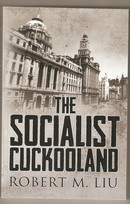
The Socialist Cuckooland is fiction based on historical facts. Against an Orwellian backdrop, Barry Lee lives in fear and struggles for survival.
Short Synopsis:
Set against a backdrop of catastrophic turmoil, THE SOCIALIST CUCKOOLAND (105,000 words) is a tale of intrigue about a man who wants to escape. With a trenchant depiction of the nefarious mechanisms of a totalitarian police state, the novel reveals what challenges the main character has to face in Orwellian conditions, what attempts he makes in order to flee, and how he eventually makes it to the free world. Despite the dismal aura of fear that spreads through, the story, interspersed with scenes of music and romance, has a happy ending, even as it asks a serious question: What would you do if caught in the same situation? The table of contents below offers a glimpse of what this narrative of a political maelstrom covers:
THE SOCIALIST CUCKOOLAND
By Robert Minger Liu
Contents
Chapter 1: Neighborhood Spies
Chapter 2: Political Study
Chapter 3: Evening Dance Party
Chapter 4: Amorous Adventure
Chapter 5: Professor Arthur Mayer
Chapter 6: Class Struggle - Hardly a Dinner Party
Chapter 7: The Swim-to-Flee Business
Chapter 8: Escape Coordinator Alam
Chapter 9: Adventure on the Sea
Chapter 10: Socialist Law and Order
Chapter 11: Music Party for the Hapless
Chapter 12: Freedom under Socialism
Chapter 13: Marlene’s Anguish
Chapter 14: Ellen vs. Political Reality
Chapter 15: The Tragic End of a Fine Gentleman
Chapter 16: Johnnie the Hawaiian Artist
Chapter 17: Major Turning Point
Chapter 18: Surprise Nighttime Check
Chapter 19: The Third Degree
Chapter 20: A Close Call
Chapter 21: The September Mystery
Chapter 22: The Entrepreneur’s Backdoor
Chapter 23: The Frustrations of Socialism
Chapter 24: Rose Room on the Guitar
EPILOGUE
Excerpt
(Sample Chapter)
The Socialist Cuckooland
-- by Robert M. Liu
Chapter 1: Neighbourhood Spies
Shanghai, spring 1966
Reluctant to hold the hefty book he was reading, he let it lie on the square table near the eastern wall of his living room, its upper end propped up with a dictionary underneath to make the pages meet his eye at a convenient angle. It was a time-yellowed copy of the American classic Gone with the Wind on loan from a friend. More than halfway through, he found himself enjoying this epic historical romance. Fascinated by the author's writing style, he had made copious notes about the story, as if he were studying a textbook. After all, Barry Lee was a serious student of English. He even thought that he should memorize some of the author's sentence patterns as best he could if he was to master the language.
Since 1949 when the Communists won the Civil War with the Nationalist (KMT) Government, no Shanghai resident had been able to purchase a new copy of the novel. In a self-imposed state of isolation, the country was like a birdcage that would let nothing bigger than a mosquito fly in or out. Probably disapproving of Margaret Mitchell's unflattering depictions of emancipated black slaves, the government agency in charge of cultural and artistic affairs did not permit publishers to reprint a Chinese-language version of the book released in the early 1940s. Some local critics would even characterize her great literary work as decadent, spurring Barry to wonder if they had read it at all. How did they define the terms they elected to use in the first place? Nobody knew. Anyway, such adjectives as decadent, bourgeois and pornographic sprang to their lips readily, when it came to describing things Western. They certainly wanted the public to think of the West in those terms.
His gaze was reaching the bottom of the page, when he thought he heard something. Listening carefully, he raised his eyes from the book to the door. It was somebody's footfalls on the landing outside, which, though quiet and cautious, struck a familiar rhythm along with a slight squeak from the shoes. While he was trying to recall whose footsteps gave such subtle but distinct clues, the tread stopped at the door, followed by a polite but firm knock. Closing the book, he rose to open the door only to find himself face to face with Comrade Yang, the neighbourhood police officer. Obviously, Yang had come with news to break, most probably, bad news, as Barry had never known the man to deliver good news in person.
Stepping in, Yang sat down at the square table. The thick book caught his eye, but he apparently had no idea what it was about, except that it was in a foreign language. Since his training as a grass-roots security officer had left out English and American literature, he could not even read the title. "Is this English?" Yang speculated, casting a glance at the book. He then took off his dark blue cap and placed it on the tabletop. With a crescent peak, a flat top and a round national emblem sewn to its front, the cap, as part of his uniform, added to his air of authority.
Before Barry could find words to respond to the police officer's seeming curiosity, he saw the door open. His mother came in with a cup of tea on a saucer; she must have heard the visitor's footsteps too. Fearful that she might say the wrong thing at the wrong time, he prayed that she would just leave without saying anything at all. Should she beseech Yang to let him go and join his father, it would embarrass him as well as the police officer. Apart from being useless, any such plea would sound very silly. Hence, when she politely placed the cup of tea on the table for Yang to drink and left the room without a word, Barry suppressed a sigh of relief on the sly.
"I guess this must be an English book," Yang said, softly tapping the cover of the tome with the fingers of his right hand. He understood it was important for Barry to study English, he added, as Barry wanted to join his father, who was in Hong Kong. If Barry planned to live and work in the British colony, he needed English, without which, he would have difficulty finding a job he liked, the police officer remarked. As he paused, his other hand rose above the table, revealing a large notebook with black covers, which he put down beside the dark blue cap.
Barry sneaked a peak at the black notebook. The neighbourhood security officer must have recorded in its pages his observations on the residents in his jurisdiction. If anyone had reported anything to him, he must have jotted it down herein as well. Barry felt an urge to reach for the notebook, wishing he could read its contents to find out what Yang thought about him, but refrained.
The topic of the conversation turned on a dime when Yang informed that Barry's application for an exit permit had been disapproved. The District Public Security Bureau recently had issued a few exit permits, but these did not include the one Barry needed in order to go to Hong Kong. In fact, the District Bureau had rejected most of the applications submitted to it, including the one from Barry. The realization that his hopes for a life in liberty were dashed sent an emotional twinge through Barry's heart, even though the news was no surprise to him. "May I know why?" he enquired, staring the police officer in the face.
Yang squirmed slightly, looking embarrassed. "Well, the decision was not mine," he responded, adding it was the District Bureau that processed all applications. As a neighbourhood police officer, he was in no position to disclose what had led to the rejection. His duty was to notify the applicant of the outcome of the application. Speaking in a serious tone with a straight face, he was without question trying to convince Barry that he had nothing to do with the District Bureau's decision. Yet, after a fleeting eye contact with Barry, he quickly shifted his line of sight off to the teacup on the table, even though he did not appear desirous to drink the tea. This planted the seeds of doubt in Barry's mind about the truth of the police officer's words.
Stationed at one of the substations under the District Public Security Bureau, Yang was responsible for the security of the neighbourhood where Barry lived. The district consisted of eight precincts, each of which had a public security police substation with jurisdiction over several neighbourhoods. Assigned to each neighbourhood was a public security police officer whose job it was to watch its residents. Yang was one such watchdog. Since his work did not involve physically tackling criminals, he did not carry a pistol on his waist.
Ostensibly, he was here to ensure that everyone living in the neighbourhood, permanently or temporarily, was registered with the public security police substation. Hence, whoever came to stay in the neighbourhood, no matter how briefly, must report to Yang and fill out a form indicating where he was from, for what purpose he had come, what relationship he had with the host household, and how long he intended to stay. In reality, however, Yang's business was information gathering. Although strictly speaking he was not an intelligence officer, his real role was as a neighbourhood spy. As such, he was an important figure in the eyes of the residents, who on meeting him would without exception respectfully address him as Comrade Yang.
Wherever he went, he carried with him his black notebook, the contents of which he kept to himself. He also had access to the dossiers the public security police substation kept on residents. Sometimes, he would help update the dossiers, and exactly on such occasions, the notebook became invaluable, as it was a treasure trove of comprehensive human intelligence collected over the years from various sources. On the other hand, it inevitably contained neighbourhood gossip and hearsay, true or false, but he would copy the information therein to the dossiers as he saw fit.
Arguably, there was a distinction between the black notebook and the dossiers. The former, private and unofficial, belonged to Yang personally, whereas the latter were official documentation that belonged to the government. Nevertheless, once a piece of information found its way from Yang's notebook to a resident's dossier, it became government property. Since no one could delete it, it would stay in the dossier forever. Unfavourable information thus entered in a resident's dossier would have a negative impact on the resident's life. Therefore, Yang wielded considerable power over the residents in his jurisdiction. The more he knew about their finances, habits, lifestyles and, more importantly, ideological inclinations, the more powerful he was. If unfavourable information led him to make a negative judgement on a resident, he could set a bumpy life path for the latter by adding a short phrase to the latter's dossier: "Ideologically problematic!" Anyone so labelled would face frustrations at every turn under the socialist system implemented by the Communist Party.
Acting in cooperation with Comrade Yang under the direction of a Communist Party cell embedded in the neighbourhood was a group of women who identified themselves as the Neighbourhood Residents Committee. Needless to say, most of its members were also ardent party members. As it was always in touch with those willing to provide information about such residents as were on its Persons-of-Interest List, the Committee proved to be an efficient Nosy Parkers' Club. Thanks to its assistance, Comrade Yang had no difficulty keeping up to date with the goings-on in the neighbourhood. As if that was not enough, the public security police substation had installed Police-Residents Liaison Boxes in the neighbhourhood, into which informers could drop their reports.
A cautious, introspective man by nature, Yang must have acquired certain specific personality traits through his training as a party member and public security officer. For instance, something in him, probably induced by party discipline, held him back from expressing his thoughts and feelings. Whatever he had to say was always politically correct, suggesting that toeing the party line had long become his second nature. Although he did not repeat the revolutionary rhetoric of the time as zealously as many other grass-roots functionaries did, he showed no sign of discontent with the sadistically restrictive form of government that Barry could scarcely stand, which fact set the two men wide apart. Yang was a product of the system who earned his livelihood safeguarding the interests of the dictatorial regime, whereas Barry was a freedom-loving young man who saw himself as a hostage held by a socialist tyranny.
What disconcerted Barry was the perception that Yang was a man of limited horizons unwilling to open his mind to ideas other than those the Party had inculcated in him. The odds that Yang would ever become a generous man were close to zero, Barry inferred. Still, he wished that he were wrong. Young as he was, he had started learning to judge character. Generosity was a virtue, he thought. A generous man might make life easier for you, even though he did not share your life philosophy, on condition that it would not undercut his own interests. Unfortunately, Yang did not match that profile. Instead, he seemed to take pleasure in obstructing other people's wishes, betraying a perverted but common mindset that the totalitarian regime had fostered in its cadre.
Barry knew he was not living in a social environment that encouraged such noble qualities as generosity, tolerance and compassion. As an atheistic political outfit in control of every aspect of national life, the Communist Party would not preach Christian values; nor would it allow schools to teach traditional Confucian values: righteousness, moderation and academic excellence. A fervent opponent of the Confucianist Doctrine of the Mean, the paramount leader of the Party, Chairman Mao Zedong, was sowing hatred, envy, narrow-mindedness and radicalism with his clarion call for class struggle. Consequently, leftist bigotry reigned, turning grass-roots functionaries into mean-spirited psychopaths eager to crack down on those who sought liberty.
To such residents in the neighbourhood as wished to leave the country, Yang was the man who could make or break their plans. If you intended to apply for an exit permit, you must first visit the police substation and request an application form, which Yang would refuse you if the District Bureau had rejected your last application recently. He would say there was no point in applying again so soon and that you must wait half a year before you could submit a new application. After half a year of waiting, you could go again and find him. This time, he would give you the form, but you had no idea where your application was to end up. He could let it stay in one of his desk drawers for as long as he pleased. Even if he decided to send your application up to the District Bureau for processing, he would attach his opinion to it. The exit permit division of the District Bureau would then decide your destiny based on Yang's opinion. If it was unfavourable, your application did not stand a chance.
For Barry, who had applied many times over the years without success, there was an extra catch. The leftist propaganda put out by the state media had evoked an aura of intimidation warning you that you must love the socialist motherland and stop attempting to leave. Exit permit applicants, therefore, appeared unpatriotic by socialist standards. As a persistent applicant, Barry had attracted unwanted attention from the authorities, adding to his hurdles.
"Higher authorities have tightened up processing procedures; it is more difficult to get an exit permit now than before," Yang stated after a brief silence. His tone of voice was firmer than minutes earlier, a sign that he had figured out how to make Barry comply with the socialist norms. Instead of telling Barry when he could apply again, he suggested that Barry's father come back to Shanghai to see the family. There were no restrictions for Hong Kong residents, he said. Sweeping his gaze around the room, he commented that Barry surely was living a comfortable life. "What makes you feel you must leave?" he asked unexpectedly.
The question caught Barry unawares. Not that he lacked an answer, but that he must conceal his true feelings about socialism from Yang, who certainly knew why he wanted to leave. To wit, he did not want to live in this socialist birdcage forever -- period. Yet the neighbourhood spy must ask the annoying question to test him. Pleased with the checkmate, Yang had a sneaky smirk flickering across his lips. Secretly, Barry made an enormous effort to hide his anger -- not only at Yang, but also at the political system that had frustrated him for so long. He remained silent; he could not afford to say anything that might prompt Yang to add unfavourable comments to his dossier.
Thankfully, Yang did not insist on having an answer from Barry but moved on to another topic, political study, which Barry knew meant ideological indoctrination. With a grave air, the police officer pointed up the importance of political study, informing that the Neighbourhood Residents Committee conducted political study sessions periodically for the benefit of the young residents in the neighbourhood. "You were invited to the study sessions, were you not?" he questioned with an odd emphasis on the word, invited, which made the invitation sound like a command.
A few weeks earlier, Barry recalled, a woman from the Committee had indeed dropped by to invite him to the study sessions. Like a flash of lightning, it dawned on him that the invitation had been a command indeed. He had unwittingly ignored it, but he was not concerned about the consequences of this non-compliance on his part. The District Public Security Bureau had already turned down his application for an exit permit. What else could the authorities do? Yang would repeat the invitation anyway.
Picking up the black notebook from the table, the police officer opened it and skimmed a page. "You did not show up, according to what they told me," he said in a matter-of-fact voice without clarifying who 'they' were. Barry was sure 'they' meant the Committee. With a swift glance at Barry's face, Yang carried on with his ideological discourse. "Nowadays, everybody tries to keep up with the times through political study; no one can stay away from the tide of proletarian politics. I am afraid you are out of touch. You must attend the study sessions," he demanded.
Barry knew that by 'the times' Yang was referring to the Party's ideological requirements for the body politic. As the political needs of its paramount leader, Mao, kept changing, so did 'the times'. To ensure that the citizenry stayed in line with the great dictator's whims, the Party demanded that they engage in political study. Hence, party-supervised study sessions were held regularly everywhere, and the attendees must read state-run press editorials, government directives and Mao's essays. The rationale behind political study was that by cramming its propaganda literature down your throat, the regime expected to remould your soul to the point where you became a socialist model citizen disposed not only to accept its control, but also to believe in its creeds. Understandably, one of the topics of discussion that came up regularly after the readings was the superior nature of the great socialist system.
Armed with the background information on the young people living in the neighbourhood, the Committee targeted those it deemed out of line with socialist thinking for political study. Barry, who was definitely on the Committee's radar screen, must now contemplate the disagreeable prospect of having to face the brainwashing. He frowned but, aware Yang was awaiting an answer, promptly loosened up. It would be unwise to defy the police officer, who, to all intents and purposes, had just issued an order on behalf of a despotic regime, which Barry could neither eschew nor disobey. He had heard that some Shanghai residents had wound up in prison labour camps after they had galled their neighbourhood public security police officers.
One must accept reality when it was just too powerful to reject, he thought. Unlike certain naive citizens who claimed their basic rights because they saw same listed in the Constitution, he was sure that the individual had no rights at all in Mao's socialist utopia. To claim your rights by way of flouting the regime's demands would only make things worse for you, whatever the Constitution said. The regime's top priority was to safeguard 'the collective good', which in its lexicon was indeed a synonym for the interests of the one-party dictatorship. That was what 'proletarian politics' was all about. The Constitution was not meant to protect the rights of the individual. Those beautiful-sounding rights printed on paper were for propaganda purposes. The rule of thumb was simple: You must forget about your rights and never say no to the functionaries of the regime, if you were to survive in this pernicious political milieu.
Yang put on his dark blue cap and rose with the black notebook in his hand, ready to go. The cup of tea stayed where Barry's mother had left it, still full but no longer warm. The police officer had sat for more than twenty minutes without touching it.
Getting to his feet, Barry promised to attend the study sessions from now on, but a feeling of despondence hit him. As Yang turned around to reach for the doorknob, a soundless sigh came from Barry's chest. Heretofore, he had managed to keep his own small world insulated from 'the tide of proletarian politics'. His interests were jazz music and English literature. His main source of information was not the state-run media, but his short-wave radio, on which he could pick up the BBC and the Voice of America in the evenings. By listening in to the two major international broadcasting stations, he was able to improve his English and get a sense of what credible news coverage was like. Apart from the correspondence between him and his father, the radio set was his only link to the outside world. Since he spent much time reading and writing in English, he had more English than his friends. Therefore, some of them occasionally would arrange to meet him for a conversation in English.
Having been born into a businessman's household, he had an instinctive aversion to the rhetoric of 'proletarian politics'. His father, who had operated an export business in Shanghai before 1949, had left for Hong Kong before things began to fester irrevocably. For that reason, he had a steady flow of financial support from outside, which permitted him to stay focused on his studies without having to worry about his livelihood. Despite his personal frustrations and the ever-worsening political forebodings, he managed to find ways to amuse himself. He would visit second-hand gramophone record shops of a Sunday afternoon, looking for old 78-rmp records from the 1930s and 1940s. Thus he had built up a collection which included such jazz masters as Duke Ellington, Glenn Miller, Benny Goodman, Tommy Dorsey and Artie Shaw. He would play jazz standards or classics on his acoustic-electric guitar, running his fingers up and down the fretboard to extemporize in a major or minor key. From Hong Kong, his father had mailed him Jazz music books, which enabled him to render melodies before he fell into his improvisational mood. Often he would practise minor-key pieces like Dark Eyes, Besame Mucho, and Autumn Leaves, as well as major-key tunes like Manhattan, The Nearness of You, and Misty.
Years earlier, as a teenager, he had taken lessons from two guitar tutors, one classical, the other jazz, but ended up with a passion for jazz, which in turn had led him to know other guitar players in town and play along with them. In the midst of the psychological strain of totalitarian socialism, he sought escape in music. None of the activities he engaged in would meet with the approval of the authorities. The Committee almost certainly would have labelled his musical passion as 'bourgeois decadency', had it known what kind of music he was playing.
"There is a study session scheduled for tomorrow afternoon," Yang informed, his hand on the doorknob, his head turned back slightly, insistent that Barry should turn up. When Barry confirmed that he would attend the study session the following day, the police officer showed satisfaction at Barry's non-defiance. "Very well," he muttered as he opened the door for himself with a perfunctory nod at Barry and left.
No sooner had the police officer's footsteps died away than Barry saw his mother slip back in. "What did Comrade Yang say," she enquired anxiously.
"They turned down my application," Barry replied in a flat tone, feeling sorry that he had nothing cheering to tell her.
"What are you going to do now?" she asked after a silent moment, her voice trembling with sorrow.
Thinking he should find a way to set her mind at rest, he said she need not worry; there must be a way out. However, based on what he had read in the state-run newspapers, he actually expected things to worsen even further. Besides, he believed that Yang had told him the truth in saying that 'the tide of proletarian politics' would leave no one alone. It had already affected the lives of millions. The fact that so many people had to waste time with 'political study' was a gauge of how bad things were, but there was no point in impressing the gravity of the situation on his mother. It would only add to her unease.
"I am a lucky man," he claimed, injecting some genuine confidence into his voice, as if he believed that God was on his side despite the difficulties facing him. He even thought that things would turn out all right for him in the end; he just did not know how. To reassure her, he asserted that he trusted his own gut feeling. Indeed, there was an enigmatic sense of optimism in his heart, which was so strong it spilt out and infected his mother. By the time she left for the kitchen, the concerned look in her eyes was gone.
After graduation from high school, he had chosen not to go to any state-run college. Instead, he had begun to study a correspondence course in journalism from a British college in which his father had enrolled him. Printed lectures would reach him regularly, not directly from England, but via Hong Kong. He would read them, write articles as his instructor required, and then mail the written homework to Hong Kong, so that his father could forward it to the college in England. In the meantime, he had been taking lessons from private tutors as well.
In his view, if he had entered a state-run college, he could not have learnt what he wanted to learn, because the state-controlled curriculum there imposed an onerous burden of 'political study' on students, turning the acquisition of essential knowledge into a matter of secondary importance. Furthermore, as part of the socialist thought police, the ubiquitous 'Political Instructor' assigned to each college class by the Party would watch every student's ideological predilections. Such insidious thought policing would definitely have got on his nerves. But now, the regime's authority had permeated into his home in the form of a neighbourhood police officer serving an ultimatum on him. What choice did he have but to obey? Nevertheless, knowing the purpose of 'political study' was to transform living souls into programmed robots, he had his mind fortified in anticipation of its stultifying effects.
|