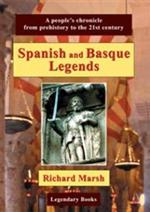
76 legends of Spain and the Basque Country from prehistory to the 21st century. 16 pages of colour photos and one black and white photo.
Distributed in Ireland and the UK by Irish Book Distribution.
Distributed in Spain by Bookworld España.
Also available from the author at Richard@RichardMarsh.ie
Translations and adaptations of medieval historical legends, as well as regional and local tales that may or may not have happened in exactly the way the story says.
Excerpt
Saint John’s Eve Bonfires
(Cataluña)
Saint John’s Eve, 23 June, in Spain is like Halloween in English-speaking countries, and bonfires are lit in celebration. This story of the origin of the custom comes from Sabadell, near Barcelona in Cataluña.
The mothers of Jesus Christ, Saint John the Baptist and Saint Judas were close friends when they were girls, and they lived only a short distance from one another after they were married. They agreed that the first one to give birth would light a bonfire on top of a hill near her house to announce the event to the other two. Saint John’s mother was the first, and she lit a fire to signal the others.
It is interesting to speculate that this story may have been brought to Spain by Mary the mother of Jesus herself. She probably passed through Barcelona on her way to Zaragoza, where she joined the apostle Saint James the Greater (Santiago) to found a church on the site of the present Basilica of the Pillar. Zaragoza tradition affirms that she came in person – en carne mortal – and that this was not an apparition. It was the only time she was known to have left her homeland. As proof that the story is true, the pillar she stood on is displayed in the Basilica. (See “Santiago” chapter.)
Orreaga
(Navarre)
Cer nahi zuten gure mendietaric Norteco guizon horiec?
Certaco jin dira gure baekaren nahastera?
Jaungoicoac mendiac eguin dituenean nahi izan du hec guizonec ez pasatcea.
What would they in our hills, these Northern men?
Why come they here our quiet to disturb?
God made the hills intending none should pass.
(from Altabiskarco Cantua – The Song of Altabiskar)
In 778, Charlemagne was returning over the Pyrenees to France after ravaging the Basque province of Navarre. The famous paladin Roland was commanding the rearguard when they were ambushed by Basques and Saracens at the mountain pass of Orreaga (Juniper Place) north of the village of Roncesvalles in Navarre. Roland waited too long to sound his trumpet to call for help, and he and the flower of Charlemagne’s cavalry were massacred.
In this poetic literary legend by Arturo Campión (1877) inspired by the Basque ballad Altabiskarco Cantua, Charlemagne and his army are camped in Espinal, four miles southwest of Roncesvalles, on the road from Pamplona. Orreaga is flanked by the hill of Altabiskar and the Forest of Irati on the east and the hill of Ibañeta on the west. Tomorrow they will march through that pass.
It is midnight. There is no moon, no stars in the sky. In the distance bonfires gleam on the tops of Altabiskar and Ibañeta. The Franks are singing in the town. The wolves howl on Altabiskar. The Basques are sharpening their axes and arrows on the stones of Ibañeta.
Charlemagne, deeply worried, is not asleep. Next to his bed his young page is reading an adventure story. Nearby, Roland the brave is cleaning the famous sword Durandarte, while the good archbishop Turpín is praying to the Holy Mother of God.
“My page,” says King Charlemagne, “what is that murmuring that breaks the silence of the night?”
“Lord,” the page answers, “those are the leaves of the Forest of Irati moving with the wind.”
“Ay, dear boy. It sounds like the cry of death, and my heart is frightened.”
There is no moon, no stars in the sky. The bonfires now gleam in the middle of the mountains. The Franks are sleeping in Espinal; the wolves howl on Altabiskar; the Basques are sharpening their axes and arrows on the rocky slopes of Ibañeta.
“What noise is that?” again asks Charlemagne. His page is asleep now and does not answer.
“Lord,” says the brave Roland, “it is the torrent of the mountain, it is the bleating of the sheep of Andresaro.”
“It sounds like a groan,” says the king of the Franks.
“So it is,” answers Roland. “This land weeps when it thinks of us.”
Charlemagne is restless, still awake; the land and the heavens are now without light; the wolves continue to howl on Altabiskar; the axes and arrows of the Basques gleam among the oak trees of Ibañeta.
“Ah,” sighs Charlemagne. “I cannot sleep. I am burning with fever. What is that noise?” Roland is asleep and does not answer.
“Lord,” says the good Turpín, “pray, pray with me. That clamour you hear is the irrinzi, the war-chant of the Basques, and today is the last day of our glory.”
The sun is shining on the mountain; Charlemagne has been conquered and is fleeing “with his red cape and black-plumed cap”. The children and the women are dancing in Ibañeta. No longer are there foreigners in the Basque Country, and the irrinzi is raised to the heavens by the mountain people.
“A Toledan Night”
(Toledo)
Ask a Spanish friend why he looks tired, dishevelled and half-dead, and if he moans, “Una noche toledana (a Toledan night),” you know that he is suffering from a massive hangover. The expression originates in a 9th-century party in which “half-dead” does not adequately describe the condition some of the guests were left in.
One of many realignments of power among the quarrelling Moorish leaders resulted in Emir Al-Hakam taking Toledo from his uncles Suliman and Abdallah. Al-Hakam named Jussuf, the son of one of his generals, as governor of the city. The inexperienced young man lost no time in alienating the people with his capricious and unjust domination to the extent that the disaffected citizenry were soon gathering to stone the castle. The nobles of Toledo marched Jussuf to Al-Hakam and demanded that they be given another governor. The emir consented, and he installed Jussuf’s father, General Amrú in his place.
Humiliated by his son’s treatment, Amrú decided to avenge himself on the nobles. He bided his time, patiently gaining the confidence of those who had deposed Jussuf until the opportunity arose to take action. This came when Al-Hakam’s young son and successor, Abd al-Rahman II, paid a ceremonial visit to Toledo with all his entourage. Amrú ordered a great banquet in honour of the occasion, which the nobles of the city were invited to attend. The castle was specially decorated with pennants and streamers and illuminated for the festivities.
The guests arrived and were greeted with all due courtesy, but once inside the door they were divided into two groups. Some were conducted into the banquet hall, while others – the nobles of Toledo – were led, with apparent respect and honour, to the dungeons, where their heads were cut off. No one in the banquet hall was aware of what was happening beneath their feet.
The following morning, Toledo awoke to the sight of 400 heads adorning the walls of the castle. It is said that the shock of this scene caused a twitch in the face of Abd al-Rahman, which afflicted him the rest of his life.
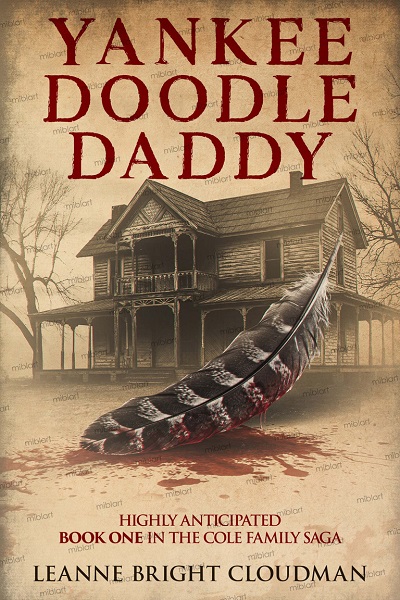
Yankee Doodle Daddy is a historical Appalachian Family Saga. The story follows a mother's reckoning as she struggles to survive and keep her four daughters alive.
Yankee Doodle Daddy is a historical Appalachian Family Saga. The story follows a mother's reckoning as she struggles to survive and keep her four daughters alive.