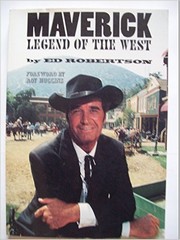
A behind-the-scenes history of the Emmy Award-winning television western MAVERICK, featuring interviews with series creator/producer Roy Huggins and other series personnel, plus analysis of the show’s success and insight into the workings of the television industry.
In the late 1950s, prime time television was saturated with Western series featuring traditional cowboy heroes. Very few of those shows stood out, and for that reason very few are still remembered.
Maverick is one of those exceptions. When it debuted on the ABC television network in September 1957, Maverick looked very much like a typical, straightforward Western, with a typical, handsome hero in the person of Bret Maverick (James Garner). But Bret Maverick (and, later, his brother Bart, played by Jack Kelly) didn't relate to problems in the ways we've come to expect from our Western heroes. The traditional Western hero is a stalwart cowboy who wouldn't hesitate dropping everything and risking his life to help a damsel in distress. If that same damsel went to Maverick, however, he'd more than likely point her in the direction of the sheriff's office. Or sometimes Maverick would help the damsel, but before getting involved, he'd ask her, "What's in it for me?"
Bret Maverick was also one of television's first openly mercenary heroes. If there was a reward involved, Maverick wouldn't hesitate becoming involved, although he did prefer making money the easy way – at the card table, and at the expense of less-experienced poker players. He was also an ardent believer in self-preservation (his own, of course), and as such, he did his absolute best to avoid troublesome situations: if a gunman came into town looking for him, Maverick wouldn't think twice about ducking out the back door. He was not so much cowardly as simply reluctant to get involved (as his dear old Pappy once told him, "Love your fellow man, but stay out of his troubles if you can"), but if faced with no other choice, Maverick would tackle the situation head on. Unlike most cowboy heroes, he wasn't the fastest gun in the West -- and he knew it -- so he always tried, whenever possible, to use his wits to solve his problems.
Maverick turned just about every convention of the TV Western inside out. Its hero was not an altruistic lawman or a noble vigilante, but rather a card-playing grafter -- the basest of professions, at least in the eyes of the fictional Old West. Yet as grafters go, Maverick wasn’t an absolute scoundrel – he may take advantage of your good nature, but he always intends, in the back of his mind, to make up for it. "I love money," he once said, "but I hate jails." In fact, the only people Maverick really cheats are cheaters themselves. Ironically, he plays poker on the level -- he doesn't need any trickery to take your money because he already knows he's a better player than you are. (He wouldn't play cards with you unless he knew he could win, because he doesn't like to gamble.) Still, unlike most TV heroes, Maverick didn't always come out on top. By the end of any given show, he may find himself broke, swindled, thrown out of town, or even (as is the case with one episode) hog-tied in the middle of nowhere.
Maverick also upset the conventional wisdom in network television. At a time when the networks were teeming with Westerns, ABC scheduled Maverick on Sunday evenings against three prime time powerhouses (The Jack Benny Program, The Ed Sullivan Show, The Steve Allen Show) -- and got away with it. For two years (1957-59), Maverick was the hottest show on television: millions of people dropped what they were doing every Sunday at 7:30 p.m. to watch the fresh, hip show that became the Western among Westerns. Maverick was the first bonafide commercial success produced by Warner Bros. Television (it won an Emmy Award for the studio in 1959), but the show's impact went beyond that: it launched Roy Huggins, its producer, on his way to becoming one of the top show-runners in television; it solidified ABC at a time when the network was struggling; and it catapulted James Garner into superstardom.
Professional Reviews
Roy Huggins, Emmy Award-winning television producer and creator of Maverick
“Ed Robertson has studied and described this entertainment phenomenon from its beginning in 1956 to its most recent return, the Warner Bros. movie in 1994. Robertson has made that history suspenseful and absorbing, and I am persuaded, after reading Maverick: Legend of the West,
that Maverick is nowhere near the end
of its illustrious history."
The Nassau Herald
"A truly dandy history of the TV show,
full of thrillingly memorable anecdotes, interviews and a lively yet scholarly) look at the television industry of the late fifties and early sixties."
So Ya' Wanna' Be A Teacher is a humorous revolutionary book that tells exactly what goes on in a typical American public school. E-book version is available at Kindle, at Nook and at Smashwords.
Film Stars! Dancing! Popcorn!
At last, a life story with everything but the movie stuff edited out.This amusing memoir chronicles film critic Betty Jo Tucker's love affair with film from the 1930s through the beginning of the new millennium