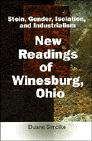
This book examines the best-known work of American writer Sherwood Anderson.
Sherwood Anderson's story cycle Winesburg, Ohio illuminates a time of change both for American culture and for American literature during the early twentieth century. The importance of this work can be shown not only on its own merit but also through a comparative study with Gertrude Stein's "Melanctha," one of the works that heavily influenced it.
Themes of industrialism, alienation, sexual frustration, gender blurring, and patriarchal oppression can be found in Winesburg. Focusing on these themes can not only offer new perspectives on that book but also more clearly place it within the traditions of a few of the countless authors who influenced Anderson and some of the concerns that went into his writing of Winesburg.
Excerpt
As I begin to reevaluate the place of Sherwood Anderson's Winesburg, Ohio in the development of American fiction, I first want to look at Anderson's symbiotic relationship with Gertrude Stein, a relationship most Stein devotees will know about through her The Autobiography of Alice B. Toklas, in which Stein pretends to write as her lover, Alice. Anyone interested in Stein or Anderson should also read Sherwood Anderson/Gertrude Stein, edited by Ray Lewis White. This book features chronological excerpts from their letters to each other and from their published comments about each other.
Anderson apparently came to love Stein through some of her portraits and through her 1909 book Three Lives. Stein generated considerable controversy with Lives, a controversy she would sustain with her subsequent works. In writing about the critical reactions to her prose, she sounds as frustrated as Anderson often felt, and much of what she says about her frustration could apply to Anderson, who appears prominently and constantly in literary anthologies and literary history books, yet continues to receive the label "marginal.” Stein says the newspapers claim "that my writing is appalling but they always quote it and what is more, they quote it correctly, and those they say they admire they do not quote" (Alice 70). The newspapers, however, reflected the general public, who found Stein's work fascinating and repulsive.
Professional Reviews
Amazon.com
Please read the reviews at Amazon, via the link at the top of this page.