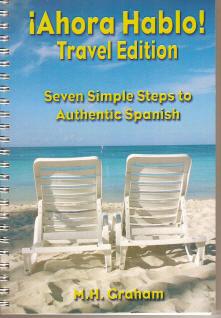
When traveling to Mexico, the Caribbean or Spain, this phonetic, pocket-sized guide will be
indispensable as you navigate around town, order in restaurants, find emergency help, speak with shopkeepers, understand the
culture, and converse with the locals
Professional Reviews
Heartland Review
Travel Books
Home Current Reviews Contact Us Archives Editorial Services Critiqueing Services
The problem with so many language books for travelers is they require way too much memorization without explaining what is happening or why in the target language. At last, this language guide for travelers has fixed that problem. The essential information needed to survive in a foreign, Spanish-speaking country is here. More importantly are the explanations of simple grammar rules which lead to a much better understanding of the language’s structure. Especially helpful are the phonetic aids to pronouncing the Spanish words. Our American accents may not be so wonderful, but at least we should be understood. If I were to travel to Spanish speaking countries or in the neighborhoods of some of our own large USA cities, this is a resource I would want to have studied well and taken with me. We rated this excellent language book five hearts.
lee foster travel
May 24, 2007
A Good Spanish Language Book for Travelers
When I go to Copan, Honduras, in September to look at the Mayan ruins for a few days, it will be helpful if I can recall some of my Spanish that has atrophied.
Recently I ran across a small book that will help me. It is Meg Graham's AHORA HABLO TRAVEL EDITION: SEVEN SIMPLE STEPS TO AUTHENTIC SPANISH, $12.95 from www.ahorahablo.com.
I like the way this Spanish language aid is laid out. It is small enough and slim enough (6x8.5 inches, 118pp) to fit into my daypack and is spiral bound, so I could set it flat on a table in a restaurant while brushing up on how to order my lunch.
Graham, a veteran Spanish teacher, has analyzed just what you need to know and don't need to know to function in a Spanish language situation. If you have had no Spanish, there is also helpful phonetic interpretation of words.
She starts with a "Necesito" and the 40 main function verbs you need to know to get along, plus the basic courtesy words.
Then she goes into the nuances of verbs. Each double-page layout has a little space left for you to jot down, right in the book, your specific, likely expression and practice speaking it. You could then go to the hotel front desk or the shop owner or the taxi driver and speak out your thoughts.
Graham proceeds finally to the main situational vocabulary that you are likely to need at the bank, or the police station, or the market.
All considered, whether you are just brushing up on your Spanish, as I am, or starting out from scratch, this book is extremely helpful. The type is large and the book has an easy pace to it, especially with those interactive spaces where you can write out your phrases and practice your pronunciation.
Though I have some other Spanish language books stashed away on my bookshelves, this is the one I will take to Copan, in Honduras, in September.
Subscribe to this feed • Email this
Posted at 02:55 PM in Travel | Permalink
TrackBack
WEAC
WEAC member's book makes it easy to learn Spanish
Need a quick way to learn basic Spanish? Mukwonago High School Spanish teacher M.H. Graham has the answer.
Her new book, "ˇAhora Hablo! Travel Edition. Seven Simple Steps to Authentic Spanish," avoids needless grammar and strips the language down to its basics so anybody can start speaking Spanish quickly.
It also has easy-to-use phonetic guides designed for the English speaker.
Need to tell someone that you need a taxi? Here's how:
Necesitamos un taxi ... neh-seh-see-tah-mows oohn tock-see.
Need to tell someone that you're hungry? Here's how:
Tengo hambre ... ten-go ahm-bray.
It's that simple!
The compact book - 5x7 and 117 pages - is designed to be easily carried, and chapters are organized around your travel needs, with common phrases grouped into such categories as Emergency, At the Restaurant, Let's Go Shopping, and Transportation.
Each section includes cultural tips such as:
"In Spanish, the word for 'pain' is dolor (doe-lohr) and the word for 'dollar' is dólar (doe-lahr). Take care with pronunciation."
The wire-bound book also has pages for notes.
Graham has more than 20 years of experience teaching high school students and is one of about 400 Wisconsin teachers who have earned national certification (world languages) through the National Board for Professional Teaching Standards. She earned a master’s degree in Spanish/education from Marquette University in 1985. Prior to teaching, she studied in Spain and Mexico, worked in Milwaukee’s Hispanic community and in the private sector.
More information about Graham and her book is available at www.ahorahablo.com.
WEAC members can order the book at a discount ($9.95 and $3 shipping) directly from the author at m.h.graham@ahorahablo.com.
"The statues of Savannah's Monument Square are silent. The statue of the solemn girl in Bonaventure Cemetery—made famous in John Berendt's blockbuster book, Midnight in the Garden of Good and Evil—can't speak. Only Savannah's literary monuments can g
Expands beyond the safety of pages bound by predictability to explore and often confirm exciting creative possibilities. A shimmering collage of memoir, creative nonfiction, literary journalism, and dizzying flights into poetic observation, this is t