Category: Cultures Publisher: University of Washington Press
ISBN-10: 0295955198
Pages: 125
Copyright: 1976
Aleuts in Transition is based on a study of two Aleut villages that show strikingly different responses to contact with the larger American society. The introduction and an excerpt from Chapter 1 appear below.
The book is available at Amazon.com and Barnes and Noble.
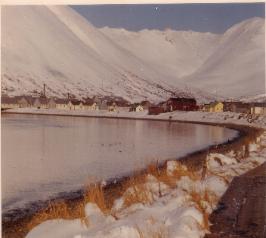
Excerpt from Chapter I NEW HARBOR(pseudonym) NEW HARBOR is a remote fishing village on the Alaska Peninsula. Traveling there on a crab boat, I was awed by the fairyland before me on that clear winter night. A sand spit, flanked by a bay and a lake, twinkled with the lights from houses lining the beach. We moored at the dock crowded with other fishing boats-gill netters, purse seiners and crab vessels—many of which were locally owned. Carrying my luggage along the dock, I passed the holdings of the fish-processing company that has operated continuously since the village was settled in 1911. Adjoining the company properties are Aleut-owned facilities—apartments, a variety store, a grocery store, a liquor store, a coffee shop, and a movie house. These enterprises stand midway between the residences of some of New Harbor's 28 whites and its 277 natives. The school is near the middle of town, and the fundamentalist church is at the far end. The following day I found the streets virtually empty due to a typical Aleutian storm with winds gusting to fifty miles. Wandering about the village, I became impressed with the number of modern facilities. New Harbor incorporated as a second-class city under Alaska Statutes in 1949. Since that time, with local or state and federal funds, New Harbor has acquired an extensive boardwalk system; street lights; a new school building; airfield; small boat harbor; health clinic; and community water, power, and sewage systems. In the native section of the village, the charming pitched-roof houses of multiple design, scattered in haphazard fashion, sparkled with fresh paint. New Harbor Aleuts build their houses and take pride in their upkeep. The interiors feature plumbing and modern appliances, and mail-order furniture. In the hills to the rear of the village, lying along New Harbor's only road, is the cemetery. I was aware that New Harbor is one of the few Aleut villages without a Russian Orthodox church, so I was surprised to find a large proportion of Russian-style graves-fenced mounds with a Russian Orthodox cross at the peak. As I later learned, the failure to establish a Russian Orthodox church conforms to the pattern of New Harbor's early settlers in shedding visible signs of traditional culture (traditional culture refers to Russian-Aleut culture). Unlike some other Aleut villages, New Harbor has no chief system, no community-owned steam baths, no fish camps, and no Russian Orthodox church organizations. Few Aleuts in New Harbor speak the Aleut language. In late morning, the storm broke and clear skies illumined the peerless beauty of sculptured, snow covered mountains surrounding an ink blue bay. It seemed that the whole village poured into the streets. Children combed beaches to find what the wash had delivered; women strolled to the store or to relative's houses, stopping in small clusters to exchange news; men busily engaged in numerous activities. Some men worked on their boats and fishing gear, others hauled supplies from the dock to the company store on snowmobiles, several departed for hunting trips, and some helped relatives or partners with house repairs or installations. Throughout the afternoon, both, men and women sauntered into the fish processing company office for news of the weather or to use the company radio, the only means of communication with the outside world. Since I conducted the bulk of my New Harbor field work in the winter months, I returned the following summer to observe the village at the height of salmon season. The activities of nearly everyone older than eleven or twelve related directly or indirectly to the harvest and processing of salmon. The men were at their fishing grounds, absent from the village for as long as a month at a stretch. Boys eleven years and older were fishing with fathers or uncles. Girls of the same age were babysitting for mothers or relatives working at the cannery. Fishing was the dominant topic of conversation. At home, women and girls ran to their home radio receivers to catch bits of conversation between fishing boats, tenders, and the company. And all eyes turned toward the sea for signs of the men's return. The same purposeful activity and cohesion I saw on those winter and summer days persisted throughout the three months I lived in New Harbor. ILIAKA(pseudonym) A twin-engine aircraft, the only means of passenger access to Iliaka, landed on a dirt runway at the adjacent Aleutian Island of Bright Bay. From a dilapidated World War 11 building serving as an air terminal, the passengers and luggage were piled into the open rear of an ancient truck held together by ropes and outsized screws and nuts. We drove past rows of gutted and rotting military barracks interspersed with several renovated dwellings housing the few whites who work at Bright Bay's air terminal and supply station. Herded from the truck to a barge, we crossed the narrow strait separating Bright Bay and Iliaka. Iliaka village was settled by the Russians in the 1760s with Aleuts from other villages on the island. Of an estimated twenty four villages on the island at the time of Russian contact in the late eighteenth century, Iliaka village is now the only one left. A breathtaking panorama lay before us. The village, stretching along a curved strip of beach at the mouth of a harbor, is framed by majestic mountain ranges interspersed with delicately carved lakes and inlets. Closer inspection, however, revealed the marring of this grand view by ubiquitous military junk. It looked as if the island had been struck by a disease that left disfiguring sores. Rotting skeletons of barracks and quonsets cover the area, and the hills and beaches are punctuated with World War II machine-gun emplacements. The barge landed at the dock on which the largest crab plant in Iliaka is located. But unlike New Harbor, the dock was virtually bare of boats. As there are no local boat owners in Iliaka (aside from owners of skiffs and dories), the five crab plants in the area depend largely on Seattle fishing vessels, which usually remain moored at the dock only long enough to unload their catches. Leaving the dock and walking along the dirt road fronting the bay, I passed the Alaska Communication System, which provides long-distance telephone service but no individual hookups. Next to the communication station stands an impressive two-story structure housing an Aleut-owned general store and apartments. Across from the market on the beach proper are six rental trailers. The Russian Orthodox church, imposing with its large green dome, painted glass windows, and fenced tombstones, adjoins the market. I stopped to converse with several church elders, who complained about the waning influence of the church. The church brotherhood ceased in the 1950s, and now only a handful of persons participates in the sisterhood or church committee, and the youth show a uniform disinterest in the church. A path from the churchyard leads to a small, aging, four-room parish house. On the other side of the church stands the dwelling of the late chief, who was not replaced after his death in 1967. Thus, for the first time in its history, Iliaka is without a chief. Farther down the beach, in the heart of the village, is the brightly painted bar, advertised by a large, hand-painted sign reading: The Elbow Room. The bar opened in 1966 coincidental with the beginning of the crab boom in Iliaka. It is said that the bar nets over $100,000 yearly for its Aleut owners. The bar owners are active in local politics. Iliaka incorporated as a first-class city under Alaska law early during World War 11. However, compared to New Harbor, Iliaka has been singularly unsuccessful in modernizing community services and facilities or even in restoring the pre-World War II level. By 1969, after nearly thirty years of existence, the council had failed in its efforts to secure these and other facilities: boardwalks, street lights, a power system adequate for servicing commercial enterprises, a new school building, a community-wide sewage system, a resident professional health service, and funds for rat control and water decontamination. The Bahai mission, near the bar, houses three of Iliaka's fifteen Bahai residents. Iliaka has been assailed by missionary activities: Russian missionaries in the nineteenth century; Methodist missionaries between 1890 and 1926 and again in the 1940s and 1950s; a Bahai mission since the mid-1950s; and, more recently, a fundamentalist mission. The persistence of American missions is amazing considering that they seldom convert an Aleut. Russian missionaries made an indelible imprint; most contemporary Aleuts identify with the Russian Orthodox faith. The school, jail, an abandoned Methodist orphanage and church, and a white-owned market and liquor store mark the eastern limit of the village. Between this pole and the west end, where the dock and major processing plant are located, stand the small, run-down frame houses in which most of Iliaka's 190 natives live (170 Aleut and 20 Alaska Eskimos and Indians). The majority of Iliaka's 108 whites live on the periphery of the village, near the major processing plant or in enclaves near the smaller processing plants located a distance from the village. As in New Harbor, the streets in Iliaka come alive with people when weather permits. But there are striking differences in the kinds and qualities of activities I observed in the two villages. Though the crab plants were in operation, many people were not working. Several men and youth fished desultorily in the creek, others stood nearby watching. On the road fronting the creek, a man loaded his truck in preparation for a trip to his summer fish camp. A cluster of adults awaited delivery of the mail outside the post office. Several persons stood on the beach gazing at a lofty projection called Priest's Rock, and discussed a recent rape of an Aleut woman. Farther down the beach, a woman filleted salmon. Nearby, another placed halibut in a drying rack. Still other women could be seen picking berries in the hills beyond. In late afternoon, unskilled fish processors filed out of the factory after eight hours on the assembly line. Three older teenage boys weaved dizzily down the street, noisily drunk, singing and swinging their rifles (thought to be loaded). In the bar, two women cried about an endless series of misfortunes until other members of their party told them to stop crying and have fun. In contrast to the relatively even keel of life in New Harbor, Iliaka was a study in jolting contrasts between the old and the new, ugliness and beauty, and an intact productive community and a demoralized one.
Yankee Doodle Daddy is a historical Appalachian Family Saga. The story follows a mother's reckoning as she struggles to survive and keep her four daughters alive.
Exploring the impact of literary icon Flannery O'Connor's noted legacy on the cultural realities of modern-day America, the world, and a certain author.
Yankee Doodle Daddy is a historical Appalachian Family Saga. The story follows a mother's reckoning as she struggles to survive and keep her four daughters alive.