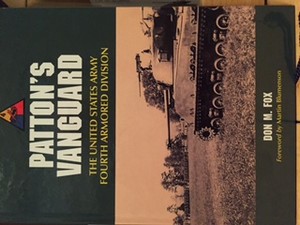
Stirring accounts of the almost legendary campaigns of the United States Fourth Armored Division, universally recognized as "Patton's Best". The accounts were assembled through the use of original unit combat diaries and after-action reports, memoirs of key historical figures and abundant supplementary documents and correspondence. The firsthand recollection from members of the division are the essence of the book. With maps, drawings, and photographs.
Professional Reviews
Army Magazine - June 2004
Patton's Vanguard: The United States Army Fourth Armored Division
Army, Jun 2004 by Hymel, Kevin M
Patton's Vanguard: The United States Army Fourth Armored Division. Don M. Fox. McFarland & Company, Inc. 484 pages; black & white photographs; maps; index; $55.
During World War II, the 4th Armored Division played a vital role in Gen. George S. Patton's Third Army. It broke out of the Allied beachhead in northern France and led the pursuit of the German army across the country. As it neared the border with Germany and ran low on gas, the division continued to fight the enemy, keeping the Germans off balance and ruining any hope of a counteroffensive. When the Germans finally launched an attack against the First Army in the Battle of the Bulge, the 4th was sent barreling north to relieve the besieged town of Bastogne, where the beleaguered 101st Airborne Division and elements of other units held the Germans at bay.
Now there is a unit history worthy of the 4th's exploits. Don Fox has painstakingly put together veterans' interviews, after action reports and combat histories, combined with excellent analysis and a macro view of the war in Europe, to make this highly readable and informative book.
While Fox does an excellent job of describing the 4th's victories, he is also unflinching about its defeats. He praises examples of good leadership and shows the consequences of bad. he also provides concrete evidence of why the 4th was considered the best armored division in the European Theater of Operations. For example, tankers in the 4th always kept their hatches open to better communicate with the infantry, while most others did not.
The action is conveyed well and battles are excellently related. Fox also debunks some of the myths and clears up some gray areas about the 4th, including the reported loss of 33 tanks by the 8th Tank Battalion before the battles for Bastogne. None were actually lost.
The author also explores why Maj. Gen. John S. Wood, the division's commander, was fired after so much success. For years, the official story was that Wood suffered from exhaustion, forcing Patton to relieve him. In reality, Wood was insubordinate to his corps commander when he defended the actions of one of his combat command leaders, who was not pressing his attacks and acting aggressively enough.
Fox also investigates the question of who ordered the 4th's Combat Command R into a position to enter Bastogne and made the decision to make the final push into Bastogne. By a process of elimination, the author claims that neither Patton nor the corps commander, Gen. John Millikin, was recorded making the decision; he concludes that it was most likely Wood's replacement, Gen. Hugh Gaffey, who made the call.
The book ends in January 1944 with the successful defense of the corridor leading to Bastogne. Volume II, which Fox is working on, will encompass the rest of the war. The book could have benefited from more and better maps.
Up until now, the best portrait of the 4th Armored Division has been Brig. Gen. Albin Irzyk's he Rode Up Front for Patton. Now, Patton's Vanguard gives a larger, more detailed picture of the 4th, and is well told.
-Kevin M. Hymel
Miltary Review May-June 2004
The 41st Infantry Division and the 4th Armored Division: memoirs of World War II
Military Review, May-June, 2004 by Gregory Fontenot
Because its scope, scale, and horrors seem incomprehensible to us now, World War II continues to fascinate us. Books published on battles that occurred over 60 years ago seem somehow both remote and immediate. World War II is remote from contemporary experience and seems particularly distant, given the intervening Cold War era. Yet, the books remain immediate because we can still hear the voices and see the veterans of World War II, albeit in rapidly diminishing numbers. The lessons learned from World War II are valuable in understanding contemporary operations, and help us understand the human conditions of war.
Aging veterans are now adding their memoirs and personal accounts to the body of literature written in the first three decades after World War II.
Biographers find that aging veterans are happy to discuss experiences that have reached "the fullness of time," and in retirement, veterans have time to discuss them.
Francis B. Catanzaro's With the 41st Division in the Southwest Pacific, A Soldiers Story, a personal memoir of a young infantryman, juxtaposed against Don M. Fox's Patton's Vanguard: The United States Army Fourth Armored Division, provides an opportunity for us to relive the events that shaped their lives. (1) Both books show how conditions and fighting methods differed between the southwest Pacific and the European Theaters of Operation (ETO).
Poverty Row
Catanzaro fought with the 162d Infantry Regiment from 1944 through 1945, serving in the early months of the occupation of Japan. When the 162d broke up, its soldiers returned in small groups to the United States to be discharged. Catanzaro boarded the USS Admiral H.T. Mayo and departed for home on 29 December 1945. On New Year's Eve 1945, the 41st Infantry Division cased colors, and the soldiers still in Japan were reassigned without fanfare. More than 60 years later, Catanzaro describes the end of the 41st ID as "sad and inglorious." The end of the 41st was in some ways fitting because the battles it fought in New Guinea and the Philippines were "poverty row" compared to the experiences in Europe of the better-known 4th Armored Division (AD).
Although the 4th AD's story has been told many times, Fox makes it fresh by tapping into interviews with veterans who were junior officers, noncommissioned officers, and enlisted soldiers during the war. He extols the virtues of Major General John S. "P" Wood uncritically, while giving Major General Manton S. Eddy, Wood's Antagonist, short shrift. (2) This criticism aside, Fox's book has many of the same virtues as Catanzaro's memoir in that it tells the story from the viewpoint of tactical unit participants. Neither author gets at the "big blue arrow" vantage point, but they do not need to, because the general movements and combat operations of both units can be found elsewhere.
These compelling books illuminate combat at the eyeball level of troops in the field. Cantanzaro's I Company fought its way through some of the toughest tactical engagements in the Pacific. Cantanzaro was in the thick of it, although he does not recall his bullets actually hitting any Japanese soldiers while in New Guinea or in the Philippines.
After nearly 4 months of fighting at Hollandia and Biak, only one-half of Cantanzaro's company remained. He and one other soldier were the only members of his 12-man squad remaining when their regiment moved into a rest area on New Guinea.
Jungle Rot
The "well" men were treated for jungle rot, with medics treating the soldiers' affected areas with a purple-colored concoction of potassium permanganate. To the sick, who were constantly under fire and poorly supplied, even small comforts proved memorable. Catanzaro remembers on 29 May 1944 burning the straps off his helmet while using it as a pan to fry "10 to 1" bacon that he scavenged from an abandoned supply dump for himself and his squad mates.
Catanzaro's communicates his memories in such a way that the reader experiences the bloody misery of being in the infantry. His little book makes it clear that admission into the unique club of combat soldiers in his rifle company was worth the price.
ETO Luxury
The 4th AD waged war in the comparative luxury of Europe, and it too was an exclusive club. Patton's Vanguard draws on soldiers' memories of the war. Fox tracks the 4th AD from its inception through its successful drive to retrieve the 101st Airborne at Bastogne. Patton's Vanguard ably illuminates the conditions of fighting in the ETO. Soldiering in the ETO differed from soldiering in the southwest Pacific by degree, not quality. Rain, cold, and German soldiers confronted the 4th AD. While Catanzaro rarely found himself the target of enemy air attacks, his colleagues in Europe often did. Fox reports that the 4th AD's antiaircraft artillery battalion shot down 134 enemy aircraft.
These books illustrate that while the sources of misery, illness, and fatalities varied, fighting in both theaters was fierce. Troops in the 41st ID and the 4th AD earned memberships in their exclusive clubs the hard way. These timeless tales of courage, compassion, and conviction are a testimony to the mens' strength in battle. The only real difference between the units is that the history of one is not well known while the other is celebrated. Both deserve accolades.
NOTES
(1). Francis B. Cantanzaro, With the 41st Division in the Southwest Pacific, A Soldiers Story (Bloomington: Indiana University Press, 2002); Don M. Fox, Patton's Vanguard: The United States Army Fourth Armored Division (Jefferson, NC: McFarland and Company, Inc., 2003).
(2). The "P" in MG John S. Wood's name stands for "professor." For more information see on-line at , accessed 22 April 2004.
Colonel Gregory Fontenot, U.S. Army, Retired, is the Director of Wargaming, U.S. Army Training and Doctrine Command, Deputy Chief of Staff for Intelligence. He received a B.A. from Kansas State University, an M.A. from the University of North Carolina, and an M.M.A.S. from the U.S. Army Command and General Staff College School of Advance Military Studies. He has served in various command and staff positions in the Continental United States, Kuwait, and Bosnia.
COPYRIGHT 2004 U.S. Army CGSC
COPYRIGHT 2004 Gale Group
Armageddon, a fact-based historical novel, is the third book of The First Strike Trilogy: A high-stakes race against time and politics unfolds in this gripping historical account of SIOP-62, revisit the tension of a pending nuclear attack, at a time
An illustrated developmental history of the American military chemical and biological protective respirator for use against war agents, this work provides photographs of actual respirator specimens and several useful appendices, in addition to its en
An illustrated developmental history of the American military chemical and biological protective respirator for use against war agents, this work provides photographs of actual respirator specimens and several useful appendices, in addition to its en