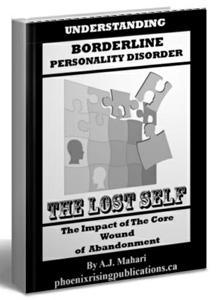
Understanding Borderline Personality Disorder - The Lost Self - The Impact of The Core Wound of Abandonment Ebook One examines and explores what is at the heart of the experience of those who are diagnosed with Borderline Personality Disorder.
Understanding Borderline Personality Disorder - The Lost Self - The Impact of The Core Wound of Abandonment features a thorough examination and explanation geared toward helping you understand Borderline Personality Disorder and gain insight into and awareness of the impact of the core wound of abandonment in BPD. It is the first ebook in what will be a series of 3 explaining, from the inside out, the many layers and various aspects of the impact of what A.J. has termed the "core wound of abandonment" that she identified in her journey of recovery as the wound that is central to what BPD actually is and how and why it persists.
This ebook includes 141 pages that provide a deeper understanding of Borderline Personality Disorder. Mahari has written a series of 3 ebooks that explain, explore, examine and define what she has termed, "the core wound of abandonment in BPD."
In this newest series of 3 ebooks Mahari shares her insight, from the inside out, as one who has recovered from BPD. She outlines what she has identified as the impact of the core wound of abandonment. This first ebook, "The Lost Self" in this series provides understanding about how the core wound of abandonment has impacted the lost borderline self and what that really means in terms of how BPD is experienced by those who have it.
"Understanding Borderline Personality Disorder - The Lost Self" - The Impact of the Core Wound of Abandonment and its coming two companion ebooks in this series of 3 ebooks, are sequels or follow-ups to Mahari's first series of 3 ebooks in her "Core Wound of Abandonment" series and are not the same at all. They will add to your understanding. First one has to know what the core wound of abandonment is and in this series of ebooks A.J. Mahari expands on the impact of this core wound of abandonment explaining many of the mystery puzzle-like aspects and manifestations of BPD so that those with BPD and those who are family members, loved ones or relationship partners of someone with BPD - non borderlines can really increase their awareness of just how to create the kind of change that recovery from BPD requires.
Excerpt
In my own experience as someone who has recovered from Borderline Personality Disorder I know both the very real pain and what stands between a person diagnosed with BPD and his or her getting on the road to recovery.
What stands in between you, and you’re getting on the road to recovery and getting better are the defence mechanisms that you’ve built up over the years.
Defence mechanisms whose purpose is to protect your from the very pain that you need to understand, learn to face, and cope with in therapy.
At the heart of the core wound of abandonment in BPD and its impact are many factors. Central among these factors however is the pain of loss. The pain of abandonment. The loss of authentic self.
As I will be exploring in this series of 3 ebooks, there is a central dilemma that those diagnosed with BPD must find a way to address.
This dilemma revolves around the dialectic of the pain of the core wound of abandonment - how central becoming aware of it is to recovery - and how having BPD impairs and even blocks the insight and awareness needed to address this pain.
Not knowing who are affects your ability to know what you want and what you need, who to trust, who to trust. In fact, it is this not knowing who you are that colours your experience emotionally in any and all efforts to feel and/or be connected to others - to relate with and or to others.
How can you relate to others in a consistent and stable way when you don’t know how to do this with yourself because you do not yet know who you are?
What does it mean to live from a lost self? What does it mean to live without a sense of actual or authentic self?
If you have Borderline Personality Disorder, you, in one way or another, and to one degree or another, know the answer to this question in your own life experience and experience of BPD.
What does it mean to you, what comes to your mind when I ask, what is your experience of living your life with Borderline Personality Disorder and without knowing your lost self?