|
Amazon
SinoAmerican Books
SinoAmerican Books
Category:
Language
Publisher: SinoAmerican Books
ISBN-10: 0976925958
Pages: 220
Copyright: Sept 30, 2008
ISBN-13: 9780976925958
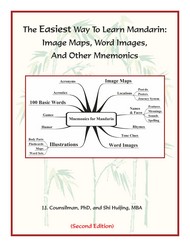
"The Easiest Way to Learn Mandarin: Image Maps, Word Images, and Other Mnemonics" applies more than a dozen established memory techniques to the study of Mandarin, most for the first time.
"The Easiest Way to Learn Mandarin: Image Maps, Word Images, and Other Mnemonics" applies more than a dozen established memory techniques to the study of Mandarin, most for the first time. The mnemonic methods include a mnemonic dictionary of over 1,400 Mandarin words; 660 clipart illustrations, a dozen large image maps; the 100 most common Mandarin words; illustrated body parts; spelling, sound, and meaning of Chinese names; and more. The book's greater value lies in its potential for helping users expand their knowledge of Mandarin beyond the presented material through the use of mnemonic methods.
Excerpt
For the student of Mandarin today, many learning tools are available, from simple word lists to sophisticated computer programs with voice analyzing functions. All have one thing in common: they require a massive amount of time because they are based on rote memorization. This book is the first to provide multiple short-cuts to learning Mandarin.
The book’s short-cuts, more formally called “mnemonics,” aid memory through clues to something unfamiliar in something familiar. For example, the phrase, “Mnemonics Neatly Eliminate Man’s Only Nemesis: Insufficient Cerebral Storage,” is a mnemonic for remembering how to spell “mnemonics.” It is a type called an “acrostic,” which uses the first letter of words in a phrase (something familiar) to identify another series of words (something unfamiliar). By far, most mnemonics are acrostics. For learning Mandarin, however, they have limited value because of the large number of Mandarin (pīnyīn) syllables that begin with j, q, x, y, and z; absence of any that begin with i, u, or v; and few that begin with o. As the graphic below illustrates, many other types of mnemonics can be applied to Mandarin. Rather than just being visual in nature, these mnemonics may provide clues that are visual, auditory, kinesthetic, or combinations of these modes of learning.
|