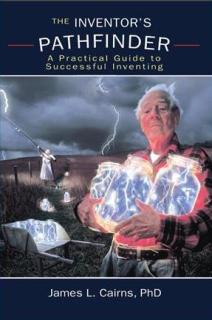
The Inventor’s Pathfinder carefully examines each inventive step leading from inspiration to product release. It's a route filled with many potential dangers that often sink novice inventors. The Pathfinder shows you how to successfully avoid the common pitfalls.
The book is written for beginning and seasoned inventors of all ages. It uses many practical examples, some from the author's own inventing and entrepreneurial experiences. In addition to the book's own material, it contains many useful links to a vast amount of supplemental information.
It's the author's opinion that inventing for profit is within almost everyone's capability. It's a wonderful, creative experience that, unfortunately, most people either miss or do badly because they simply don't know how to do it. But it can be learned with just a little effort and the right instructions. Don't be left out. You can do it!
The Inventor’s Pathfinder carefully examines each inventive step leading from inspiration to product release. It's a route filled with many potential dangers that often sink novice inventors. The Pathfinder shows you how to successfully avoid the common pitfalls.
The book is written for beginning and seasoned inventors of all ages. It uses many practical examples, some from the author's own inventing and entrepreneurial experiences. In addition to the book's own material, it contains many useful links to a vast amount of supplemental information.
It's the author's opinion that inventing for profit is within almost everyone's capability. It's a wonderful, creative experience that, unfortunately, most people either miss or do badly because they simply don't know how to do it. But it can be learned with just a little effort and the right instructions. Don't be left out. You can do it!
Excerpt
When lecturing, I usually ask for a show of hands from those who’ve had ideas for good inventions. Almost everyone raises a hand. Then I ask how many have ever done anything with their ideas, and no hands come up. The beginning inventor’s biggest problem doesn’t seem to be getting interesting ideas; it’s knowing what to do next. That’s a needless shame. It deprives the inventor of a very satisfying experience and keeps his new technology from the rest of us.
Who wouldn’t want to make money inventing? No one! However, most people do not recognize their innate talents and don’t even try. All they need is to be shown the way. Creating and profiting from inventions is not a black art. With a little effort, almost anyone can do it. You must start with a fundamentally good idea. How to get that idea and what to do once you have it are things you can learn.
Novice inventors are often stopped in their tracks by the common misconception that as soon as they find a good idea, it’s time to patent. Patents are expensive, and the unseasoned inventor stalls, uncertain if his innovation merits the investment. Or worse, he goes ahead and patents a useless invention.
What they do not realize is that there are important steps to take between inspiration and investing in a patent. One critical step is to gain confidence in the invention. Another is to see if somebody else already owns it. These are early, inexpensive parts of the process that the inventor can do himself. And they’re fun! Following that, the inventor who is not quite ready to pay for a patent can still get other, temporary, minimal protection. The U.S. Patent and Trademark Office offers inexpensive disclosure and provisional-patent application programs. They allow the invention’s development to advance a bit before the inventor actually files for a patent. In short, one can get some protection and a pretty good feeling of an invention’s value before investing significant money.
You’ll find that inventing is pretty much a solitary game. Others might contribute in important ways to the effort, but the inventor is the one who doesn’t give up, who’s there when everyone else has gone home, and who, against long odds, carefully threads a path through the labyrinth of impeding obstacles. Persistence is the grit that will get you through. When you’re convinced you can do something, don’t give up. Stick with it. Very few things work perfectly the first time. Edison tried over four hundred light bulbs before he found one that worked well. Marconi was publicly humiliated over and over before succeeding in trans-Atlantic radio communications. Those inventors had faith and never lost it. Countless other immense successes were steeped in early failure. There’s far more to be learned from failure than from success, so don’t be discouraged by it. It’s an important part of inventing
Complete Troubleshooting & Repairing guide to hot air furnaces * Complete operation, maintenance, and repair * Covers gas, oil, and electric forced air systems * Includes flowcharts and highlighted tips and solutions to common furnace problems