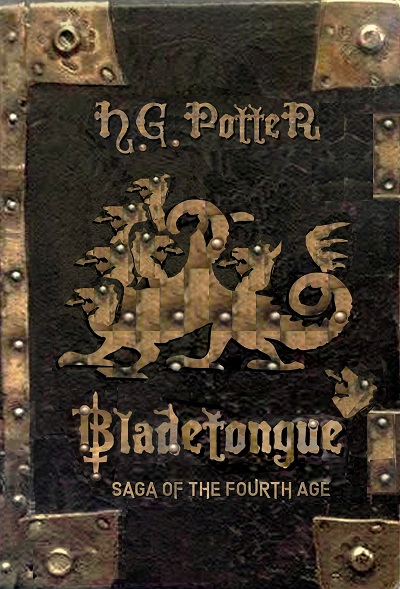
A crusade against an ancient evil.
A brotherhood bound by oath.
A victory that will cost everything.
This chivalric epic, lost for centuries, now in the refurbished language of Malory. A crew of disenfranchised veterans strike upon sea for a dragon horde, but the many-headed one attempts to corrupt their souls first.
The sworn company known as the Bladetongue is charged with an impossible task: to bind and remove a primordial many-headed dragon, seducer of souls, and hidden architect of a realm’s decay.
Led by the priest-captain Norgonce, and joined by warriors, monks, and outcasts of troubled conscience, the Bladetongue descend into volcanic depths, endure illusions meant to break the will, and carry their captive across land and sea toward a final prison prepared from eternity.
But evil does not yield easily.
Temptation stalks the faithful.
Pride hunts the heroic.
Despair claims its victims even among the brave.
As undead navies rise, kings are restored, and ancient prophecies awaken, the Bladetongue must face not only Hell’s armies—but the darker battleground of the human soul.
Written in a high medieval style reminiscent of Malory, Tolkien, and epic chronicle, Bladetongue is a tale of sacred warfare, moral trial, and costly obedience, where faith is not sentimental, heroism is never simple, and victory is measured in righteousness rather than survival.
This is not a story of easy triumph—
but of standing fast when Heaven itself seems distant.
Editor’s Note on the Provenance of Bladetongue
The work here set forth, known by the customary title Bladetongue, does not come to us as a single intact composition, nor even as a continuous manuscript, but as the end result of a long chain of preservation, loss, and conscientious restoration.
The earliest trace of the narrative appears to have surfaced in the late medieval period, several centuries after the Fall of Nystol, when fragments were discovered in the lost library of the renowned scribe Morpheus Memnos, situated in the Pale Desert. That library, now vanished, was already in Memnos’ own time reputed to contain texts salvaged from early ages, some of which were said to have been from civilizations long faded from the maps of Whitehawk.
Among these were fragmentary verses written in what scholars have identified as Oruscan Greek, composed in dactylic hexameter. Marginal notes accompanying these fragments—partly in a later Oruscan hand, partly in early Ammouric Latin—suggest that the original epic was already considered ancient at the time of copying. It certainly dates to the time of the first Greek colonies. History and myth were not yet cleanly divided. However the story of a confrontation with a many-headed metaphysical dragon has truly primordial origin, told in certain cave pictographs, surely dating back through oral transmission possibly to the First Age of the world, "the Paleolithic."
The original bard looked back to action set in the Bronze Age of Heroes, and the Oruscan poetry was recorded on parchment in the Third Age, with many scattered leaves, a number of citations, and three summaries surviving. Four large portions of the poem however were already lost when first catalogued at Nystol. Alongside the fragments were found detailed synopses of the narrative, evidently compiled by an earlier reader deeply familiar with the whole. These summaries preserve the sequence of events, the principal characters, and—most notably—the architecture of the tale, even where the poetry itself had perished.
It appears that the possessor of these remnant materials, likely a learned patron rather than a poet, commissioned a Christian clergyman—his name now unknown—to compose a complete work from the surviving elements. This cleric did not attempt a mere reconstruction of the pagan epic, but instead produced a Latin redaction that wove together the ancient fragments, the synoptic outlines, and a theological interpretation consonant with the faith of the Church, for he maintained that the ethic of the work already leaned heavily that way, as if it were a kind of presage. In doing so, he supplied missing episodes, speeches, and connective passages, not as inventions of fancy, but as moral necessities demanded by the structure of the tale as he received it. He re-locates the action in “the Fourth Age” his own time, as he meant it to edify the soldiers of his own feudal nation.
This Latin version in Ulthoran miniscule, long prized among the literary circles of Whitehawk, survived into the early modern period. Tragically, it was destroyed in the London Fire of 1666, along with numerous other irreplaceable texts of the Whitehawk corpus. Its loss has been lamented ever since as one of the great calamities of our literary inheritance.
The Whitehawk corpus was brought to Europe in the 14th century by a certain Franciscan monk who returned from crossing “The Great Ocean-sea.” He left his record of the journey Inventio Fortunata, which was summarized by Flemish writer Jacob Cnoyen’s Itinerarium, there was found listed the Bladetongue MS. as cargo.
Providentially, the Dominican scholar and poet Thannato Excorpus, during his years of study and travel, having stayed in cognito at the London household of James, Duke of York during the year 1660, completed an English translation of the Latin text. His purpose, as he states in a surviving letter, was not elegance. He was concerned rather with fidelity: to preserve the substance of the work for readers unable to approach the Latin, and to safeguard its moral instruction against the uncertainties of time. It is this English version—copied and recopied in private hands, and now set forth in a stabilized form—that is presented to the reader here.
What remains, therefore, is neither the original Oruscan epic, nor the medieval Latin composition, but a faithful witness to both: a work standing at the meeting point of pagan hero-song and Christian moral chronicle. Its seams are sometimes visible; its voice shifts subtly across layers of time, as it had in previous tellings. Yet precisely in this stratification lies its value as told of the Fourth Age. Few texts so clearly show how an ancient tale of strength and ambition was received, judged, and reshaped by a later conscience trained in obedience, humility, and the fear of God.
The reader is accordingly asked not to require of this work the smoothness of the kind expected in modern invention, but to attend instead to its gravity.
Prefatory Note; Architecture of This Tale
The present work, Bladetongue, stands within the tradition of epic and chronicle, in contradiction to that of the modern “fantasy tales” and like novels which dominate readers today. We have retained a voice that is archaic. This is not from nostalgia, but from keeping with a moral grammar no longer native to contemporary speech. The world it depicts is not governed by psychology, but by order. It does not give its gift as self-expression, but through obedience rightly understood.
Of the several fragments and marginal traditions herein alluded to, include descriptive phrases from The Whitehawk corpus, especially a work called The Ancient Book of Bloody Battles. Excorpus used the famous text as a language model in his translation from the Latin. It was a short work testifying to several historic Whitehawk battles, (now all pages lost save for the siege of Sarpis), being also translated into in English around the same time, that of Sir Thomas Malory. The archaisms there he retained not as curiosities, but as witness, and being enamoured of the style, he thus found it desirable to imitate both Malory and the military history in translating Bladetongue. The stylistic roughness, precisely reflected in this translation, we have intentionally preserved, updating spelling and modernizing only a few minor things for easier reading.
Excorpus left no instruction for the divisions of chapters nor made any comment on such in his translation notes, and very likely there never existed such within the ancient text. The descriptive headings were his, after the fashion of Malory, but he seems to have forgotten about them during the intense latter half of the work. Epic, in its earliest form, was not polished literature but dangerous memory.
A recurring theme in these sources is the nature of heroism itself. In Bladetongue, the hero is not defined by divine lineage, nor by victory, nor even by righteousness alone, but by submission of strength to blessing. The sword drawn without blessing appears again and again as a symbol of ruin; the same sword, when drawn to obey rightful authority, becomes an instrument of restoration, even immortality. But be wary, courage untethered from order will warp into schism, and conviction severed from vocation will become betrayal.
Prince Sinistox is therefore not condemned chiefly for misbelief, but for false authority. His tragedy is not atheism, nor even revolt. Rather is it a refusal of place marked by unrepentance. He does not deny truth outright; he rejects the order that limits him. In this he resembles not the heretic, but the antipope; he represents not the unbeliever, but the usurper. Therefore his fall is not an annihilation, rather is it a dispersal: command dissolving into obscurity, because power that will not kneel must eventually become irrelevant.
Conversely, the Bladetongue heroes are not saints by temperament, nor even by success. They are men bound by oath, often failing inwardly, sometimes falling outwardly, yet remaining within order. Their victories are partial; their losses grievous. Yet the world is altered by their obedience in ways mostly unseen by themselves.
The hearer is therefore cautioned with the same caution writ in The Ancient Book of Bloody Battles: this tale may awaken battle-lust, as all epics may. But it also demands judgment. The measure of a man herein is not how fiercely he strikes. It is whether he strikes where and when he is told—and whether he sheathes the blade when thus commanded.
If any lesson is to be drawn, let it be this: strength is never neutral, it is to be used, and freedom without form becomes another tyranny. What especially is praised in these pages is not domination, but rightly borne authority, and the peace that follows righteous conduct, whenever it be costly.
— Set down by Br. Stagolucus, Duns Scotus College 1902. Fragments handle with care.
Excerpt When the companions had supped, draining their flagons, Thalfin the mage leaned inward over the table, and in low voice, scarce above the tone of the other guests, addressed them:
"We must be cautious," he began. "The beggar's words may be true, yet in him we have not full trust. We should rest now, gather our strength, and move forth under cloak of night as he hath advised. The town keeps many secrets, and sharp must be our watch."
Norgonce inclined his head, his gaze turning about the room lest any were eavesdropping.
“Agreed. Here shall we tarry until the night is deepest, and when the Eye of the Wane stands in the highest vault, then shall we stir. Each must keep his watch in turn, that no mischance befall us.”
Such was the order, and the Bladetongue arranged their watches, each taking a turn to keep awake while the others dozed off as night deepened. The hours crept by, merriment ebbed away; and conversations faded. Guests departed to their ships or dwellings, casting curious eyes upon the strangers lingering by the hearth. One by one men left, until only the flickering lanterns and the scraping of chairs remained, and the hall took on eerie stillness.
The new quiet only served to wet the Bladetongue's sharp anticipation, as they remained there with only a few other drunkards half-slumbering at other tables.
All dozed but lightly, save Urius, the fierce son of Jarlath, who, though seated upright, slumbered as soundly as a beast in his lair. Those still wakeful found the ale not so potent as to dull their fears or keep them from contemplating what might lurk within the ominous twisted tower of Zenops. They had gazed on it earlier from across the bay, a strangely built colossus, removed apart from town, but which seemed to watch over all.
Pary conversed softly with Thalfin.
“Terrible things are said to lurk within that place. In Yrbath it was easy to scorn such accounts as the imaginings and babblings of poets, published abroad to keep trespassers out. But now that mine own eyes have looked upon the tower’s alien shape, of a making not mortal; I waver, Thalfin.”
“Nay, but don’t hope to get out of this now, Pary. Take heart. Not far away are things which legend has described, which you will see! You are still young and strong for a middling, of good spirit, and recklessly capable of anything.”
Pary answered, “Yet here, seeing it thus, chilled my blood. The tower’s look—‘tis not of this world. Tales for children may well have sprung from realities best left forgotten. We have fought men and horgs together in war, sword to spear, but never have we matched sword to talon and tooth, the onslaught of creatures unearthly.”
“’Tis too late for misgivings, Pary. Gird your loins and steal yourself to meet any opposition with relentless sword. In the hands of a trained mage, a shaft of elemental can frighten anything, even supernatural things crawling up out of some pit. “Blazing ore” we called that back in the war, which the alchemists these days class as radiant matter. We used it to great effect in the Battle of the Long Hairs. Don’t be afraid. Keep your eye on the prize.”
Rohorst had awoken and was listening to the conversation. He could no longer hold back from saying his piece.
“The problem with you wizards in this part of the world is that you tsuppose your magical science can touch anything. You imagine you can reach to the ends of the world with knowledge of so many things. Where I come from, savannahs of distant Mahanaxar, our witchdoctors and wizards make no such claim. They realize the limitation. Elemental magic can do scant work of driving off spirits, or banishing things supernatural, not like a shaman can. The tribes of our lands are much safer and do not have to worry about a spell backfiring, or its deadly byproducts poisoning the earth and sea.”
“So what do you suggest, Rohorst?” asked Thalfin, indignant. “There are indeed entities supernatural. What will you do to oppose them when they advance hither like demons? Piercing a ghost is not the same as skewering troll-kin.”
Rohorst turned his gaze to direct him to Norgonce, asleep.
“I will rely on him. The magic he can hurl will reach any power. It’s from Heaven.”
¶ How Gulathar the Deepseiger Spake of the Worm That Dieth Not
Now when the evening waxed late and the wind drave the sea-mist against the casements, the talk among them had lapsed to silence, and they sat awhile with their ale-cups low and the fire burning red. The ale was strong, their hearts were warm, and for a time all foreboding was forgot. Pary Lothren sang a short lay of the South Marches, and Urius beat the table softly with his knuckles to the tune. But when the song was ended, Phaethar, who ever mingled cheer with scorn, began to jest of the dark paths they soon would trod.
“Mark me,” he said lifting his tankard, “if we go deep enough into the tower’s roots, we shall come out beneath the very floor of the sun, hanging upside down like bats and quaffing stalactite dew for our wine. Then I’ll open a tavern there, and call it The Worm’s Belly, and there will be ever room within.”
At that they laughed, some spitting ale for merriment. Kajet clapped the table and said, “Aye, and the beast will spit thee out again, Phaethar, for thy tongue is sourer than vinegar. He’d sooner dine upon a bishop!”
Urius smiled grimly and said, “Better a worm below than one within. Men whose valour is just arrogance cleverly guised, aye, are eaten long before they’re swallowed.”
Then came a lull in the mirth, for Urius’s words had a weight in them, and none could tell if he jested or prophesied. Only the fire crackled, and the sea moaned faint through the shutters. Then Gulathar, who had sat apart, his cup untouched and his eyes upon the flame, spake low and hoarse, as one half-dreaming.
“Laugh while ye may, but speak not lightly of worms, my friends. For I have seen one: —and lived to curse the memory: the Worm that dieth not. I saw it in elder days, when the wide world was nar old and my hair was yet greyed. We were twenty-two Deepseigers then, venturing along the shores of the intermundane sea that rolls beneath the earth. We were seeking the lost trove caverns of Caernox. Brave men all, and some dearer to me than brethren.
“We left the cavernous sea and turned along an ancient canyon. The waters there are black as pitch, and the stones are hot beneath your feet. There the stalagmites are as mountains, and we traveled tunnels wide as cities, where the river Sigurwash flows as fresh water under fire and ice. And from the deep as we marched along the shore in the midst of that realm the thing came: vast as judgment, red as a wound. Its eyes were lamps of the burning pit, and its breath was a storm. Ere we could sound the horn, half our number were taken in mouthfuls, armour and all, so fast was its fury. Some the worm hunted down and devoured, the rest we lost to mad panic, for not of this world was the sound it made.
“It found me. Once did I strike at it—once only—and my blade snapped like glass.”
Now did Gulathar at last take of his cup, swallowing down the barrel-aged ale.
“Then into darkness I was taken and knew the light of day no more for many years, time beyond reckoning. Yet I lived. Yea, within its belly as in a tomb alive, hearing the beating of its hearts and the groaning of earth around. I tell you, time itself runs different down there; mayhap I slept a century, for my own flesh, being not in full of human kind, persists against the naturally-formed acid of bellies. But in the year when Nystol burned, some men, as if by miracle, found me and pulled me free, and I rose again to the upper air, but with no comrade left to name me.
“Since then I have known this: the Worm dieth not. Strike it, burn it, curse it—it will rise again, for it feedeth on the sins of men and can scent the heat of their pride. Wherever kingdoms fall and deep works are raised against Heaven, there will its shadow coil beneath the stones. May we never meet it, and our venture goeth where it slither not.”
When he had ended, none spake for a long while. The fire gave a crack as though it too were afraid. The merriment was gone out of them like breath from a slain man. At last Urius said, slow and thoughtful, “Thou hast been in Hell, friend, and returned to warn us.”
Gulathar answered not, but looked into the embers as one who readeth omens there. Then Phaethar, uneasy, muttered, “—no scorn meant.”
The Deepsieger gave him a faint smile. “Fret not. Only remember—if ever ye feel the earth begin to tremble, or the waters retreat, flee not backward, but forward. For the deeps have no mercy.”
And with that he drained his cup and rose, casting his shadow long across the floor. “Too much I told ye, causing ye dread over much. Now. If ye mind not, I’ll step outside for a breather.” The others watched him go, and no man laughed again that night. The sound of the sea outside seemed nearer, heavy with unseen motion, as though something vast had stirred in its sleep.
3
When at the last the Eye of the Wane, Arcturus, was gotten up to the height of the dome of starry night, Thalfin quietly roused his companions. They all stirred about, cloaks drawn tight, their boots treading lightly on the rush-strewn floor. They readied themselves for what was to come. The innkeeper had long since barred the gate, but a side-door for late sailors gave them passage into the chill night. All was deathly still now. The wind had slowed, and the harbor lay still beneath a sky toggered with stars. The patrons were either fast asleep or too deep in their cups to notice the group slip out the door into the nocturnal town. Only the cry of a night-water tern brake the silence, faint and lonely over the dark waters.
They stole through the narrow ways between timbered houses and down toward the warves. Here the smell of pitch and salt and tar thickened in the air. Lanterns guttered low in their iron hooks, casting circles upon the slick planks. They passed the Alambrest, her moorings creaking faintly. Within her hull sailors were snoring, heavy with ale and its oblivion. Some great fellow inside gave a sudden snort and turned, the timbers groaned with him, but none awoke. Like shadows over water the fellowship passed by without a sound, save for their cloaks faintly ruffling in the sea breeze.
At length they came to the same marine shed as before, the weather-bleached structure at the edge of the warf, where the tide lapped low beneath the pilings. Its doors stood slightly ajar, swaying on their iron hinges. Within, the air was heavy with old rope, oak shavings, and the sweet tang of pitch. Here shipwrights in daylight would store their tools for repair of the bellies of merchant craft; now all was empty and still.
Pary Lothren slipped in first, holding a small lantern shaded by his cloak. As he stepped across the threshold, something alive, hairy and thick-bodied dropped from the rafters onto a coil of rope beside him—a dock spider, large as a man’s hand, its many eyes glinting like pearls. Pary stifled a cry, stumbling backward.
Phaethar cried out faintly, “What in all the stars—!” and reached for his dagger.
Then Gulathar, who followed close behind, chuckled quietly, only muttering dryly in his eldark voice,
“I dare say, friends, that is not the largest spider you shall see tonight.”
A nervous laugh was whispered among them, and the tension lifted like fog in a breeze. The spider hurried away crawling upward on his invisible rope into the shadowy rafters.
Norgonce moved to the corner where beneath a stack of planks lay the torn sail that hid their arms. He cast it aside, and at once the lantern light glimmered on blades, helms, and shields, bright as hoarfrost in the dark. The shed, for a moment, seemed like a secret forge of war, the weapons arrayed for choosing. There they gathered, grim and quiet, readying themselves for the deeds to come.
One by one they came forward to arm themselves, as men do who know that their next hour will bring either glory or grave.
Urius, son of Jarlath, the champion, emerged first from the shadows. Casting aside the cloak, he stood bare-chested, the night breeze coursing over the spiral marks traced upon his chest, tokens of his tribe’s ancient rites. Onto his forearms he pulled his bronze bracers, embossed with the sun-discs of Vath his eastern home, relics from the oases where water is hidden under sand. He wound his lizard-skin baldric tight across his chest, fixing at his back the great brand of Ulthraki steel, his broadsword, fullered down the midst like two deep-cut furrows, the work of smithy masters, gleaming cold beneath the stars. No shirt of mail wore he, for barbaric strength and speed was his shield; his boar’s main seemed to bristle, and upon his brow was great confidence, for his eyes glimmered like the stars upon the ancient River Urash.
Next came Rohorst of Mahanaxar, lean and tall, whose dark hue summoned thought of the savannah and sunburnt realm. He girded his light chain mail over his leopard-skin kilt. Upon his arms he drew armlets of bone and copper, and at his belt hung twin casting spears, their hafts wrapped in ox-hide. He slid his long tribal blade into its plain leather sheath, which he carried slung at his hip beneath the cloak. As he tightened his sandals and rose to his full height, Urius cast him a look and said, “Rohorst, have you words of caution before the plunge?”
Rohorst smiled thinly. “I do. In Mahanaxar we say: ‘He whom shadow frights is he that best not chase the lion.’ ” And so he took his place without further speech.
Kajet, the massive nord, the sinewed warrior of Niruz, came next, slow and deliberate. Pulled he down the byrnie of riveted rings over his tunic, and tightened the leather breast-straps until they creaked. Over it he fastened a wide belt of bullhide, studded with iron rivets, and then slung his sword bestride his hip, its scabbard of dark leather bound with brass nails. Then the giant, in a moment of levity, took up his long-hafted axe and danced it about twice through the air, excited to play like the wind over the fjords. His round shield, rimmed in iron, he slid onto his back, and at his thigh tied his long-bladed dagger in its sheath, a reliable weapon for any close combat. At last he pulled on his horned helm, setting it low over his brow, and his breath steamed in the cold night air. He said nothing, who needed to say nothing.
Next Pary Lothren, the middling scout, armed himself with quiet efficiency. He slung over his back his short-sword in a brass-bossed scabbard, its fittings gleaming faintly. Over this he cast his griffon cape of wool, the gift of his father. His belt he buckled with habitual care, his fingers quick and practiced. Then he tested the gut-cord of his sling and checked his stones. Though small beside the others, there was in his stance the keen poise of a hawk in a thorn bush—watchful and ready.
Thalfin the mage did not take up arms of steel, but removing common clothes stood and gird himself in his long dark robe embroidered with sun, moon, and stars. He belted himself with a plait of golden cord. Across his back he slung a leather satchel containing the spell-scrolls, powders, and instruments of his craft, and on his left arm he set a small buckler wrought with sigils of protection. His long hair he tied back with a silver clasp, and his eyes burned with sharp light. “Steel is good,” he said softly, “but words of power older and better still.”
Gulathar the valraph took up his armour without flourish. He wore no gleaming helm nor ornament, only the ringed mail of his people and a dwarf-forged axe slung at his side, its beard heavy and cruel. His boots he stamped twice upon the ground, testing their fit. He gave the hairy dock spider, still watching from a corner, a glance.
“Worry not, little one. ‘Tis not you we are after. You go back to your home in the dark,” he murmured, “for us greater prey is yonder.”
Finally Phaethar, the beardless lordling, stood forth in the lantern glow, and beside him lay his father’s gilded harness, each armour plate well-wrought and polished, glimmering faintly. Piece by piece his companions helped array him, as men preparing a knight for his first trial by arms.
First Norgonce took up the cuirass, shaped and chased with golden vines, and set it upon the young man’s breast. With quick fingers he tied the leather thongs beneath the arms and adjusted the fit, his scholar’s hands unaccustomed yet deft in the task. And then he lifted the pauldrons, broad and gleaming, bearing the rearing horse of Phaethar’s house; these he bound upon the shoulders, the buckles clinking softly in the shadowy shed.
And Pary Lothren also readied Phaethar. He busied himself with the girdle and its buckles, no need for him to kneel, pulling the straps tight around the youth’s waist and lacing them firmly, while his quick tongue offered a half-mocking commentary: “Aye, noble lord, these fine leathers are agleam with shiny metal, and shall blind the bulbous-eyed fiends when they hurry upon.” Phaethar smirked, though he stood still and calm.
“With death so near, fame and fortune now seem but a fool’s game.” he said. “Let me only see to the defense of my comrades.”
And next came the vambraces, bound at his forearms, and he stretched forth his arms, and Thalfin and Urius, one on either side, slipped the gilded gauntlets over his hands, the knuckles etched with tiny stars. And upon his hips they buckled the sword-belt, from which hung his father’s long blade in a red scabbard with gilt chape, well-balanced and shining like a sunbeam caught in crimson cloth. And finally, over all this harness they cast his blue cloak, embroidered with constellations at the hem, so that when he stood ready, he seemed almost like some figure from an old bardic lay—youthful splendor awaiting manly trial.
And Rohorst knelt down and worked on his leg pieces, securing the greaves about his calves.
And then Kajet finally fitted the helmet gently on Phaethar’s head, and passed him lance and sword. He smiled and looked upon him respectfully now, like an equal. Unlike before. He found satisfaction in this, fastening the final buckle at the gorget. “This is surely a boy no longer, be he transformed into warriors like ourselves, live he up to the look of it.”
Urius, watching, grunted softly. “Shine too bright, little star, and the darkness will notice you first.”
But Rohorst added in his quiet way, “Yet in the blackest night do stars burn the clearer”
Phaethar lifted his chin, feeling the true weight of the armor for perhaps the first time—less than he thought, but still burden and no ornament. He wore it with earnest pride. Pary fastened the final buckle at and stepped back. Then for the final finishing, Gulathar brought forth Phaethar’s medallion, the heirloom given from the boy’s mother. It was glorious; an amber stone set in wrought gold, girded about with solar rays. He placed the chain round Phaethar’s neck and let the sun hang upon his chest, for it was as magical as the rays captured within softly gleaming.
“A light for you in dark places,” said Gulathar, “yea, for us all, good man.”
“Now, golden boy,” the mage said dryly, “try not to drown in it.”
And the companions laughed softly, not in mockery, but in fellowship.
When all were armed and ready, they doused their lanterns and opened the shed’s back door. A cold wind came in off the sea, stirring their cloaks and making the loose sail rattle on the floor like some prophetic tongue. Norgonce lifted his war-mace Mithrohan and whispered a prayer that each man’s soul might be rightly reckoned before dawn. One by one they filed into the night, their weapons bound close in cloth so as to make no sound. Their path led toward Craney’s Hill, and beyond, to the secret way beneath the earth, and to the Tower that awaited them. Urius carried the Banner of the Lamb.
And so in that nocturn hour, when all honest men lay asleep, went they forth in fellowship toward their star, bearing with them strong blades and high hopes, and none knew what would befall ere the morrow’s light.
Following the beggar’s counsel, they fared through the narrow and silent streets, keeping well to the shadow and eschewing the watchful eyes of the town guard. Cool and damp was the night air, and the mingled scents of sea-salt, pitch, and earth rose about them.
By and by they came unto Craney’s Hill, without let or hindrance. There stood the two windmills, long disused, like sentinels of some past era; their tattered sails creaked faintly as the wind hummed through their bones, the fixed stars twinkling beyond seeming to watch. Clouds coursed swiftly across the sky.
Then Gulathar the valraph, stepping forth, drew from his pouch the key that the beggar had given. With gnarled fingers he turned it, and with a soft click the door swung wide. A narrow stair, damp and dark, yawned before them, leading down into the earth beneath the hill. The air was musty and cool, carrying with it the faint scent of old worlds and forgotten things.
“Stay close,” whispered Pary Lothren, the middling scout, as he took the lead. “If peril lieth before us, nay, I shall nose it out.”
So they descended into the sapper’s tunnel, shadows closing round them like a funeral shroud. Their feet rang soft upon the stones, each step ushering them into the unknown. The watery way wound only little, but it stretched far as though it were endless.
At length they emerged to a small vault, where a single candle guttered in its sconce, throwing fitful light upon primordial karzalt stone and floor covered in a thin layer of dust. A single, narrow passageway was before them, the only path onward.
“We draw near the tower,” said Thalfin softly. “This way shall lead us beneath the city wall and out into the hollow hills and forest beyond.”
So pressed they on, their hope steadfast, though the uncertain dark deepened about them. The passage sloped down narrowly, and the cold air grew colder, the blackness more absolute. At times, vague hints of things, perhaps long past impressions, went through the murk—scrapings, mutterings, voices of the long ago. The tunnel began to slope upward again.
After the long subterrene toil they finally exited the tunnel and emerged into a moonlit forest. Tall stood the trees in stillness, their looming branches casted twisting shadows across the ground.
Across the vagrant moon a sudden blast of air drave the shapeless clouds, dimming her lamp; and for a space the earth lay in spectral gloom. Then the wind passed, and the moonlight returned. But soon by the advancing of their course she again withdrew her light—dimmed this time by a darker shape, vast and looming.
“The tower of Zenops,” said Urius Crald, his voice mingled with breathless wonder and foreboding. “Found it, aye, we have.”
A cerebral dark Mystery of the Third Age..The serenity of a Roman statesman is interrupted by a wild-haired wanderer. The zealot seeks refuge from the powerful demon pursuing him, and not only that, but tries to recrui
The hoar witch and her forest full of malformed creatures await Vanx and his curious group of companions as they try to save the fairy folk and their magical Heart Tree from the powerful old crone and her evil.