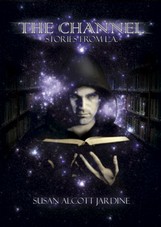
The Channel: Stories From L.A. is a fiction collection set against the tapestry of Los Angeles. Ten Tales for Troubled Times ranging from the 1950s to the not-too-distant future. The diverse characters, age, occupations and background share a common thread. Dealing with loss and life's challenges, how well they cope is for the reader to determine. A hint of the metaphysical touches each of these ten stories. It asks the reader to question their own choices, life paths and inner worlds.
Are we in control of our lives, or merely at the mercy of fate?
In The Channel collection, Los Angeles becomes the tapestry against which ten stories unravel. They take place from the early 1950s to the not-too-distant future.
Each of the protagonists experiences life altering dilemmas. Some are unprepared for their reversals. Others are not. How well they cope is for you to determine.
Excerpt
A look inside ... from
The Solution
"The fires had taken everything. The sky was ablaze with red and orange embers being whipped up by the powerful Santa Anas that were moving north from Los Angeles. Blue vapor rose from the charred pines silhouetted against the grey horizon. Wildlife had long fled the inferno. Creek beds were full of ash and dead fish, their eyes boiled white in a permanent glaze."
Professional Reviews
This is a beautiful collection of short stories, Jan. 1, 2010. By Robert G. Yokoyama, Mililani, Hawaii-
Susan Alcott Jardine is a talented writer. The Channel is a moving collection of short stories set in Los Angeles. I love the quotes that preface each story. There is a quote by Francis Bacon in this book about how a man's fortune is in his own hands. There is another good quote by Jeremy Taylor about how friendship is the greatest gift a person can give. These two quotes are very deep and insightful.
Jardine is an author who understands that loss is part of life. The element of loss is a common thread in her short stories. My favorite story is "Run For The Money." This is a story about how two people from different walks of life make a connection through art. "Hello, You've Reached Amy Byington" is a story that resonates with me, because I know how frustrating it can be looking for work. "Do You Know Marcus Hanley" is a heart wrenching story about working in the entertainment business. It is also about the relationship between two brothers who take different paths in life. "The Gift" is a story about two women who are life long friends. This is the kind of story that makes me evaluate the long term relationships in my life. The Channel is the best collection of short stories I have read in a long time.- Robert G. Yokoyama is a "Top 500 Reviewer" for Amazon.com
Switching Channels, Dec. 30, 2009. By Christopher Willard (Canada)
The Channel Stories sit inside a triangle framed on one side by the old Alfred Hitchcock Presents series, on the second side by Isaac Asimov's Science Fiction, and on the third by fiction written for young adults. The first story, Don't Go Into the Killing Place is an effective young adult story for a few reasons. The focus is on a teenager who is transplanted for a summer and who undergoes a life-changing experience. The writing is even with enough repetition so teenaged readers can get it. It's the early 1950's, the girl's brother heads to the Korean War and the girl is sent to a chicken farm where her mother tells her not to go into the killing place. Remember the story's title, now consider the plot opening and guess the ending. Adults know immediately that the brother will die and the girl will go into the killing place, but young adult readers, given their need for literal clarity, will probably relish the many indications of the impending finale. The book's cover depicts a young man in a hoodie amidst cosmic dust which should attract that readership. Alternatively, other stories appear somewhat geared to the adult reader. "Hello, You've
Reached Amy Byington" is such a story, and the funniest work in the book, if you like dry humor. A nutcase prepares to commit suicide (note her name Byington/Dyington). She speaks endlessly about loose ends and unfinished business, she calls her dogs boys, she obsesses over a Chinese elm, and she speaks of a business woman named Meryl Jones (consider the combination of Merrill Lynch and Dow Jones) and her company H.R. Morgan (think J.P. Morgan). We know by the first page that Amy will kill herself--the Thomas Carlyle quote "One life; alittle gleam of time between two eternities" certainly helps -- but the author pretends that we don't. She humorously gives clue after clue before finally having Amy sink into her eternal sleep as the BEEPS of the answering machine continue like (a) heart monitor. It's a subtle, over-the-top pastiche. On a broader level, Jardine loves unannounced shifts of time and place. She is also not afraid to start a plot and then apply lots of backstory in which details adorn every moment; if we didn't remember which Bach punctuated one paragraph well get another soon enough. I think Jardine's sense of location and time work best in Don't Go Into the Killing Place. That and The Metamorphosis of Nathaniel Kronstadt are beginning to be the more polished works in the collection. -- Christopher Willard is a reviewer for BookPleasures.
Teresa Konopka's Book Reviews, December 23, 2009
"The Channel: Stories From L.A." by Susan Alcott Jardine is quite a perplexing set of stories. Each takes a few characters and weaves unusual tales around them to make ordinary situations yield pensive questions. The ages, genders, races, occupations, and personalities of the characters are altered as to not bore the reader. Most involv an overall question of fate, as "Are we in control of our lives, or merely at the mercy of fate?" is strewn across the back cover. Some stories are better than others, but the generally follow the same style. This book is good in that it is not graphic in nature (some parts leave it up to the imagination of the reader). However, there is some swearing and violence is used. Christian readers my be offended when a crazy character in one of the stories sends a Bible verse to another character. Metaphysics also comes into play with many philosopical ideas being thrust at the reader and some paranormal science-fiction thrown in. Overall, this book is entertaining and will definitely make readers ponder, especially when they get to understand the true meaning of the title in the last short story. -- Teresa Konopka reviews for Thomas Nelson Book Review Bloggers.
The deep-dive literary meditations presented as stories, poems, and essays in The American Poet Who Went Home Again, A Mosaic of My Soul at Work, have captivated and inspired readers ever since its first paperback publication in 2008.