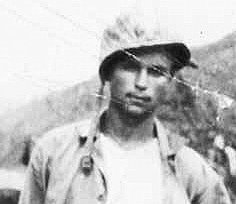
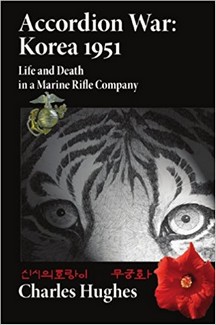
Accordion War is the story of a band of brothers and the battles they fought half way round the world in the rugged mountains of a country known as "The Land of the Morning Calm."
At a time when North Korea has dramatically burst into the news once more as a belligerent nuclear power, Charles Hughes has published a historical memoir of his experiences as a hospital corpsman in a Marine rifle company during the Korean War.Accordion War: Korea 1951-Life and Death in a Marine Rifle Company is a detailed personal account of combat in the Korean War during its most violent “blitzkrieg” phase, the first third of the three-year war.While the descriptions of battles are up close and graphic, the conflict is also viewed from the perspective of the 21st century, from a keen awareness of the wars since—Vietnam, Afghanistan, Iraq and the war on terror.Interwoven into the narrative is a meditation on life, death and war—on the question of why men spend so much treasure and blood fighting one another.
Hughes’ experiences came six years after those of another corpsman, Jack “Doc” Bradley, whose story was depicted recently in a best-selling book and popular movie, Flags of Our Fathers, whichtell the story of the five Marines and one corpsman who were immortalized in Joe Rosenthal’s iconic photograph of the flag raising on Mount Surabachi during the battle for Iwo Jima.
The men who fought in Korea, however, were never the focus of such attention. Having served their country between World War II and Vietnam, many Korean veterans felt they were largely invisible to their
countrymen.But, as the distinguished historian, Clay Blair in his excellent book, The Forgotten War, has noted, the Korean War “was a traumatic and momentous chapter in American history.” He says, “The first year of combat was brutal and bloody, often surpassing the toughest battles of any war in American history.” That seesaw phase of the conflict, a war of lightning advances and rapid retreats, is what Hughes calls “The AccordionWar.” He hopes with this book that the sacrifices of his close comrades of H Company, 3rd Battalion, 7th Regiment, 1st Marine Division, both living and dead, will be a little less forgotten, and beyond that, that Americans will remember the terrible price always paid when young people are sent off to war.
Excerpt
We stayed with the tanks on the road for a while, and then turned east, away from the hill where Smitty and I had heard the Chinese mortars dropping into the tubes, crossed a creek and moved out onto open rice paddies. To our right was a group of houses and ahead of us, across the rice paddies on the east of the valley was a high range of wooded hills or low mountains that formed the other boundary of the valley we were in. As we moved across the rice paddies toward those hills we came under heavy mortar and machinegun fire. The tanks had moved out into the fields on either side of us and were now firing into the mountain ahead of us. The muzzle blasts from their cannons shook the ground and bounced blankets of dirt from the dry paddies each time they fired. All of us in the 2nd Platoon did what we always did in such circumstances—we looked for cover.
I jumped in a wide, shallow ditch with a number of other Marines and we continued moving up the ditch in a crouch toward the mountain. Mortars were whistling in and exploding all around and the sounds of small arms and machinegun fire from the mountain mixed with the returned fire from our tanks engulfed us all. We had progressed some way down the ditch when I got that dreaded call.
“Hey, Doc, they need you!
“Where?”
And then the Marine, raising his hand up above the rim of the ditch and pointing, yelled,
“Out there!”
“Oh God!”
I climbed out of the ditch and began to sprint in the direction he had pointed. I ran by a tank out in the rice paddy firing its 50 caliber machine guns into the mountain and passed some Marines hunkered down behind hummocks and berms. One of them seeing me coming pointed toward a rice paddy dike. As I ran in that direction I saw a Marine lying face down. I ran up to him, bent down beside him and grabbed his shoulder and pulled him over. When I did his intestines slid out on the ground and lay there beside him. He had taken cover behind the low dike but it had not protected him from the mortar shell that landed right beside him.
I double-timed it back to the ditch, jumped in and rejoined the column of Marines moving toward the mountain. After a short while our progress stopped.
Someone behind yelled, “What’s the holdup up there? Get it moving!”
Then a Marine up ahead said, “This guy won’t move! We can’t get by him!”
I could see about three guys ahead of me a man down on the ground curled up in a fetal position apparently sobbing.
“Kick him in the ass!” the voice behind me yelled.
And then the Marine behind the sobbing man kicked him in the ass.
”He still won’t move!”
“Then climb over him!”
That’s what we did. We all climbed over him and continued to move toward the mountain.
In Korea we learned some things about assaulting mountains. The times you are most vulnerable are when you are approaching the mountain and when you get near the top. As you are approaching the mountain, as we were crossing the open rice paddies, the enemy in the high ground can see you coming and will throw everything they have at you. Once you reach the base of the mountain you are in the cover of the trees and out of their line of fire and vision. Then you can begin to move up to seek them out and they can’t see you coming. But when you arrive they will see you again, and all hell will break lose.
The mortars hitting us were coming from high on the ridgeline ahead of us. About this time an FO in an OY plane spotted the Chinese mortar crews and called in artillery and quickly knocked them out. When Captain Hoey got the word the mortars had been hit, he radioed Lt. Barnes to move out. As we moved forward and passed by the deserted houses we could see our objective ahead.
We were approaching the base of the mountain now and could see two Marines of our platoon leading the way. Somehow they had gotten far ahead of us and were determined to take out the Chinese on top of that hill. Our 3rd Squad leader, Corporal Lawrence Nolan and a BAR man were scratching their way up the slope. But just at this time Lt. Barnes got another radio message from Captain Hoey who had been observing the action from a hillock behind us. The Skipper told Barnes to abort the attack and return to our former positions. We began to yell at our two gung-ho Marines to stop and come back to us, but they seemed reluctant. After repeated calls we finally got them to come down off the mountain and rejoin us. I don’t know how the others felt, but I certainly was not disappointed to have the attack called off.
I learned later that the tanks picked up the Marine who had broken down in the ditch and the one who had been killed by the mortar round. I didn’t recognize the dead Marine at the time and only learned many years later that he was Corporal Donald Robert Gross, twenty-one years old.
Professional Reviews
Leatherneck Magazine of the Marines
When a Marine comes under fire, there is no more valuable member than the Navy corpsman attached to it. Knowing that the Doc is around to quickly treat the wounded is a source of comfort and morale. However, Marine infantrymen are not quick to bestow the sobriquet Doc on every corpsman. It s a nickname that is earned under fire and when bestowed it is a sign of acceptance and an announcement to all that their corpsman is a good one.
Charles Doc Hughes, the author of Accordion War: Korea 1951, Life and Death in a Marine Rifle Company, was serving as a hospital corpsman at Mare Island, Calif. at about the same time the first Marine Division was ending its epic march to the sea from the Chosin Reservoir in Korea. Hughes, who enlisted in the Navy at 17, regretted having been too young for combat in World War II. Determined not to miss the action in Korea, he volunteered for duty in the Fleet Marine Force. In short order he found himself with a Marine rifle company and his taste for combat was quickly satisfied.
His baptism of fire came shortly after joining How Company, 3rd Battalion, Seventh Marine Regiment. As a corpsman he was assigned to 1st Platoon. Later he sat on a rim of a high hill and watched enemy troops move across a rice paddy below his unit. When others of his platoon began firing at the enemy, Hughes fired his one and only shot of the war. He missed, but his attempt to take a human life bothered him and after that he left the shooting to others and concentrated on tending to the wounded.
Marines who have seen combat and who have witnessed the often heroic efforts of corpsmen treating and protecting the wounded seemingly without regard for their own safety, will be interested to read that Hughes had a mantra he repeated to himself as he moved through fire: Oh God, Please don t let me die. He writes. Purely selfish nothing heroic in that. I was terrified.
Hughes, who is professor emeritus of English at Henderson State University in Arkadelphia, Ark., is a gifted writer. While the thread woven through the pages of his book is connected to his time with a Marine rifle company, he also spins a separate yarn of his life after military service and his philosophy on war in general. What is apparent is how much value Hughes has placed on his time with the Marines. His letters home, written in 1951, make clear that he considered himself a Marine. Years later, the connection he felt to the Marines would lead him to contact many of his former platoon mates, and to write this book.
This book is hard to put down. The writing is terrific, and Hughes tells his story with sprinkles of history, poetry, philosophy and his take on what it all meant. The experiences he writes about took place more than 50 years ago in a war that has for the most part been relegated to the back burner of history.
Korea was a harsh war. Many who fought there, however, came back to lead long and fruitful lives, because Hughes and other corpsmen like him were on the battlefield with them. Well done, Doc.
GySgt John Boring, USMC (Ret) --Leatherneck: Magazine of the Marines, September 2007
Military Writers Society of America
There is nobody more important when a Marine comes under fire than their Doc. Navy corpsmen live, work, fight, and die with their Marines, and build a relationship with their Devil Dogs that is as deep as that between the Marines themselves.
Author Charles Hughes was a corpsman in Korea with How Company, 3rd Battalion, 7th Marines. Too young for WW2, Hughes joined the Navy and volunteered to join to Fleet Marines in order to see some action. His wish was granted, and this exceptionally well-written book is his memoir of his time in Korea.
Professor emeritus of English at Henderson State University, Arkadelphia, Ark., Hughes is a gifted writer who spent considerable time and effort recalling his experiences and thoughts from some 56 years ago. In comparison to those macho stories of many veterans, Hughes recalls his private mantra when in battle Oh God; please don't let me die. In between his stories of combat with his Marines of H Company, Hughes has skillfully added his philosophy on war and killing and his life after his military service.
This is one of the rare books that begs to be read in one reading. Hughes s stories of combat and life in Koreaare lively; the reader can smell both the gunpowder and the kimchi. Korea may be a war unknown to the current generation, but books like Accordion War: Korea 1951 will give the reader an appreciation of what young men like Charles Hughes and his Marines endured. Well done, Doc. --Military Writers Society of America
Korean War Project
This is a gripping work and a must reading. The present-day overview/perspective ties the decades together and makes sense of the cost of war as well as the whys of warfare. --Korean War Project Newsletter
A Viconian Cycle/ Babylonian Captivity Memory Silence Re-Founding of Southern history out of Dublin GA and the KBPS7 Trial. In psychology this is a Wounded Pride case.
A work in American history and existentialism Which is an Invitation to connect and create the dots in your life to other revolutions like the Cuban Revolution.