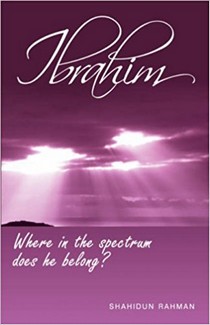
It tells the story of my son who grew up with Semantic Pragmatic Language Disorder (SPLD), an autistic disorder.Ibrahim is included on the National Autistic Society’s list of publications.
This is an autobiographical account of a mother's struggle to bring up a child with a learning disorder. It tells the story of Ibrahim Rahman and his struggle with Semantic Pragmatic Language Disorder, (a speech and language disorder) part of the autistic spectrum disorder. It highlights the lack of awareness of this condition within our society, but particularly within the Asian community where autism is not widely recognised.
As we follow Ibrahim's journey, from birth to his early teenage years, we observe how his struggle to overcome his severe language difficulties have impacted on so many other aspects of his development. Narrated by Ibrahim's mother, ultimately this is an inspiring tale which provides hope and encouragement for those undergoing similar circumstances.
Excerpt
Many people hear the term ‘autistic’ and have some vague idea
what it means. Autism is a life-long development disability and
effects people in different ways. Autism is a spectrum disorder
which means the condition has wide-ranging degrees of severity.
You can have a child at one end of the spectrum with barely noticeable
traits, whilst another at the other end of the spectrum has full
blown autism.
One condition which comes within this spectrum is semantic
pragmatic language disorder, a term which has been around for
nearly 20 years and was only used to describe children who were
not autistic. This was the diagnosis given to my son, Ibrahim, and
this book will follow his progress from birth to his teenage years.
Before we commence, it would be useful to look at the common
features of SPLD which include:
• delayed language development
• learning to talk by memorising phrases, instead of putting
words together freely
• repeating phrases out of context, especially snippets remembered
from television programmes
• muddling up ‘I’ and ‘you’
• problems with understanding questions, particularly questions
involving ‘how’ and ‘why’
• difficulty following conversations
Children with this disorder have difficulty understanding what
other people say to them, and they do not understand how to use
speech to make themselves understood. Most of the children
v
diagnosed as having semantic pragmatic disorder also have some
mild autistic features. For example, they usually have difficulty
understanding social situations and may not know what is expected
of them. They may also prefer to stick fairly rigidly to routines and
often need to have their day planned out for them. They also lack
imaginative play and will tend to copy other people rather than
think of their own ideas. This is the pattern followed by Ibrahim
from about the age of two.
If we break the condition down into its two components,
‘Semantics’ and ‘Pragmatics’ we will have a better understanding
of what the condition involves and why it develops.
Semantics is the aspect of language function that relates to
understanding the meanings of words, phrases and sentences, and
using words appropriately when we speak. Children with semantic
difficulties have a very hard time understanding the meaning of
words and sentences. They may have difficulty processing words
that relate to feelings and emotions such as ‘upset’ and ‘worried’,
abstract words like ‘justice’ or ‘valour’, and words that refer to
status, for instance ‘essential’, ‘expert’ or ‘authority’. They often
take slang expressions literally or interpret them oddly and they are
unable to understand the concept of sarcasm. They may not be able
to identify the key point or topic in a sentence and because of this
may suddenly make obscure changes to the subject being
discussed, apparently thinking they are on the same subject.
Pragmatics is the area of language function that embraces the
use of language in social contexts – knowing what to say, how to say
it, and when to say it. Children with pragmatic difficulties have
great difficulty using language socially. For example, they often do
not understand that we take turns to talk, and they will talk over the
top of another person, constantly interrupting at inappropriate
times. On other occasions, they respond to what you say with inexplicable
silences, or in a voice that is too quiet. When they interrupt,
which they do excessively, it is usually to talk irrelevantly or to
discuss things which the listener shows no interest in so that they
appear rude and inconsiderate. They may look around them during
vi
IBRAHIM
a conversation, giving the impression of complete disinterest in
what is being discussed.
Children with SPLD have a language disorder that affects both
semantic processing and the pragmatics of language use. Some
authorities see SPLD as part of the autism spectrum of disorders
while others see it purely as a language disorder. It is difficult to
make an individual diagnosis because the symptoms vary
immensely. Although the mistakes with words and phrases that
you are about to encounter with Ibrahim can appear quite amusing,
they can be extremely embarrassing and upsetting to the child. It is
therefore important that family, peers, teachers and other adults
apply great sensitivity in guiding the young person with SPLD.
Professional Reviews
BME communities National Autistic Society
‘Parents and carers of children with autism will identify with
Shahidun and her difficulties with her family, wider society and the
Bangladeshi community… making this book a fascinating read.’
Saleem Akhtar
Development officer
BME communities National Autistic Society
Sexuality is very misunderstood.What if the tornado dropped Dorothy not into Oz, but onto the shooting set of an X-rated film?
Eric Edwards makes sex films. Period... Sex-on-command. Sex-for-hire.... So begins the story of Eric Edwards, Mr.
This book has been eight years in the making. It is mostly a jumble of thoughts written down in old spiral notebooks and hidden in the bottom drawer underneath various manuals for software packages and hardware long since turned obsolete.
Destiny's Daughter by Frances Altman highlights events in the life of Mary Edwards Walker, maverick suffragist, Civil War doctor and only woman Medal of Honor recipient.