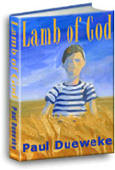
Guilt, murder, and Old Testament zeal seize three children during the turbulent days of World War II Detroit
This World War II suspense drama explores how Michael Tether, age 12, copes with the guilt of being too weak to save his twin from murder by one of his parents. What's worse—he sees him-self as not just a witness, but as an instrument of the murderer. He remains deeply traumatized by that death and the loss of his sister long into adult-hood. Those losses shape Michael's life as he searches for redemption and for-giveness.
Michael’s mother designated him to be the “general in her struggle against Satan.” He failed her, but her favoritism of Michael isolates him from his brother and sister. In spite of that isolation, he reveals his love for his siblings as he describes their last, wonderful summer together.
Lamb of God spans a half century from The Depression to Michael's res-cue on a Michigan farm after World War II, then finally to the dawn of heal-ing of this ill-fated family. Dueweke illustrates the racial tension and vigor of a city reaching its finest hour as “The Arsenal of Democracy.” He blends Michael's war and the great war around him into a seamless struggle to survive.
Excerpt
PROLOGUE
My mother designated me the general in her struggle against Satan, a war she inherited from her mother. She trained me and prayed for me to someday lead men in this holy cause. I failed her.
My brother, Joe, was Strength. He wasn't the chosen twin, but he was the real soldier—and playing my role for me cost him his life. Our little sister, Susie, was Innocence, the glue that held our young trio together. Mother and father played their roles exceptionally well. My father was Treachery, a crusher of bones and wills. Mother was Comfort, the confidante. Her treachery exceeded even my father's, but subtlety wove through it, softened it. Then there was Grandpa, my wonderful grandfather. He was Love. But he had neither the strength nor the resolve to save us from our parents.
I alone had no real role—except Survivor. First, Innocence was borne away in conspiracy, destroying our vital trio. Then Strength was crushed by the fears of a father and the weakness of a twin. But weakness bends and survives long after strength has broken.
* * *
One by one, glass panels of the elevator flashed by and disappeared beneath me. As I rose in Detroit's tallest skyscraper, I watched the city transform from urban decay at the ground level to a vast world of twinkling lights that seemed to merge with the real stars above. My eyes swept a cityscape they hadn't seen for half a century as it slowly mellowed below me.
When I happened upon my own reflection, I halted. Had I never looked into a mirror before? How then could I have overlooked the resemblance? My grandfather stared back at me. My eyes, imprisoned by a lifetime of despair, showed glimmers of Grandpa's playfulness. A life of washing windows had seasoned his face and weathered his lips that now whispered to me. I felt his stubble beard that once had scratched my tender face, his "tangle finger," and the bronzed neck we gripped like a life ring.
My thoughts leapt back fifty years. We were here in Detroit in 1943, in an elevator—Grandpa, Susie, Joe, and I. It was Grandpa's elevator ride. As another glass panel flashed by, I heard him say, "I wouldn't have no cause to go in an elevator. They don't have windows, right?" The corners of my mouth briefly turned up to meet his.
Then I looked at my hands. They showed the burden of age, but not the furrows and canyons that Grandpa's always had. But the veins—they flowed together between the first and second knuckle just like on his hands. I remembered tracing those veins with my young fingers as we listened to his stories. He sometimes told us about pilots, although he'd never flown and had probably never been closer to an airplane than when they flew over as he washed windows all over the city. His hero was Colonel Lindbergh, and we knew the story of that Atlantic crossing long before we could recite the alphabet.
Grandpa believed flying was the most magical thing a person could do. If he'd lived to see astronauts, they would have been angels to him, not bound by the physics of men and ladders. He spent much of his life either on a ladder or driving his wagon behind Pal, whose reins draped over his palms as a world of motors challenged them. Daydreams probably filled his mind as he washed away a mighty city's grime. He would tell us about his days and his dreams when we converged on him, submerging him with questions and begging for stories.
* * *
Grandpa and I were a maze of opposites. His simplicity, maybe aided by fantasies, bore him above a defective world where he could not be overwhelmed by it. He daily climbed his ladder and washed life's windows with easy strokes. He did it naturally, and he did it well.
I tried to climb the ladder my mother erected for me to fulfill some failed mission she had inherited from her mother, Grandpa's bride. But I never made it past the first rung in spite of all the coaxing from my mother, the Old Testament zealot. Why did Grandpa never warn me about that? Did he even recognize the damaging force of her crusade, a force that would ultimately destroy his grandchildren? How could he not? And yet he was so naive.
The essential thing I inherited from my grandfather was the one thing that prevented me from saving my strong twin and my innocent sister. It was his weakness. My misfortune has been that I inherited his weakness, but never acquired his ability to love.
Had I loved Joe, I could have found some way to save him when his strength was spent. Had I loved my mother, I could have forgiven her for loving me more than Joe—or for hating me less. Had I loved Susie, I would not have befriended her greatest enemies, her parents. I was blessed with intelligence, but lacked the dedication supplied by love.
In the end, you'll return to Detroit with me to help me finally conquer that weakness, a frailty that held me in chains for so long. It might seem like a small victory for most men. But if only I'd been lucky enough to face the trials of most men.
My story abounds with the adventures of kids growing up in the world's mightiest city, a city at war with half the world. But there was another war, not fought with B-29s and Sherman tanks, but with the lives of children held hostage. You'll face the rage of a father frustrated by a lifetime of failure. You'll suffer the sweet kisses and toxic lessons of a mother trying to fulfill Old Testament prophecies. But there were others crucial to those early years, others who tried to teach me love after that lonely escape from my war in Detroit. And you will know Grandpa as I knew him.
My story is sometimes funny, sometimes sad—but always as I remember it. I can promise no more than that.
Book I of Southern Swallow Series – 12th Century scholar Li K'ai-men takes command of his first official assignments during a time of political unrest and barbarian invasions.
Encountering danger, romance, heartache and tragedy, Catherine Merit strives to fit into a world filled with prejudice, hatred and violence where she is forced to kill a man in order to save herself. Third book of the Indignities Series.