Category: History Publisher: SUNY Press
ISBN-10: 1438431791
Type: Non-Fiction
Pages: 192
Copyright: July 2010
ISBN-13: 9781438431796
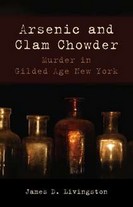
Arsenic and Clam Chowder recounts the sensational 1896 murder trial of Mary Alice Livingston, who was accused of murdering her mother with a pail of arsenic-laced clam chowder.
Arsenic and Clam Chowder recounts the sensational 1896 murder trial of Mary Alice Livingston, who was accused of murdering her mother with a pail of arsenic-laced clam chowder. The chowder had been delivered to the victim by her ten-year-old granddaughter, and Mary Alice was arrested in her mourning clothes immediately after attending her mother's burial. In addition to being the mother of four out-of-wedlock children, the last born in prison as she awaited trial, Mary Alice faced the possibility of being the first woman executed in New York's new-fangled electric chair. All these lurid details made her arrest and trial the central focus of an all-out circulation war between Joseph Pulitzer's World and William Randolph Hearst's Journal.
This ripping good story is set against the electric backdrop of Gilded Age Manhattan. The arrival of skyscrapers, automobiles, motion pictures, and other modern marvels in the 1890s was transforming urban life with breathtaking speed, just as the battles of reformers against vice, police corruption, and Tammany Hall were transforming the city's political life. The aspiring politician Teddy Roosevelt, the prolific inventor Thomas Edison, and the anti-vice crusader Anthony Comstock were among Gotham's larger-than-life personalities, and they all played cameo roles in the dramatic story of Mary Alice and her arsenic-laced clam chowder.
Excerpt
Matricide is a particularly heinous crime, and the arrest of Mary Alice in mourning clothes immediately after attending her mother’s burial drew special notice from the press. That the allegedly poisonous chowder was delivered to the victim by her ten-year-old granddaughter added extra interest; experience had shown that stories involving children always drew considerable attention, particularly among women readers. There was also a substantial inheritance involved, and Mary Alice was a member of the prominent and socially prestigious Livingston family. Money and New York society were reliable attention getters. On top of all this, Mary Alice was the mother of three illegitimate children and pregnant with a fourth. Scandal piled upon scandal. Although this was not the first time that Mary Alice had drawn the attention of the New York newspapers, her 1896 trial for the murder of her mother would dominate the news for many weeks at a time of “yellow journalism” when papers focused even more attention than usual on sensational stories. Hundreds of thousands of readers in New York, and well beyond New York, would become very familiar with the story of Mary Alice, the clam chowder she sent to her mother, and the death of Evelina Bliss.
Professional Reviews
Arsenic and Clam Chowder - by Ann La Farge
Back in 1895, as the Labor Day weekend approached, there occurred - or did there? - a case of matricide involving a member of the Livingston family in upstate New York. Mary Alice Livingston was arrested and accused of murdering her mother. Would she become the first woman to be executed in New York's newfangled electric chair?
The story is told, in lurid and fascinating detail, in James D. Livingston's Arsenic and Clam Chowder: Murder in Gilded Age New York (SUNY Press, $19.95). Mary Alice was living in New York City, pregnant, unmarried with several children - and she was broke. An inheritance would come her way - but not as long as her mother was alive. One day, she sent her daughter and a young friend to visit her mother and bring her a bowl of clam chowder. Grandma ate the chowder...and died. There was arsenic in it, as you may have guessed.
This was the age of "yellow journalism" and New York's two most famous newspapers - Joseph Pulitzer's New York World and William Randolph Hearst's Journal - competed for the juiciest details during the circus that was the trial, while Mary Alice (and soon, her newborn baby) languished in the Tombs. Jury selection took forever, the trial lasted seven weeks, pushing off the front pages such events as the nomination of McKinley, the crowning of Czar Nicholas II, and the performances of Lillian Russell and Sarah Bernhardt.
The author - Mary Alice's first cousin three times removed - tells this story laced with details of the social and political events of the period, and the controversies over capital punishment, the rights of women, etc.
Did she do it? If so - or if not - was she convicted? Read this fine book and see. And next time you think about eating clam chowder...ah, but that's another story.
Neil Armstrong played the Dissolution of America Card After His Return From Space-- the Military Dishonor Card. He had a very messy DIVORCE after a military Platoon Experience for his wife and family.
Neil Armstrong played the Dissolution of America Card After His Return From Space-- the Military Dishonor Card. He had a very messy DIVORCE after a military Platoon Experience for his wife and family.