Category: Literary Fiction Publisher: No Frills Buffalo
ISBN-10: 0578047119
Type: Fiction
Pages: 216
Copyright: Jan 20, 2010
ISBN-13: 9780578047119
“Evocative and compelling.” - Trident Media Group
“This book will lure the reader in…” -Michele Tater, Review the Book
“Truly unique and intriguing book…” - April Sullivan, Reader Views
“Mesmerizing, unforgettable and totally unique…” -Bettie Corbin Tucker, IP Book Reviews
“Unique and very highly recommended…” -Micah Andrews, Mid-West Book Review
“Fast paced…Truly thought-provoking.” - Kam Aures, Rebecca’s Reads
5 Stars From Barnes and Noble
5 Stars From Amazon.com
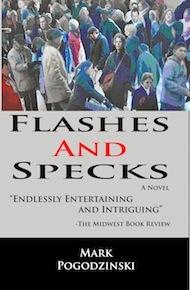
Math, Madness and The End of the World.
This is the story of Henry Kent, father, husband, teacher, and would be superhero.Henry’s son is building a city out of milk cartons in the basement.Henry’s wife has returned with a message from The Pastor, God is angry.Henry’s friend knows the date of the end of the world.Henry’s students are being tortured, but only the bullies.And then there’s Henry, trying to hold it all together in the face of madness, torture and the end of the world.
Original in style and fast paced, Flashes and Specks dares to ask the tough questions: Is there a God?What is reality?What makes a superhero, super?What’s the key to happiness? And finally, what’s the point of it all?
Excerpt
Affection will not be gainsay’d, the sense of what
is real, the thought if after all it should prove
unreal,
The doubts of day-time and the doubts of night-time,
the curious whether and how,
Whether that which appears so is so, or is it all flashes
and specks?
Men and women crowding fast in the streets, if they are
not
flashes and specks what are they?
- Walt Whitman
Episode 1: The Conqueror
Blood trickles from his mouth.
It all comes down to this, as it should, the hero and the
villain. All other things are meaningless, trifles set against the
grand notion of good versus evil. You see that now, don’t you?
You see it for what it is, for the beauty of it and the simplicity.
This is all there is, this is all that matters. The small things are
inconsequential, because each decision, each choice is at its core
this truth: you’re either a hero or you’re a villain. I can see that you
understand. I also learned it at a young age. That’s the great thing
about the hero and the villain, sometimes they’re not that different.
Knuckles are sore suddenly, must’ve hit his chin. There’s
blood trickling from his mouth again. It seems so bright even in the
darkness.
<<<>>>
It all started at the funeral breakfast. He was aware of it in
the corner of the restaurant among the whispers and the clinking of
coffee cups. He knew that he was fated to do something to help the
world, combat evil, right wrongs, a childhood dream that never left
his mind. It never died as so many of childhood’s visions do. It
clawed and scraped to remain alive, convinced of its own truth and
justice.
Henry’s cousin had killed himself. His family called it a
tragedy and for the best in the end. Carter was different, but Henry
liked him because he was honest when he was alive. Carter was the
wild one, the artist without art. To Henry he was humorous,
making fun of the adults, talking back, swearing at them. He told
people what he thought, what he believed, the plain facts of life,
the right and wrong of the world.
Henry was only thirteen when Carter slit his wrists and
walked about his house, dripping blood on the carpet. His mother
found him in his bed, his body white and pale in the evening
gloom. Henry thinks of the scene from time to time, the horror of
it. The image haunted him for months as a child, and even after his
own son was born. It creeps in now and then, and is still horrible.
Henry knew Carter had attempted suicide once before. Carter had told him the story and was even proud of the scars, the white marks along his arms. He told Henry that when he first saw
the blood he was terrified. Henry was sure that he wouldn’t try again. It wasn’t good to kill yourself. They talked about it, Carter confiding in his younger cousin, explaining the pain and the reasons why, the daily anguishes of his life. The cousins talked over comic books, both collecting and sorting after weekly trips to the local store. Carter often related his experiences to the
characters in the colorful pages. Henry was happy to know that his cousin had decided to live.
And then he was gone. Henry tried to put the pieces together and solve the mystery of the sudden change. He was
immensely and profoundly sad.
The funeral breakfast seemed to drag on, time slowing down for the family to gossip and mourn. Henry had just finished a piece of toast when it happened. He wasn’t hungry, but his mother told him the food was paid for and he should eat, so he did. His
mother was sitting next to him, speaking with a distant relation
who also sat at their table. Carter was the subject of the conversation.
“He was too emotional,” Aunt Barbara stated.
“Well, I’m not sure it was that,” Henry’s mom responded.
“Oh, it was. His parents should’ve watched him,” Aunt
Barbara continued.
“I think they did the best they could,” answered Henry’s
mom frankly.
“I told his mother he was dangerous,” Aunt Barbara said
pointing her fork at Henry’s mother.
“No mother wants to believe that about her child,” Henry’s
mom said.
“I told her,” said Aunt Barbara as she shook her head.
“In the end he only hurt himself,” said Henry’s mom.
“He should have thought of his poor mother,” answered
Aunt Barbara while eating a fork full of salad.
“I think he was concerned about his own pain,” Henry’s
mom responded and sipped her coffee.
“Children don’t know anything about real pain,” said Aunt Barbara again pointing her fork, this time at Henry.
“Hmm.”
Henry watched Aunt Barbara eat undercooked roast beef, boiled potatoes, and other half-prepared foods without pause. She seemed to be in constant motion, but not moving at all. The base of her, the center remained a part of the chair, connected forever. She nodded once at him, acknowledged he had been born and continued eating.
“Even this brunch seems wrong,” observed Aunt Barbara and she waved her fork to the room as bits of potato fell to the floor.
“Hmm.”
“Suicide is a sin. We shouldn’t be celebrating Carter,” Aunt Barbara explained.
“I think it’s more for the family than for him,” Henry’s mom said.
“Still. All this seems too much for him,” continued Aunt Barbara as she chewed and chewed.
“Too much to remember his life?” asked Henry’s mom, looking at Aunt Barbara for the first time.
“To hear everyone talk, you’d think he was special,” sneered Aunt Barbara.
“He was.”
“Oh yes, I know he was special. I didn’t mean to imply that he wasn’t special. But what he did, makes this seem too grandiose for him,” choked Aunt Barbara, as shades of embarrassment crept into her cheeks.
“You know,” Henry’s mom said through clenched teeth, as if she was almost ready. “I think I’ll get some more coffee.”
“Fine. I’ll watch your boy,” said Aunt Barbara and she smiled at Henry.
Henry remembered the times when he was told to watch Carter. It was his role at large family functions, picnics, weddings and funerals to occupy Carter and keep him out of trouble. Henry
always brought his comic books and that seemed to calm his cousin, made it okay to be still in a swirling world.
Aunt Barbara continued to talk and to feed.
Henry knew his mother was waiting for Aunt Barbara to leave so she could return. It was her nature, evident to a child that she would rather retreat or run than stand. It was her way and
eventually she would come back as if nothing happened.
Henry gazed around the room, noting the small clusters of people huddled in whispered conversations. They seemed to lean into each other, almost touching, but afraid to make contact, afraid
the other person might be real. They spoke of Carter in the abstract, in the ethereal afterlife, Carter the ghost. The real person, the wild happy sad person ceased to be real, to be anything. He lived solely as conversation, stories and lessons, a dark tale to be told once a year at holiday time. Rumors would grow out of Carter, he would produce more in death than he had in life.
Cluster 1: He was depressed.
Cluster 2: He was on medication.
Cluster 3: Maybe he was gay.
Cluster 2: They should sue.
Cluster 3: Maybe he was in love.
Cluster 1: All teenagers are depressed.
Cluster 3: I think it was a girl.
Cluster 1: I heard there was a note.
Cluster 2: It was a girl. It’s always a girl.
Cluster 1: A note?
Cluster 3: Remember when he…
Cluster 2: Remember when…
Cluster 1: Remember…
Henry continued to scan the room, watching and marking. In his mind he saw the scene simply: a culmination of fear and doubt, a gray area that was all too common. Carter would have
hated being there. Aunt Barbara spoke again, wiping salad dressing
from her mouth. She was talking about the popular story that Carter had killed himself because of an argument with his girlfriend on the bus ride home. Then Henry saw him.
“She wasn’t my girlfriend,” Carter said. He was standing
behind Aunt Barbara.
Henry watched his cousin, not surprised by his presence.
“It was a mistake, really. But I think it was for the best. I
might even come back from the dead. The good superheroes never
really die.”
“She’s been talking about you,” Henry told Carter. “She won’t shut up.”
Aunt Barbara ignored Henry, preoccupied with a roll.
“Yeah, I guess I’m the center of attention now. I think
they’ll forget me in time. At least most of them will.”
“I won’t,” Henry said.
“I know. But she will. She’ll forget me until I’m brought up
in conversation. I’ve never even talked to the whale. Remember I used to make fun of her. Fat bitch.”
“Yeah.”
“I should do something, so she will remember me.”
Aunt Barbara put the buttered roll in her mouth. Then she started to cough. Henry watched her with interest. She quietly tried to cough with more force, attempting not to draw attention to
herself. She looked about the room as signs of panic filled her eyes. Her hand spread on the table, growing faintly pale. She tapped her chest with her other hand, pressing with more force as seconds passed. Her eyes grew wider as she realized certain
aspects of life and that it might end quickly. Henry observed her, noted each change as she moved from fear to terror to desperation. Her face turned to a deep red, her eyes widened and her nostrils flared. Carter stood motionless behind her. She started to beat her hands on the table. Cups and silverware jumped into the air.
The clusters of people grew louder to compensate for the distraction. Henry noted them too. No heroes in the groups, no one rushing to the rescue of an overweight woman. Carter did not
smile, did not laugh, but watched with Henry, taking it all in, the epic final moments of a life. Aunt Barbara began to pound her chest in an attempt to heave the roll from her throat, her lungs starved for air. Henry tried to appreciate the fact that the woman
might die, that he was witnessing her last seconds before the end.
He looked at Carter.
“In the comics death is full of color and sound. It’s always a cliffhanger, gotta buy the next issue to see what happens. But like I said, the really good heroes never die.”
Aunt Barbara could not speak, only gag and convulse. She continued to beat the table and her chest. Henry watched with Carter, waiting for someone to help. Henry made the conscious decision not to attempt a rescue.
“Good idea. All great heroes have a gray past. ou can use this instance as motivation for future deeds.”
Henry considered his cousin’s advice as he watched Aunt Barbara struggle, desperate to live another year, minute, second.
“She’s choking!”
Carter and Henry turned to find silence in the room. All eyes were drawn to Aunt Barbara in her battle for survival. She staggered to her feet, jumped once and collapsed to the floor.
No one moved instantly. It was as if time stopped and everything froze confronted by the closeness of death. The world paused for a moment of grand reflection.
Then movement and there were suddenly people about her,
pulling her to her feet. She coughed as her arms dangled. Her eyes
were open, sad though, as if she had seen enough. A hero emerged from amongst the mourners. A large man
stepped behind Aunt Barbara and forced the roll from her. She
expelled the morsel to the room and fell forward. It was a simpleact, common. This man, larger than life, was congratulated
heartily. Henry took it all in.
Carter disappeared into the crowd. Henry would see him again.
Sometimes they would talk and sometimes not. As for Aunt Barbara, she died a month later. She fell off a ladder while hanging wallpaper, renovations to celebrate not dying. Her body went
undiscovered for several days.
Professional Reviews
Flashes and Specks
Flashes and Specks
Mark Pogodzinski
No Frills Press
ISBN: 978-0-578-04711-9
229 Pages (Includes front and back matter)
“Flashes and Specks” by Mark Pogodzinski is a mesmerizing, unforgettable, and totally unique novel which is written in thirty-five episodes, each one ending in an unresolved tease. The aforementioned adjectives also describe the characters whose dark sides slowly erode any illusions of sanity in their lives.
I found it a bit unusual that Henry Kent, the main character, is introduced as a young child in the past at a funeral breakfast being held for his young cousin Carter who had committed suicide. The unusual part is that Henry sees and converses with Carter, not only at the breakfast, but several times throughout his life.
Readers are quickly taken to the present where they meet Henry as an adult; he is an eighth-grade math teacher who seems to enjoy his job and shows concern for his students. He appears to be a devoted husband and father; however, his wife was apparently less devoted to him as she had disappeared without explanation. With the mention of medication that is being taken by several of the characters and their eccentric behavior, I found myself on edge, wondering who would take that next step into total madness. The comic book references and names of the characters are interesting, but it is the fast-paced movement of each episode and the definitive style of writing that hooks readers and keeps them asking for more. The author makes every word count and beguiles readers with his dialogue and original situations.
I read this novel all the way through twice. It is philosophical in nature and stirs up thoughts and emotions that made me continue to think about the episodes once outside of the bound pages. Readers will ponder about the fate of school bullies, the next war, and Henry’s son whose grandiose imagination leads him to create a city in his basement. It is made of milk cartons with cut-out photographs of people as its inhabitants. One woman disappears—just like his mother in real life. We do see Mrs. Kent return home with a tale of religion, only to leave again a short time later. Another interesting character is Henry’s long-time friend and mentor who is convinced that he knows when the world is going to end—the exact date—but the formula for determining the date makes no sense. Or, does it?
Other than conversing with the childhood friend of his ghost, I thought Henry was fairly rational, a person who wanted to be a superhero and save the world. However, as the episodes progress so do the questions regarding the teacher’s state of his mind. As far as the other characters—was anyone truly sane? When the light of reality exposes the truth, I found myself thinking about the darkness of insanity as opposed to the darkness of sanity. Which is better?
I highly recommend this book as one that challenges the mind; it is also a fascinating read.
Bettie Corbin Tucker
For Independent Professional Book Reviewers
www.bookreviewers.org
Review The Book: Flashes and Specks
Book Title: Flashes and Specks
Author: Mark Pogodzinski
Publisher: No Frills Press
IBSN: 9780578047119
Reviewed by Michele Tater for Review the Book
“Listen, my friend, there are two races of beings. The masses teeming and happy --common clay, if you like --eating, breeding, working, counting their pennies; people who just live; ordinary people; people you can't imagine dead. And then there are the others --the noble ones, the heroes. The ones you can quite well imagine lying shot, pale and tragic; one minute triumphant with a guard of honor, and the next being marched away between two gendarmes.” ~Jean Anouilh
Just in time for the Christmas holiday season comes a story of comfort and joy, guess again. Even if the book “Flashes and Specks” takes place close to Christmas it is far from being a holiday classic.
“Flashes and Specks” begins at the funeral breakfast for a troubled young man, Carter, who decided to try once more to end the anguish he was suffering. Carter was the cousin of Henry Kent, who is the main character of the book. Let me try and sum up the life as Henry knows it. When Carter was still alive they were comic book buffs. In reading them they found that characters, although you wanted them to stay the same, changed as their writers changed. In the present time he is a 8th grade Math teacher who hopes he is shaping young lives as he teaches his formulas and solutions. Henry’s wife has left him with no word as to why and even if she plans on coming back, he is hopeful she will. He has seen his father go through the same situation and his mother, after a time, returned home. He has a young son, Arthur, who takes random pictures of people and adds them to the “city” he has made out of milk cartons and a vast amount of imagination, in the basement of their home. Playing in the background of Henry’s life are the rumors of nuclear bombs and of World War III, as seen on news reports and heard of the radio. Even his teaching mentor is having delusions of having the exact date of the end of the world by using random numbers in a secret formula he has developed.
This book will lure the reader into the psyche of a man who craves for a hero to fix things and make the villains go away. On the surface Henry seemingly lives a normal ordinary life, but underneath its really full of complex relationships and circumstances that are out of his control. The book is a fast read and I recommend it to adults who want to read a present day story that shows how life can get in the way of real life. But I would not recommend reading it during the holidays!
Reviewed on 11/23/2010 by ReviewTheBook.com Member michele tater
Rebecca's Reads; Flashes and Specks
Flashes and Specks
Mark Pogodzinski
No Frills Press (2010)
ISBN 9780578047119
Reviewed by Kam Aures for Rebecca’s Reads (01/11)
Before I even began reading the actual book I knew that “Flashes and Specks” by Mark Pogodzinski was going to be different. First, the book does not have chapters; it has “episodes.” It has 35 of them to be exact with some of the episodes having Prologues or Epilogues.
Another element that caught my eye was on the page immediately after the cover of the book. On this page, Pogodzinski lists quotes from various reviews that he has received for the novel already. Intermingled among reviews from Amazon are fun quotes from various people in his life. For instance, one reads, “It’s very nice, dear. No, I didn’t read the whole thing. I really prefer mysteries set in Scotland.- Author’s mother.” I really enjoyed the author’s sense of humor and my interest was piqued already after reading this page.
The actual body of the novel is very unique and the characters are quite intriguing. Just to give a little snippet, the opening episode begins when the main character Henry is younger and is at the funeral of his cousin who had committed suicide. One of the aunts is talking about the cousin in a negative light. The cousin appears to Henry standing behind the aunt and proceeds to make her choke on the roll that she was eating. His cousin will continue to appear to him throughout his life. What follows in the rest of the book is just as unusual as the opening episode.
The storyline moves at a fast pace and the subjects and issues that Pogodzinski touches on are truly thought-provoking. The layout of the novel is original making for an interesting read. “Flashes and Specks” is a complex story which is philosophical and entertaining in nature.
Determined to confront the hazy memories of his troubled youth, Oliver Matthews, a retired detective and confirmed bachelor, returns to the picturesque town of Henley-on-Thames for the first time in years.
London: Lashed, Lacerated, Lampooned and Lambasted satirizes 18 popular Jack London novellas with adult content and language and the work is author Jay Dubya's 37th published hardcover/paperback book.
As deafness, illness, and demonic forces close in around him, Ludwig van Beethoven must summon his faith and genius to complete the Missa Solemnis—a sacred masterpiece he believes could bring divine light into a darkening world.