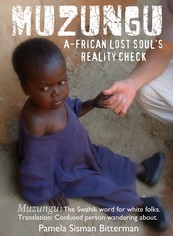
Muzungu, the swahili word for white man, literally translated means "confused person wandering about". This aptly describes the authors own personal experiences while spending months working and living in Kenya. Muzungu is hard-hitting, in the trenches, down and dirty, funny, brutally honest, informed, unique, and first person true.
‘Muzungu: A-Frican Lost Soul’s Reality Check’. Throw away all your preconceived notions about Africa and what you think you know. Pamela Sisman Bitterman’s new e-book is published by eBookit.com and is now available for download. “I traveled to Kenya Africa with an idea of what I might find there only to have that idea completely turned inside out.” Says Bitterman. “One cannot truly know African reality without going there and experiencing it first hand. Sometimes not even then.”
The word “Muzungu” is Swahili for white folk. Translated, it literally means “confused person wandering about.” This aptly describes Bitterman as she audaciously spent months working and wandering throughout Kenya, not willing to avoid the frightening shadowy underbelly of the country. This was a journey, which saw the author’s husband railroaded and sentenced to prison. This was a journey, which ultimately contributed to the suicide of the author’s personal friend and guide. The reader will witness religious elders morphing into villains, political leaders exposed as criminals, and tribal chiefs engaging in forbidden rituals. Bitterman weaves a tale that reveals foreign missionaries at the ends of their ropes, and a country in violent revolt. This is no journey for the feint of heart.
The author’s white skin and declaration that she is a writer become her “free pass” through a succession of previously barred doors, and lands her smack into a living newsreel of Kenya in the flesh. From bizarre meetings with doctors and activists representing then President Bush’s AIDS Relief Project to hospital wards, surgery rooms, orphan clinics, huts, schools, churches and government offices, the reader will discover the real “Aids in Africa”. In fact, the reader may come to realize that few concepts familiar to them can be applied in Kenya. The term "lost in translation" emerges as a gross understatement. Fellow volunteers who find themselves trapped in the foxholes during a horrific national political revolution witness and report from the front lines. Secret tribal rituals are described in graphic detail. Long-established cultural traditions are examined. Western religion's influence is dissected. Foreign intervention is challenged. History is revisited. Kenya is deconstructed.
The author invites the reader to take a shocking and unapologetic dose of Africa. Pamela Sisman Bitterman will be returning to the United States in late March 2011, and will be available for dynamic and compelling interviews about her new book. She will also be touring with a video-to-music presentation of revealing photographs from her unforgettable journey.
Excerpt
Since returning home, reflecting on the time I spent in Kenya has proved to be a frustrating exercise. Throughout my journey I toted my copy of National Geographic, the issue on which the title page flashed, Africa: Whatever you thought, think again. I was hoping that somewhere in this illustrious exposé I would find validation for the conflicting messages I was receiving. To make matters more confounding, from the moment my plane touched down back on U.S. soil I was buried in an avalanche of material insidiously designed to debunk my own eyewitness accounts. As a result I began to question my perceptions, which in turn caused my intention to commit the experience to print to stutter and then stall out completely. I feared that if I wrote an honest appraisal of my adventure I would be vilified. Even worse, I was afraid that what I wrote would have a deleterious effect on the people of Kenya, the people I went there to help. Then later on, while leafing through the stack of magazines that had piled up in my absence, I stumbled upon an article that casually discarded the term hunger, substituting in its place the new PC term, “low food security,” when describing the unpardonable state of the starving multitudes on the planet. It was at that moment that I pledged to tell my story.
Curious as to how the media’s tone when dealing with current issues jived with my personal impressions, I collected every Dark Continent news tidbit that cycled down the pike. Culling information from a variety of sources and comparing it with anecdotes from my own journey, I ferreted out what I hoped amounted to the litmus test for a Kenyan reality check. Materials from newspapers to newsmagazines, adventure journals to journals on health, and nonprofit charitable organizations to profiteering political organizations, were referenced and offset against my own experiences. As a result I began to suspect that the media’s Africa had taken on a life of its own and that tragically that life had precious little to do with improving the lives of Africans. It became increasingly apparent that although my story was certain to be a great many things, one thing it would never be was representative of the norm. I am changed as a result of my trip to Kenya though not in any way formerly anticipated. In addition to acknowledging the existence of the established abominations at work in Kenya, I expose some lesser-known evils. In the end I wrestle a few slippery demons of my own.
David arrived home to San Diego six months after I did. I called him immediately and we got together to catch up. He seemed like the same old David—happy, kind, helpful, manic, and refreshingly clear-eyed and unsentimental about the situation in Maseno. I was thrilled to have him back, had dozens of ideas to run past him, and felt such a profound sense of comradeship that I became cautiously optimistic about completing the book. My Kenyan cohort confirmed everything I remembered, sensed, questioned, and concluded about our shared experience at St. Philip’s. I am not crazy . . . I consoled myself. Then David stepped off the front porch of his and Michael’s sweet little cottage, strolled down his lovely tree-lined street, settled beneath a blossoming willow on a soft green lawn, and calmly sent a bullet through his brain.
Yankee Doodle Daddy is a historical Appalachian Family Saga. The story follows a mother's reckoning as she struggles to survive and keep her four daughters alive.