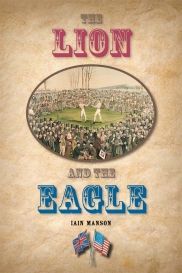
The story of the 1860 prize fight between Tom Sayers of England, and John Heenan of the US. The fight became a national obsession on both sides of the Atlantic.
Early on the foggy morning of 16th January, 1860, the steamship Asia docked at Liverpool. Amongst the passengers was US bare-knuckle champion John Camel Heenan, the Benicia Boy. He had come from New York to fight British champion Tom Sayers in what was effectively boxing's first world championship. At a time of great transatlantic rivalry, two nations were transfixed by the unfolding drama.
Victoria reigned over an England transformed by the Industrial Revolution, and over an empire on which the sun never set. In America, as the iron horse sealed the doom of the Indians, millions lived in slavery, and Abraham Lincoln set out on the journey which would take him to the White House.
In the midst of it all, Tom Sayers and John Heenan struggled with chaotic personal lives as events carried them inexorably to their destiny in the English countryside.
Long forgotten, the old prize ring lives again in the pages of a book which offers an intriguing insight into mid-nineteenth century England and America.
Excerpt
But if the sporting houses were lively on Sunday, it was nothing to the excitement of Monday. Owen Swift, Nat Langham, George Bryer and Harry Brunton were all guaranteed a big night, Bell’s Life having named them as ticket sellers. The Americans were out in force, and the home-bred Fancy had flooded into London by road and rail, determined to witness the greatest sporting event of the age. Writing in The Illustrated Police Budget some forty years later, a participant recalled the crush at Owen Swift’s, where he was obliged to spend all evening, since “having once got in I was utterly unable to get out.”
". . . never have I seen anything to compare with that never-to-be-forgotten night preceding the great battle between Sayers and Heenan. The people were literally packed as tight as sardines in a box, or herrings in a barrel. The noise was awful. There was one continuous roar of voices shouting for tickets. It was impossible for half or even quarter of the throng to get near enough to the receipt of custom . . . to obtain what they wanted. And the language of the disappointed ones was of the strongest . . ."
Harry Brunton’s was just as bad.
Professional Reviews
The Lion and the Eagle, by Iain Manson
Over the past two decades, Britain’s ruling political class has become particularly adept at ensuring that blind eyes are turned whenever it’s deemed politically expedient. Perhaps it’s because we know this that no-one ever resigns, even when caught red-handed, though one wonders whether our political masters would consider keeping quiet if a high-profile sporting event ever threatened to break the law.
This might sound like a hypothetical question, but back in 1860, the biggest prize fight ever held in Great Britain very nearly didn’t take place for it was a bare-knuckle affair fought at Farnborough between England’s Tom Sayers and America’s John Heenan.
That was until the Prime Minister of the day, Lord Palmerston, instructed his police force to let the fight go ahead because to ban it would probably have caused civil unrest. However, Palmerston didn’t simply tell the police to turn a blind eye, he too was so excited by the prospect of seeing the two men do battle that he actually attended the fight in person.
Iain Manson has written a terrific account of what was boxing’s first world championship bout, a duel that caught the public’s attention in a way no previous sporting event had.
A report from the Illustrated Times described the nation’s mood ahead of the fight which, it said, “had been the subject of conversation in every circle of society for a month past.” The popular newspaper maintained that “the people were all in favour of the fight coming off.” On the morning of the bout, when the train carrying the great and the good left London en route to Hampshire, the paper reported that it “carried numbers of both Houses in plenty. Authors, poets, painters, soldiers and even clergymen were present.”
Policemen on horseback in “knee-length navy blue coats and stovepipe hats, armed with cutlasses, watched their progress with grim impassivity.” They followed the train’s progress, but did not intervene. Upon reaching Farnborough, the train’s occupants alighted and trudged across open fields and through hedges on their way to the clandestine open air boxing ‘ring’.
Their numbers were swelled by villagers formerly “cowering behind their closed windows” who charged up to catch a view of proceedings and watch now muddied noblemen (there were 87 of them) part with a colossal ten shillings (50p) an enormous sum for the time, to gain entry into the inner-ring.
Manson has undertaken a huge amount of research in piecing together the build-up and the aftermath of this famous fight. In part, it reads like a well-paced social history, the narrative simply racing along as we career towards the world championship bout itself, rushing like Farnborough’s inhabitants to see what happens.
It would be unfair to reveal the outcome here, although boxing aficionados will already know the result. That should not prevent them and anyone else with a love of sporting history reading this excellent account. Every member of Parliament should read it too.
(Sports Book of the Month)
Book is real heavy mettle
NOTHING compares to the euphoria generated when British and American heavyweights meet to determine global supremacy.
For more than 70 years the wars to win the richest prize in sport between the two nations has stirred the blood like no other.
The passions aroused by world title fights between Louis and Farr, Tyson and Bruno twice, Tyson and Lewis and the two Lewis and Holyfield feuds are prime examples. The first Anglo-American battle created just as great a furore in 1860.
The build-up to British champion Tom Sayers' bare-knuckle brawl with American John Heenan, lasted almost 12 months.
Modern promotion masters Don King, Bob Arum and Frank Warren, could not possibly have whipped up more interest.
Big fight day was April 17 1860, but as prize fighting was illegal the location remained secret.
Heenan sailed into Liverpool four months before the event and thousands lined the rail route at Crewe, Tamworth and Rugby, to get a glimpse as he journeyed to London.
Sayers was six inches shorter and three stone lighter than Heenan, so every day he pickled his knuckles in turpentine, lemon juice, scraped horseradish, salt, vinegar and whisky until the skin was as hard as leather.
The lucky ones who managed to get hold of a ticket had to pay £3 - a whopping sum worth about £1,900 today.
Such was the demand, one titled gentleman was seen to put his ticket in his mouth for fear of having it stolen.
Fans were told to meet on the morning of the fight at 4am at London Bridge station to board two special trains - though they were still unaware of their destination.
Eventually the 63 carriages stopped at Farnborough in Hampshire, a ring was erected in a large meadow. The pair then proceeded in 42 rounds, over two hours and 20 minutes, of such brutal combat that their facial injuries were gruesome.
Their heads were grotesquely swollen and Heenan was a bloody mess as Sayers' fists were as hard as cudgels.
Heenan attempted to strangle Sayers to death on the top rope and would have succeeded had someone not cut it.
That was the signal for the crowd, including aristocrats, MPs and Victorian celebrities to invade the ring.
The fight was declared a draw. The New York Herald's ringside reporter wrote: "If Queen Victoria had eloped with Napoleon III the news could not have created more excitement."
I was lucky enough to find historian, Iain Manson's book The Lion and the Eagle in my Christmas stocking.
It graphically tells of the fight and gives a penetrating insight into life in Victorian London.
Let's hope none of our more fainthearted heavyweights get their hands on a copy.
They would swoon with fright.
(The Sun)
Sayers and Heenans's fight offers insight into time of Anglo-American animosity
The world in which England's Tom Sayers and America's John Heenan met for boxing's first world championship bout, on 17 April, 1860, was one in violent flux.
Driven inexorably forward by the flames of Industrial Revolution, the mid-Nineteenth century was an age of cruel contradictions: on the one hand, an era of romantic progress, with unparalleled advances in transport, medicine and commerce; on the other, an endurance of misery, disease and intolerable poverty. This was Dickensian England and Hawthorne's America, the former, barrel-chested, belligerent, smog-filled and riven by Empirical notions of class; the latter brimming with post-colonial impudence, energy and straining under the paradox of mass immigration and the extraordinary racism of indigenous slaughter and a slave trade. That these two nations should find some symbolic resolution to their festering animosity in the prizefighter's ring, felt entirely appropriate.
Pugilism then was an out-of-favour, illegal and ugly pastime, practised by brutish, gnarled but finely-tuned toughs and devoured by the "Fancy", men with "concave faces trampled in, as if with the iron hoof of sin". Survival in the square ring, in bouts often extended over three hours, required more than a passing familiarity with the harsher realities of Victorian deficiency. In Sayers and Heenan, the Fancy, their respective countries had two such men. Sayers, a small but teak-tough and ferociously hard-hitting bricklayer, champion and man educated in violence among the rogue's gallery of the neglected and abused, was unbeaten and adored. Heenan, one of the thousands of Irish Catholics who descended on American shores in the great migration, was relatively inexperienced but no less sturdy, unknown in England and less revered in his homeland. Yet his impertinence in challenging the popular Englishman rallied a disparate nation. Amid unprecedented fanfare, and with both sides of the Atlantic at a standstill, this was a fight for their nation's honour.
The book is an absorbing account of the build-up to, and climax of, that meeting and is as much a tale of the turmoil of an era as it is of boxing. Packed with charming detail and atmosphere it is a primer into the brutality of bare-knuckle prizefighting and should be enjoyed by fight fans and non-fans alike.
Experience the early 20th century in Michigan's Upper Peninsula through the artistic camera lens of J.W. Nara, one of the Copper Country's earliest professional photographers. This collection of historic photos brings the "Copper Boom" era back to li
The Borderline Anti-Memory PastBook asks questions a diary does not ask and raises the questions to dialectics and answers them in a way a memory work does not answer questions.