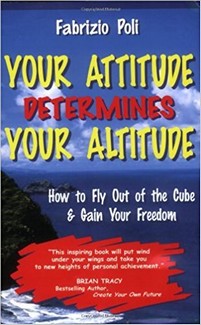
The author explores the flight-path to happy, successful living, from positive thought and action to nurturing our selves by 'decluttering' the mind, body and spirit.
Learning to fly a plane is a skill that takes years of training. Yet when it comes to piloting our own lives, many of us leave this vital task to chance-and then wonder why it all crash-lands before our eyes. In this inspiring and entertaining book, Fabrizio Poli explores the flight-path to happy, successful living, from positive thought and action, to nurturing ourselves by 'decluttering' the mind, body and spirit. Written in an exuberant, energetic style, and accompanied by equally vibrant cartoon illustrations, Your Attitude Determines Your Altitude shows how in life, gaining altitude really is a question of attitude.
Excerpt
Coping With Terrorist Attacks
My wife Silvia and I walked through the front door of our new home in England, went straight upstairs into our bedroom, sat down together and cried our eyes out …
A few weeks prior to this we had sold our apartment, our furniture, our car and I had resigned from my job in order to move from Italy to England. I had a very good contract with a new airline, on a bigger airplane, and was confident this would take my career in the direction I wanted it to go. In addition to this, Silvia and I were expecting our first child. We were very happy and had everything mapped out, just like a flight plan…
When you are trained to fly a modern jet airliner, you are taught how to deal with a myriad of emergencies. You learn a set of procedures on how to deal with these so-called inconveniences.
However, on September 11th 2001, the pilots flying the planes involved in the terrorist attacks in the USA were faced with an emergency they weren’t trained for. A group of terrorists stormed into the cockpits, of the four aircraft involved, killed the pilots, and turned the planes into missiles. The result of these attacks has changed the history of the world, and affected most people’s lives.
Silvia and I were very happy about how our life together was working out and my career as an airline pilot was progressing nicely. Needless to say, the move to England was done under stressful conditions: moving country, Silvia’s pregnancy and a course on an aircraft I hadn’t flown for over three years. The airline put me through a refresher course, tailored for an experienced Boeing B737 pilot. I had been busy flying other types of planes and struggled to fit into the very brief training course, I had too much on my plate. The Flight Operations director called me into his office and told me that it had been a corporate decision to fire me. I was shocked, to say the least. My “cockpit” had just experienced a “terrorist attack”. Now what?!
We all experience at some time in life a “personal terror attack”, where an unexpected adversity hits us. Terrorist attacks in your life can be prevented, but invariably if you do experience one you have got to deal with it with an attitude that will give you altitude. Silvia and I had faith that our Heavenly Father loved us and would help us face this challenge. I could very easily have blamed the airline and adopted a victim mentality, but this was not the enlightened way; so I focused on what I had done wrong and how to avoid making the same mistakes again. After all I had been through enough crew resource management courses to know that a good pilot is not the one that doesn’t make mistakes, but the one that manages and corrects errors effectively and safely. Silvia and I also prayed for strength and guidance and got up and started to make things happen. Our attitude was positive and we were focused on finding a way out…
Vision: Imaging Success
In Order To Materialize It
I had always been a student of personal development and success psychology and read many books, listened to tapes and attended many seminars on this fascinating subject.
Everybody seemed to agree that visualizing yourself having achieved your desired goal was step one. Martha Farah, PhD, Professor at the University of Pennsylvania in Philadelphia, points out that, “mental capacities such as memory, perception, visualization, language and thought processes are rooted in complex structures in the brain”. Her research suggests that visualization is not part of language symbols, but is simply the chemistry of the visual system. Basically, we think in pictures and not words.
There are numerous examples of cyclists, skiers, runners, tennis players, volleyball players, swimmers, weight-lifting athletes, golfers and others who testify of the extraordinary power of this form of mental rehearsal. The most interesting thing about this research is that the brain can’t distinguish between something imagined and something really experienced.
Golf champion Jack Nicklaus claims that although he was one of the longest straight drivers and an excellent pressure putter, his strongest asset was his mind. “Your mind should always be your strongest weapon in your game”, he said in an article in a golf magazine.
During the Vietnam War, Major James Nesmeth, a Phantom F-4 fighter jet pilot, was shot down and kept in solitary confinement for seven years. To keep himself sane he used to play golf every day in his mind. His average round on the local golf course near home was 94. When he was released and returned home he went to play golf and averaged 74! How was this possible? His mind was convinced he had played golf for seven years, improving every day; consequently this became reality.
I visualized myself every morning getting through training and flying an airliner. I made sure that while I was doing this I could feel I was there in the cockpit; a sensation of joy at overcoming the challenge permeated through all my body. I created the victory in my mind first and once the exercise was over I went to work to manifest it in reality.
Planning
Brian Tracy in his international bestseller ‘Create Your Own Future’ states that 97% of people don’t have goals. Setting goals and writing them on paper is the easy part, it’s surprising most people don’t do it. I needed to come up with a valid flight plan…
An aircraft flies a heading (direction in which the nose is pointing), which enables it to maintain a track (actual path of aircraft over the ground). However, the heading and track are very rarely the same. The difference is caused by the wind; the pilot, in order to stay on track, has to turn the aircraft’s nose towards the wind. On average the difference between a heading and a track is about five degrees; this can mean being way off course if we don’t keep correcting. So when setting a goal and planning a flight you’ve got to keep checking to see if you are on track.
Another important part to achieving a goal is to plan for emergencies. Before taking off in an airliner jet, I brief with my colleague on what to do if we were to experience a failure before lift-off speed or just after getting airborne. We visualize the procedures, deciding what to do and who is going to do what. It is just like in golf: if you choose the wrong club you can give the ball your best shot and be very positive about it, but the outcome will not be very effective.
So I had a plan that would get me back into the air. First of all I went through the UK airline directory and a list of contacts I had and made calls on a daily basis. I also researched the internet for info on airlines that were recruiting and read nearly every aviation magazine I could get my hands on. Even the tiniest piece of information was valuable to me.
Networking Back Into The Air
Networking was another part of my plan, a skill I had learnt through network marketing. How to meet new people and build relationships of trust with them was the key. I knew that the quickest way back into the air was going to be through this and there is nothing better than network marketing to teach this skill.
I came across this marketing system when I got back from doing my flight training in the United States. We were in an economic recession, just after the 1991 Gulf War, and most airlines were laying pilots off, so for a guy who had just qualified it was hard. Unable to find a job as a pilot, I needed something to do and, through a friend, was introduced to an American company that produced a weight loss product.
This company were about to open the Italian market and were looking for distributors. My dad and I went to a meeting and thought we’d get my mum on the product to see if it worked. My mum lost 7 kilos (16 lbs) in one month and I was feeling more energized as a result of taking it too, so I decided to go for the business. I became an independent distributor, had to recruit other distributors and create a network called down-line. I would be paid not only for retailing, but also a commission on the volume of business produced by the people in my down-line.
I started building my network and it got big pretty fast. The thing I liked about this business were the training courses they ran twice a month. I was exposed to training held by the number one distributors in the world, who were earning in excess of $100,000 a month. This experience was an incredible school and taught me how to develop contacts, which is one of the most important keys to success.
I learnt that everybody knows at least 250 people, who also know another 250 people. So, instantly you have access to 62,500 people (250 X 250), who also have their own networks. In the 1960s Harvard social psychologist, Stanley Milgram, did an experiment where he proved that through our social networks, we are within five or six connections to anyone on this planet.

So I knew about the power of networking and put it to work. Within a week after we had our first baby, Benjamin, I was off to Switzerland to do some freelance work on a corporate jet, work I’d found through a friend of a friend. While in Switzerland I popped over to Milan and visited my former boss, who offered me my old job back. So Silvia, Benjamin and myself commuted between Manchester, England and Milan, for six months. We were living out of a suitcase and by the time Benjamin was a year-old, he’d been on 30 airplanes!
Flying Out Of The Cube
I often get asked if it’s difficult to train to become a pilot and how I got the money together for the training. Well, the training isn’t easy but if you’re highly motivated you get over that. The money is another motivational aspect; my desire to become a professional aviator was high so I went out to work hard in order to rake in the amount I needed. However, the most difficult part of the equation is that once you’re qualified, you need to find a job. This is definitely the part I have always found the hardest. You see, if you are a teacher or a salesman and you lose your job, there are still jobs you could go to within a reasonable distance from home. When you’re a pilot you may have to go to the other side of the world to go to work.
I usually started by knocking on the front door, but I found that most chief pilots wouldn’t even acknowledge my CV, it’s as if they weren’t in. I then knocked on the back door by phoning or turning up on their doorstep, but when I did this most chief pilots were too busy to see me. At that stage I opted for the Santa Claus approach and went down the chimney. I wouldn’t go to the extreme of wearing a red suit, but maybe a red tie! This is doing something outside the Cube, trying something unconventional.
My goal was to fly for a UK-based airline, as living in the UK and working in Italy wasn’t the ideal scenario. This was a difficult task as I didn’t know anyone and only had one work experience in England, which hadn’t ended well. I believed in being honest and told people what had happened to me. I knew I needed to fly out of the Cube, because this was the only way I was going to succeed.
The standard procedure most pilots follow is to send a CV with a short cover letter. I had to do something different. I needed to tell my story and how this experience had made me stronger. To be effective in this I needed to know my audience. Sending off CVs wouldn’t do the job, as potential employers would immediately read through the lines and throw it in the bin. A Chief Pilot has under a minute to read a CV, so I needed to put my writing skills to work and write an intriguing covering letter, explaining what had happened in a compelling fashion, in order to keep him interested enough so that he would read all the way through. I thought that all pilots have a licence and some flying experience, but there is a human being behind the numbers and that is what counts the most. I then went to all the pilot job conferences and developed some contacts in a few airlines. It was thanks to this that I learned some valuable info about one airline in particular. I put together an email explaining the story behind my CV, a few hours later I got a phone call from the Chief Pilot, and this landed me an interview. During the interview I told him what had happened, admitting I had overloaded myself and this is why I had failed my course. He appreciated my attitude in having taken responsibility for what had happened. A short while later I was offered a job on the Boeing B737 Next Generation with a full six weeks’ training course.
In the upcoming chapter
you’ll discover the secrets of dream stealers…
 Terror Attacks happen; we mustn’t fall into victim mode but learn to deal with life’s challenges with a proactive attitude.
 We must visualize our goals in order to manifest them.
 We must work out a plan and have check-points along the way.
 In developing a plan, think outside the Cube; don’t do things by the book if you want to fly out of the Cube. Try the Santa Clause approach; do something unconventional!
 Challenges in life are overcome with the help
of others. Use your network to help you succeed.
Professional Reviews
Brian Tracy Endosement
This inspipring book will put wind under your wings and take you to new heights of personal achievement. -- Brian Tracy, Author International Bestsellers 'Eat that Frog', 'Million Dollar Habits' and 'Goals' -
Nido Qubein Endorsement
Read this book to be inspired. Study it to succeed. -- Nido R. Qubein, Author International Bestseller How to be a Great Communicator & CEO Great Harvest Bread Company
Aviation close to earth
Mr Poli's book had many peak moments describing important issues in a very close to earth (even it is a book written by a pilot and having most of it's content reflected via aviation)manner. Some of the chapters however had a little bit lack of "beef". However it was quite useful and pleasant to read. The feeling of man taking off from his own experience, learning from them and sharing with others is very positive springboard.
Stress is everywhere! We don't have to do anything to find it. It will usually find us. How we handle that stress is the key factor in determining our wellbeing, both emotionally and physically.
Even though stress is so common, too many peop
Are you a pastor or other church leader who would like to counsel but are afraid you can't do it? This book is for you! It will help you get over the fear of counseling and help you to counsel most people with most of their problems. It will also hel
ebook Version
Too many people attempt or commit suicide while those around them didn't realize they were suicidal. This book will teach you what you need to know so that will never happen to you. It can also give hope to the suicidal person