Category: Architecture Publisher: Fast Pencil, Inc.
ISBN-10: 1607463652
Type: Non-Fiction
Pages: 310
Copyright: May 8, 2011
ISBN-13: 9781607463658
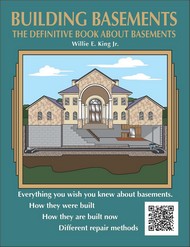
The book outlines how basements are built, repaired and should be built.
This book explains the history of residential basements in a simple and realistic way for anyone who is interested building, repairing or understanding basements.
The book explains in simple detail how basements were built in the past and how they are built today. Basement building in this book is systematically broken down and the advantages and disadvantages of each method outlined and explained in a no nonsense way.
A variety of basement repair methods are covered, which provides a knowledge base never before presented in one resource.
Excerpt
Preface
I have to honestly admit that the most difficult part of this book is writing this preface. While reading this book, you will find at times several attempts on my part at sarcasm, which will be un-mistakable. I couldn’t help it, as I never wanted to write this book. I do not, have not nor will ever consider myself a writer in any sense of the word. The reason I wrote this book was not for fame, glory or even money which are all honorable causes for that matter.
My reason for putting my words in print was due to the fact that I hated knowing a large number of facts about basements are known by very few people. I would love to tell everyone that I am a genius and begin explaining how smart I am, but the truth is nowhere near that interesting.
We all know that basements, in one form or another, have been around for hundreds of years. Which begs the question, why are there so few books about designing, engineering or constructing basements. The world is full of basements built every day in nearly every conceivable type of soil condition we can imagine.
Basements are not unusual in Egypt where the primary soil is sand. In St. Louis, the Gateway Arch is built on a basement which serves as the visitor center adjacent to a dock which exposes the center to water. The George Moscone Convention center built entirely underground as a basement where the soil is comprised solely of rock.
In every major city in Arizona, basements are attached to many of the most prestigious homes in the state. Arizona is comprised primarily of clay, which is found in vast amounts and in nearly every variety. Arizona is comprised of some of the softest clay in the U.S., which is why the NRCS issues/publish soil shrink/swell potential maps for every area in the state. Florida has a large number of homes with basements across the state in places were many might not have thought it possible. South Florida in particular has homes in neighborhoods where the highest elevation is only 29 feet above sea level. What is more impressive is that homes located along U.S. Highway 1 on the east side of the state are no more than 10 to 15 feet above sea level.
The idea that basements can’t be built, basements will not be stable, the soil shifts too much and the soil is too bad to hold a basement is utter nonsense. What is truly sad is the fact that an entire industry practically does not exist, in great part because of these fallacies which are not based on fact what so ever.
Even before today’s innovations, basements were not only possible but were, and still are, the best kept secret for home owners today.
Imagine what you think when you see old video announcements telling children to duck under their desks if the country was under a nuclear attack.
Watching videos of children getting under their desks is un-settling with what we now know about nuclear bombs. The Federal Emergency Management Agency (FEMA) suggests something similar for how Texans are to respond during a tornado. Citizens are told to go to an inner hallway, bathroom or a closet until the storm passes.
Anyone familiar with what a tornado can do to a home will consider their suggestion similar to hiding under a desk in a nuclear blast zone. I would use the words laughable, if the matter was not as real as it is for the large number of people that live in tornado alley. Thousands of people each across the south hear warning sirens every year, warning everyone to take cover from impending tornadoes in their area. It is nice to have some kind of warning system, but wouldn’t the situation for Texans be safer if they actually had a safe area to protect them. The story of Chicken Little is how many people feel about the possibility of dangerous storms which we actually face every year.
Writing this book serves two purposes, both of which are equally important to me. First, to shout as loud as I can to let everyone in the South know that they can have a basement. Every major disaster plan that has been written suggests that citizens take shelter in their basements. I am here to tell everyone how they can build a safe, economical, water proof basement. In fact, for the first time in history, we can build them green with concrete that actually heals itself. Also, with proven methods that have worked for over 50 years we can add basements to existing homes. The methods used to add basements to new or older homes are not only practical but easily explained as well.
The second purpose of this book is to inform home owners of all the advantages they give up if they do not have a basement. Ignoring the safety basements provide, I am talking about the financial advantages, which are equally important.
Speak with a realtor and ask them how much more a house in the south is worth with a basement rather than without one.
Ask a cooling specialist about how much cheaper your energy costs would be if you could move into your basement during the hottest months of the year. Ask them would it be wiser to build a two story home or a single story home on a basement to save on energy costs. Go down and ask your local tax man how an unfinished basement is treated in the calculation of your property taxes.
While you’re there, don’t forget to ask them does it also apply to your county, college and school taxes as well. That is correct boys and girls, the possible tax savings can be huge when you consider the normal tax burden that you face every year. While you’re out and about one day swing by the office of a local contractor and ask them what would be the easiest part of the home to expand.
They all start with if you had a basement it would be cheaper and faster to expand, transition or remodel a basement than any other part of the home. Less dust to contend with, less noise and practically no interruption in your home life while the area is under construction. Everyone can’t do without a garage when homeowners find themselves needing the extra room for a practical purpose. Building in an attic to add an extra room is always a great idea until the summer arrives to educate you. Attic temperatures in the summer are not only uncomfortable but dangerous to anyone living inside them. When you consider all you’re doing is adding basement walls to your building project, it really sounds more reasonable. It does not matter what you build if you’re building a home because you still will need a slab for your foundation.
Depending on your type of soil, heavy equipment will be used to clear the site and remove the top soil. If you need a septic system or install a swimming pool, they will already have a back hoe to dig it out.
This brings me to the common sense that my book forces everyone to use when considering if they can have a basement. If the soil is not stable enough, if it shifts too much and is too bad to hold a basement, why can it hold a large swimming pool, hummmmmm? My construction back ground began when my father began taking me out with him whenever I was not in school. At the age of nine, my father began taking me out to learn the family business, which was building in-ground swimming pools. My family has built swimming pools from California to Boston in every soil there is in the United States. I can honestly say that while working primarily in the south over the past 40 years, neither I nor my father have ever left a site because it would not take a pool. So my question is: why can someone install a 12-foot deep swimming pool but not a basement? The same equipment used to dig out a pool is used to dig out a basement. If the soil is too hard to dig, why is it that every single neighborhood has swimming pools? Every state, every town, every city and every neighborhood has swimming pools which cost in the tens of thousands of dollars to build. Are we to believe that all the swimming pool owners have floating, cracked and un-repairable pools because of the soil? The answer is as clear as the question is simple, and we all know while nodding our heads up and down the answer is no. So why don’t you have a basement if you live in the south?
ACKNOWLEDGMENTS
I would like to thank my best friend and mentor Don Isett for always believing in me. Thanks to Beverly Isett for taking on the most difficult job of editing my first draft, and keeping me from looking foolish to the rest of the world. Thanks to Suzanna Savoie who rose to the challenge of handling my final edit in record time and working with me to finish my book.
I would also like to thank my father for teaching me the family business and instilling in me a strong work ethic. I would like to thank Kevin Jackson for teaching me how to start and run a business on a shoe string budget. Thanks to Mary Ann Monreal for taking me under her wing to teach me how a professional man should dress.
Special thanks to Karen Dickens (Pruett) for making me do my best for many years. Thanks to Tish Lanius (Garney) for teaching me to type, which took great patience over several years.
Lastly, I would like to thank my family, Marjorie Johnson (King) and Elizabeth Vara, who has always been a King, for always being there for me. Through school and over 15 years in business, they have always held my hand and reminded me family always comes first.
A special dedication to my mother Beverly A, King who passed November 3rd of 2007 for pushing me to give her a grandchild. Reyna Louise King was born in 2007 to be a Taurus like her Dad. I love you very much mother and think of you every day.
The History of Basements
Professional Reviews
The Planet of Success
As an educator for over 20 years I can honestly say we need more books like this.
This book is about not being judgmental about other people outside appearances.
The writer creatively teaches what character is and how they should watch someones actions and focus more on their good deeds. I am happy to say we also purchased this writers other books:
"The Magical Mystery" (This book was about having faith and to belief in yourself).
"The Playground is Dirty" (This book is about the greed factor of teenagers having sex with whom ever they want, and not caring about who they hurt).
Teaching lessons about how to care for others is great so please read these books and tell your friends about them.
wking
The Magical Mystery
I love that fact that the book teaches about having faith and belief in yourself.
If you believe, you can conceive!
The Playground is Dirty
We need more books like this that how the greed factor of teenagers having sex with whom ever they want, and not caring about who they hurt. No matter if it's their best friend. They just want to satisfy themself.
This book teaches lessons that we can't teach in school.