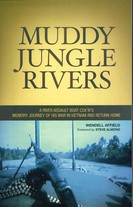
A river assault boat cox'n's memory journey of his war in Vietnam and return home.
Foreword by Steve Almond
Muddy Jungle Rivers is a close-up look at life on a gunboat during 1968, the bloodiest year of the Vietnam War. It’s the story of a seven-man crew captained by a volatile pro-war enlisted man. Like Philip Caputo’s “A Rumor Of War,” this narrative takes the reader into frustration, rage, terror, death, betrayal, and the search for redemption.
Muddy Jungle Rivers has 29 chapters, maps, and photographs.
Today’s generation watch their peers returning from combat and cannot understand why their loved ones have changed after being blanched in the cauldron of war. In Muddy Jungle Rivers the reader will glimpse the genesis of post traumatic stress disorder (PTSD).
Excerpt
Chapter 19 – U Minh Forest
Our riverine assault boat division made a six hour run west on the Mekong River through monsoon drizzle carrying a full platoon of army troops on each Tango boat. We were moving deep into the U Minh Forest, located near the southwestern tip of South Vietnam. There had been no outsiders since the French departure in 1954. The American war had missed these people—predominantly farmers—in this remote area until now. Buddha had returned from a boat captain’s meeting and told us that the VC had training camps, hospitals, and POW camps in the vast jungle swamp. He said they even came there on R&R.
At dusk our boat column received sniper fire when we turned south into a smaller river and passed through the large town of Can Tho. We were ordered not to return fire; speed up, get past. It was a common tactic of the VC to fire on us from populated areas—if we returned fire and wounded villagers, it provided them propaganda.
I drove into the night; the boat quieted—the well-deck packed with sleeping troops, our gunners lying on the deck between their turrets behind me in the cox’n flat, Buddha topside between the turrets trying to stay awake. Professor sat in the corner behind me dozing. I followed the colored lights mounted above the boat ahead of me as we snaked slowly south on narrow dark rivers. Sometime during the night fog set in low, about a foot above the water.
In the early morning hours I must have hallucinated. Mixed diesel fumes and fog hugged the river, hung in the still air, and drifted me back to the train I’d ridden through the Cascade Mountains of Washington when I was sixteen. It had been dawn as the locomotives crawled toward the summit tunnel and diesel fumes hovered, sucked into the open-doored boxcar. The rising sun had illuminated the white peaks of the mountains across the valley. Looking down at the fog bed resting in the valley, I seemed in another world—above the clouds.
“Afe, back down, back down,” Buddha yelled. I grabbed the throttles, threw them into reverse, and revved the engines. I barely missed the boat in front of me—somehow I’d crept up on him when my mind had drifted. “You been driving all night—why the hell didn’t you wake somebody up to take over?”
Troops were stirring in the well-deck. The smell of heating C-rations wafted up from below through the hatch near my feet. A sergeant climbed the ladder, stuck his head through the hatch. “They just called on my radio—we’re about half an hour from our insertion point.”
Professional Reviews
By Colonel Patrick Donahue USMC (ret)
Muddy Jungle Rivers (MJR) is a must read for military professionals and future warriors who will face the trauma associated with combat. MJR delivers a profound take on life during the most violent days of the Vietnam War, punctuated by the challenges facing survivors returning home. Everyone who reads MJR will come away with a far better understanding why the Vietnam War profoundly affected those who lived through it. Boatswains Mate 2nd Class Affield has captured the essences of the sacrifice, dedication, courage, fear, and brotherly love of warriors fighting an unpopular war.
Tango 10 Medevac Boat
I just finished the book and thought it was great. I was the cox'n on Tango 10, the medivac boat so as you can see this really took me back. I don't remember Wendell but being that close I know we had to of talked, drank a beer together or whatever. I didn't make it a point to make close friends over there since my best friend Joe was killed on Tango 7 after we had only had been in country for about a month. They had asked me to escort Joe's body back home to the Chicago area but I told the Lt. that if I went I wouldn't be coming back. He decided to send someone else. I really like the way the book flowed and took notice of small things along the way. The description of the rivers, the jungle and the distant look of people who had been there for awhile. Sometimes I look calm cool and collected on the outside but the inside will be going ninety to nothing and the mind will be back in that world. I think this book eased a few of those feelings by just knowing that someone else that had been in the exact same spot as me was having the same thoughts and feelings as me. I don't know, maybe it justified my feelings or something like that. Since I'm not a writer, it's hard to put into works.
I highly recommend this book for those who were over there and for the ones who were not. It's a different part of the war that you don't hear about unless you read a book like this. The book is very accurate and you can tell that a lot of research went into it to be able to keep with the timeline.
Thank you Wendell for opening up your heart and letting so many in.
Bravery
Muddy Jungle River gives us the first-hand experience of a cox'n in the Navy's Mobile Riverine Force in 1968 during the Vietnam conflict. The vivid pictures presented in this writing portray the reality of the ugliness of war. I appreciate the honesty, Wendell says it like it is from his point of view. It must have been painful to go back and write these details about a time most would rather forget and yet the author describes rather matter-of-factly the horrors he saw and the miserable conditions he endured. The foul language, no doubt in the vocab of men at war, is something the reader will have to tolerate as they read his story. The difficulties in returning home, including judgements, post-traumatic stress, guilt and facing those who have no idea what you have been through, were eye-opening. I found myself wanting to hear more about his life. Thanks to the author for sharing his recollections of this time in history.
An illustrated developmental history of the American military chemical and biological protective respirator for use against war agents, this work provides photographs of actual respirator specimens and several useful appendices, in addition to its en