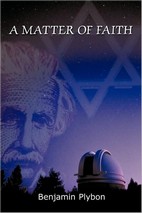
A discussion of relation between belief in science and belief in God.
This is a book about belief in God as a Christian and belief in science as a way of life dedicated to search for truth about our universe. It is important to understand science does not preclude faith in God. Millions ot perfectly sane, rational people do just that and have done so for centuries. So many people do not understand Christianity, what it is and what it isn't. So many people do not understand what science is as an intellectual activity. The result is conflict between science and religion in the minds of many people.
We have an on-going battle between Creationists and educators over the decision to teach evolution and Big Bang theories but not the Genesis view of creation of life and the universe. It is important to understand teaching children that God created the universe in six days and the earth, even the universe, is only about 6000 years old would be very bad science education. There is much evidence that the earth alone is at least 4.5 billion years old and the universe is probably more than 14 billion years old. Reading this book should help clear the air.
Christians, Jews and Muslims are called people of faith. It is important to understand that everyone has some kind of faith in something. All scientists are also people of faith. They have faith in many things: their reasoning ability, honesty of of other researchers, existence of a world out there, existence of particles they can see, hear or touch. The list of articles of faith in science is long. We are all people of faith. Life is otherwise impossible.
Excerpt
Historically, Science and religion were closely related until late in the nineteenth century. Plato and his school of philosophers were very much interested in gods, ethics and morals. Their thoughts on the subject were discussed and criticized at great length by St. Augustine in his book, The City of God. Roger Bacon and Copernicus were religious men and their religion and science were not totally separate. The great physicists Newton and Galileo were also religious men and their religious beliefs motivated much of their science. Albert Einstein was a religious man in his own unique way; he was neither a Christian nor a practicing Jew but he did believe, as noted earlier in this book,
“Science without religion is lame, religion without science is blind.”
He spoke and wrote on many occasions about the relation between religion and science and their mutual importance.
So we see that religion and science do have something in common. They were created by people searching for truth. The ancient Israelites and early Christians wished to know the truth about God. The ancient Greeks wanted to know facts about the natural world and principles governing it’s operation. Their methods differed since their goals were different. The ancient Israelites showed very little interest in science as we understand it. They discovered no scientific laws or principles so far as we know, because they were taught to rely entirely on God’s wisdom. He would reveal what they needed to know. The Greeks contributed nothing to our knowledge of God. They philosophized about gods and religious ideas but contributed nothing lasting to our knowledge of the one true God, as St. Augustine noted. They were sometimes surprisingly close to the truth but never quite attained it.
Science and religion have much to offer each other. Even the Greeks realized in their philosophizing that we need both to understand the world and live happy lives. It is doubtful that modern science as we know it in the western world would have developed and thrived without the influence of Judaism and it’s off spring Christianity. Judaism and Christianity provide an incomplete and unsatisfying view of the world without science. St. Augustine and St. Thomas Aquinas knew this and tried to create a philosophy including both areas of knowledge. Unfortunately they adopted the science of Aristotle since that was the best available at the time. We could do better today but haven’t made a serious effort.
If you long to discover your spiritual gifts, understand your calling, and become more effective in God's Kingdom, this book will provide a solid biblical foundation for your journey.
Finally! Understand and learn from the New Testament Book of Acts.
Try James first for free
Now there is a Bible translation that is easy to read, understand, and study.
This translation is unique in that it is arranged in
Titus and Philemon: The Easy Study Bible Commentary
Completely Revised and Greatly Enhanced!
Not for scholars but for anyone who struggles to understand the New Testament!
The Easy Study Bible Commentary take