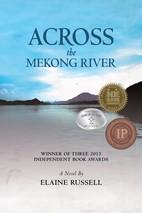
The story of a Hmong family fleeing war in Laos to a refugee camp in Thailand and eventually a new life in the United States.
In a California courtroom, seventeen-year-old Nou Lee’s mind reels with what she is about to do. What she must do to survive. She reflects on the splintered path that led to this moment, beginning twelve years ago in 1978, when her Hmong family escaped from Laos after the Communist takeover. The story follows the Lees from a squalid refugee camp in Thailand to a new life in Minnesota and eventually California. Family members struggle to survive in a strange foreign land, haunted by the scars of war and loss of family. Across the Mekong River paints a vivid picture of the Hmong immigrant experience, exploring family love, sacrifice, and the resiliency of the human spirit to overcome tragic circumstances.
“Russell aptly integrates the culture clash…The family’s richly drawn tension culminates in a grueling court case that affects all involved. A multifaceted tale of complex characters finding new lives in their new world.”
-Kirkus Reviews
Excerpt
Prologue
Truth is an illusion. It is only something we create from memories and wishes and fragments of dreams. The truth is what we want to believe. And sometimes lies are so essential they become part of that truth. I realize this now, perched on a chair in the small courtroom, my mind reeling with what I am about to do. What I must do to survive.
The windowless chamber is stuffy and heavy with scents of polished wood and linoleum floors swabbed in pine-scented cleaner. My father sits alone at the scratched oak table on the other side of the aisle, a five-foot space that spans between us like a vast river. His familiar mix of stale smoke and musky aftershave drifts my way, and I want to be eight again, giggling wildly as I ride on his back across the lawn outside our first apartment in America. He wears his one tweed jacket, gray slacks shiny at the knees, and a white shirt, which is frayed at the collar if you look closely. His body remains rigid, his face impassive. He stares straight ahead at the imposing judge in his black robe behind the bench. Occasionally, the muscles around his mouth tighten and twitch as he swallows.
My mother is in the first row behind him, next to Uncle Boua so he can translate. She weeps softly and stares at me with dark, accusing eyes. I long to reach across the void, to cry out to them: please understand. But it is too late. They already know about my lies. And the past slips from my hands.
The judge rubs his left temple in circles. He is a portly, Caucasian man with thinning silver hair and eyes barely visible under folds of skin. The room is deathly quiet except for the low moan of his chair, as he rocks back and forth, leafing through documents. He peers over his reading glasses at me, then my father, then back to me. The clock on the back wall clicks, another minute passing. His forehead wrinkles into deep lines. His expression is puzzled, or perhaps disturbed. Does he notice my hands shaking as I crumple a damp tissue? Or the tears that blur my vision, creating halos around objects and people in the room? Can he hear my breath catch on each painful draw of air, as I dare to glance at my father?
Before long this judge, this stranger, will ask how we came to this impasse. My attorney will detail events over the past weeks and months, and Father will respond with his version. But this will not be the truth. These statements will be a fraction of the whole. For the judge to truly understand the splintered path of misunderstandings and struggles that led to this moment, I would have to begin somewhere else, far from this small room in California. Twelve years ago when I was only five.
The details of my early years remain opaque and shadowy, viewed through a window clouded with steam. I can never be sure if the few vivid images I carry rise from memory or were painted by my parents’ reluctant retelling of our passage. Perhaps I invented moments out of necessity to fill the empty spaces in my heart. To justify my choices. This is what I think I know.
You see, truth is an illusion. Lies are essential.
Here is where my story begins.
A red scar in the shape of a half-circle marks the back of my left calf, a three-inch reminder of the other part of me, the part I left behind. I suffered the burn one July night in 1978 as my family ran through an open field, from the cover of mango trees to bamboo stands lining the Mekong River, on the last stretch of our escape from Laos. We fled the reign of terror the new communist government waged against the Hmong for fighting with the Americans during the Vietnam War. The refuge of Thailand, its twinkling lights dotting the distant shore like fallen stars, beckoned across the dark divide. Flashes of moonlight glanced off swirling waters, turning the shadows into silver stepping stones. My heart raced, and my ears filled with the roar of the river as it swept past, heavy with monsoon runoff. Mother promised we would be safe when we reached the other side. And being only a child, I believed her.
Many weeks before--maybe several months, I’m not sure--Mother wakened me in the middle of the night. “Quiet. We are leaving on a long journey,” she said in a voice so hushed I barely heard her. She warned me not to disturb the soldiers who slept in the camp next to our village, as she dressed me in two layers of clothes. The mention of the bad men filled me with dread. They loomed in my mind as frightening as the tigers Mother said roamed the forest, equally capable of harm.
I blinked, sleepy and confused.
“Not a word.” She put her finger to her lips.
“But what about Hwj Txob?” This was my black and white baby pig that I had named Pepper. He tagged behind me through the village and butted against my knees, knocking me down and licking my face. I loved my pig and did not want to leave without him.
“We’ll get him later.”
Mother and my brothers, Fue and Fong, ten and twelve years old, loaded heavy bundles with clothes and food onto their backs. We slipped from the house to the edge of our village, up the steep hill through the peach and apple orchard, and past the bamboo stands where once I had seen a red panda nibbling tender leaves. We climbed higher into the forest, fragrant with pines, the ground cushioned with fallen needles. A light drizzle brushed across my cheeks as soft as corn silk.
Deep among the trees we joined Uncle Boua, Auntie Nhia, and their four children, another cousin, Choa, his wife and new baby, and seventeen members of the Yang family, all huddled together in silence. I could barely make out faces in the muted light of a single flashlight hidden under Uncle Boua’s jacket.
From behind my cousin Choa a shadow moved toward me, and a man lifted me up, murmuring in my ear, “Nou, ma petite, it is your father.”
I thought I must be dreaming. My father had been gone a very long time. Mother had told me bad men had taken him away and kept him from us, but someday he would return. Often at night, when she crawled onto the bed next to me, I heard her cry into the quilt. I had no recollection of this man holding me close, no memory of his face or his voice or the feel of his wiry arms. I only knew the photograph that Mother had hidden under her blankets, the image of a soldier standing in front of a metal building in Khaki pants and a short-sleeved shirt with ribbons and metal shapes that hung above the pocket. He wore black boots that laced up his calves, his hands gripping a wide-barreled gun so large it nearly came to the top of his head. As many times as I studied the picture, I could not make out the face, a mere shadow obscured by his cap’s broad brim. Yet here he was, leading us off into the night.
That first day filled me with happiness. We crept through the forest as if playing a game of hide-and-seek, the way my brothers and I often had in our village and the surrounding fields. Father cradled me in his arms, and I drifted off to sleep. I woke to the calls of Mynah birds and the jostling of Father’s steady pace, my head bouncing on his shoulder. A pale gray-green light seeped through the canopy of teak and rosewoods that towered over the pines like elder brothers. At last I could study the face next to mine with its sharp angles around the brow and chin, the sunken cheeks, the skin so pale and thin I was afraid to touch it. Bones protruded from Father’s ribs and hips and arms. I had never seen anyone like this, not even old Grandfather Yang who had withered away to dust. I touched his wrist and asked why there was not more of him. His smile revealed gaps of missing teeth. He whispered that he had been hungry a very long time, but soon he would be fine, as fat as a big hog. I laughed at the idea, picturing him running around with Hwj Txob.
We stopped in a clearing to rest and ate bundles of sticky rice. The rain had stopped and up through the branches, I could see white puffy clouds sail past. Sunbeams sprinkled through leaves, casting elaborate patterns on the ground as I chased about, tracing them with a stick. Mother threw two blankets over a bed of moss and pine needles. My brothers collapsed on one, while my parents lay on either side of me on the other, smiling and whispering to one another. A woodpecker rapped on the trunk above us, and hypnotized flies buzzed in shafts of sunlight as if trapped, unable to find an exit. A string of carpenter ants gnawed at the decaying log beside us. I gasped as an enormous orange dragonfly landed on Father’s leg and fluttered its sheer wings of spun gold for one pure and perfect moment.
Eventually, days and nights blurred together. Each became more difficult than the one before. The joy of Father’s return became lost in the deep creases of his face and his ever tightening grip on my hand. We spoke only in whispers. We moved very quickly. Every time I uttered the slightest sound, Mother grabbed my shoulder and shook her head. I could not play with my cousins or brothers. I could not sing or laugh or clap my hands. At the slightest rustling in the bushes, we took cover behind the thickest trees or fallen logs, freezing in place, barely breathing until we were sure it was safe. No one told me where we were going. I wanted to go home. I wanted Hwj Txob. And for the first time I understood that Mother had lied to me. We would never go back for my pig.
Father and the other men took turns slashing a narrow trail with their scythes through dense thorny bushes, grasses, and thistles. The rest of us followed single file, up and down one jagged mountain after another, slogging and slipping through the mud, stumbling over fallen branches and roots. It was the monsoon season, and the rain poured down in great torrents. My clothes and skin remained damp with the ripe smell of decaying leaves and wet earth.
The first few days, my oldest brother Fong carried me on his back for short stretches. I felt safe with my legs wrapped about his middle and my arms around his neck. Soon he grew too weak for the extra weight. I walked until my calves cramped and my bare feet bled. Mother wrapped a cloth around my head and neck to block the mosquitoes that swarmed about me, searching for a succulent spot of skin. I became numb to the sting of leeches biting my legs, greedily sucking my blood until, sated, they fell to the ground.
Professional Reviews
Across the Mekong River
Ravaged by the Vietnam War, a culturally ingrained family from Laos leaves everything behind to pursue a dangerous journey across the Mekong River leading them from Thailand to the United States in Russell’s novel.
Violence interrupts the lush Laotian landscape: Bullets spray from the rifles of Communist soldiers, while indifferent American helicopters unleash bombs from above. A family makes the harrowing, death-defying struggle to elude patrolling soldiers and cross the Mekong River into Thailand. Nou, who later goes by Laura, recalls that half her family, including her two older brothers, perished during the escape. She was a mere child at the time, but the devastating effects of the loss lingered in her mother Yer’s fluctuating states of depression. Interestingly, Russell changes perspective throughout the story, including but not limited to Nou, Yer and Pao, the father. As each character’s internal conflicts unfold, his or her unique voice sheds light on the different aspects of Hmong culture while Nou’s family survives in the hope that the war will soon be over. After three years, Pao takes the search for a better life to America: Minneapolis, Minn. Shifting from Hmong culture to American, the family finds a stark contrast in lifestyle. Here, other ethnic groups are quick to blame the Asians for the Vietnam War and the ensuing loss of American soldiers. In school, Nou becomes the perfect target for teasing, while her childhood is spent playing the “adult” as her mother drifts deeper into depression. The novel takes another twist (thankfully the plot’s expansiveness is seamless) when the family moves to Sacramento, where Russell aptly integrates the culture clash as Nou changes her name to Laura and begins to see a life outside of Hmong cultural traditions of early, arranged marriage and many children. While her father is immersed in his farming business and her mother is intent on marrying her off to Dang—a respectable Hmong man—Laura dares to tread the boundaries of the Hmong culture, hoping that she will be able to pursue a career rather than marrying at a young age. The family’s richly drawn tension culminates in a grueling court case that affects all involved. Laura must decide if she is willing to sacrifice Hmong traditions in order to live the life she desires.
A multifaceted tale of complex characters finding new lives in their new world.
- Kirkus Reviews
Across the Mekong RIver - a Hmong novel written by a Caucasian writer.
From the opening of the Prologue of her new book, "Across the Mekong River," author Elaine Russell pulls you into a tale at once fascinating and engaging. The Prologue reads: "Truth is an illusion. It is only something we create from memories and wishes and fragments of dreams. The truth is what we want to believe. And sometimes lies are so essential they become part of that truth."
While the novel recounts one family's experience during the Secret War and directly after it. Following them on their escape through the jungle; life in a refugee camp; and finally America, Russell strives to produce a story that goes beyond one family or one culture's experience and explore more about the human condition. "Russell spins each story strand seamlessly into a moving, deeply person, and yet universal portrait of the immigrant experience of leaving one's homeland to begin anew in a strange and foreign country," reads one review of the book.
At first I found the movement between different members of the family a bit disconcerting. While the Prologue begins in the voice of the daughter, Nou, the first chapter is in the voice of Pao, the father, followed by Yer, the mother. After reading several chapters though I found that this format worked extremely well introducing the reader to each of the characters in a way the third person could never accomplish.
HMONG TIMES spoke with Russell, who lives in Sacramento,CA, about the experience of writing the book. She shared that she "always wanted to write. I dabbled in it when I was younger, wrote some op ed pieces but I had to earn a living." For Russell the opportunity to pursue writing came when her son was younger and she was only working part time. It was through her son that she was first introduced to the Hmong community through his classmates.
"My community has quite a large Hmong population. I didn't know anything about the Hmong." Russell confided that it was through her son's schoolmates and a reading of Anne Fadiman's book, The Spirit Catches you and you Fall Down, that she became interested in learning more. "I travel a great deal and have always been interested in other cultures. I am a great reader and love learning about other cultures."
Still the idea of writing a book about the Hmong hadn't entered her mind. "I thought maybe I would do a short story or something, but then one thing after another happened that kept me on this path. It all snowballed and I realized there was a lot more to tell than just a short story." She shared about a co-worker of her husband's who loved sharing her culture, getting involved with the non-profit organization, "Legacies of War" and traveling to Laos.
"I wanted to get all the cultural details right." She added and was careful to check all her facts and have her work previewed.
In the end you have an intensely engaging book that rings true of some of the deepest human emotions. How for instance would you deal with the absence of your husband and the constant fleeing from place to place or the death of two of your children in one quick sweep of a searchlight. Nou shares her own difficulties as she becomes Laura, but still considers herself Nou, and how she must decide on the path of her own versus the path of her parents.
While the story is not new to many Hmong, many non-Hmong will read the story with new eyes. Russell has undertaken a huge task in sharing the Hmong story, one that may not please everyone. However, she has done it with respect to the human story and a love for her work. It is a very worthwhile and entertaining read.
- Amy Douen, Hmong Times Online
Across the Mekong River
Working at a US airline in the late 1970s, it was not uncommon to see multi-generational groups of bewildered Southeast Asian refugees—entire families, onlookers supposed, from grandparents to great-grandchildren—being ushered to connecting flights for American cities offering sponsored residence. From the terrified looks on their faces, they might as well have just landed on the moon. I could only try to imagine the tragic upheavals that had necessitated their exodus to this new and strange life on the other side of the world, as the US offered asylum to those allies it had once fostered, then abandoned, as its Southeast Asian anti-communist adventure collapsed.
Elaine Russell’s moving and well-crafted novel, Across the Mekong River, fills in the details as my imagination never could. We follow the travails of a Hmong family named Ly—daughter Nou, our story’s focal point, father Pao, an ex-officer of the Royal Lao Army, and mother Yer—as they, along with a bevy of Nou’s siblings, aunts, uncles, and cousins, flee their agrarian life in Laos to avoid communist re-education camps or death at the hands of the Pathet Lao. After the calamitous crossing of the MekongRiver that inspires the book’s title, they come to the first stop in their new life as refugees: a squalid refugee camp in Thailand.
After several years in the camps, the Ly family is finally offered sponsorship in the US and find themselves in the alien, snowy winter of Minneapolis. There, they suffer the first of many affronts to traditional Hmong culture: the American immigration bureaucracy has modified the spelling of their surname from Ly to Lee. Ms. Russell effectively displays the mix of hope and exhaustion as Pao struggles at multiple low-paying jobs to support his growing family, while harboring for his children the American dream of success through academic excellence. Yet he adheres to the rigid tenets of traditional Hmong patriarchy, expecting Nou to fulfill the subservient role expected of all Hmong women. Pao is blind to the shattering conflict this cultural dichotomy will inevitably produce.
Nou, however, is not so blind. The family has relocated to Sacramento, California, returning with some small success to its agricultural roots. Now in high school, her wish to live an American life takes unmistakable form: without her parents’ knowledge, she adopts the name Laura at school. Laura has become a superb student with excellent college prospects—fulfilling at least that part of her father’s dream—but desperately craves social acceptance as an American teenager. With this craving comes the desire for independence, the yearning to be free of the traditional subservience demanded of Hmong women. These are aspirations her father’s orthodoxy can never permit, as Laura knows all too well. The crisis foreshadowed in the opening chapter erupts in a California courtroom with a heart-wrenching tangle of emotions that are wincingly painful and all too real.
The story is very effectively told from the alternating, first-person points of view of Pao, Yer, and Nou/Laura. The POV shifts are effortless and never distract the reader. The editorial presentation is nearly flawless. I must, however, take issue with one of Ms. Russell’s artistic choices. On two occasions in the story, we are confronted with interacting characters having the same given name. First, we have Pao (Ly Pao, the fictional father), being discussed in the same breath as Pao, an actual Laotian Army general (full name Vang Pao). It takes a moment, but the reader overcomes the resulting confusion. Later, we are confronted by a conversation between Yer, Nou’s mother, and Yer, a cousin. This confusion, too, passes quickly and for the remainder of the book Cousin Yer is mercifully referred to as just that. I fully respect the depth of cultural understanding that may have driven Ms. Russell to assign the fictional names in this manner, but I question the choice from a reader’s perspective nonetheless.
Ms. Russell has a gift for simple yet beautiful descriptive passages. One of my favorites: as Yer (the mother, not the cousin) tries to snatch back fading memories from the heavens, Russell writes, “Only the nothingness of clouds met my touch.” There are many more expressions of equal beauty to be found throughout her work.
Speaking of written beauty, I found the conclusion of Across the Mekong River as surprising as it was delightful. In a wise, final touch, Ms. Russell leaves one big question unanswered. The effect of those last sentences takes your breath away.
- Awesome Indies
Part Three in the Mu Series - Sarah Thompson reluctantly abandons her desperate search for her soul mate on Maui and returns to her Montana hometown. Her brother has had a terrible accident...
3 WAY MIRROR is about a lost identity as experienced by a twenty-eight-year old who thinks he's Charles Randall, until strange events suggest otherwise.
High school student Kevin Borden has a secret and his name is Louis Lannegan. He also has an overbearing mother. A tale of coming out in the shadow of parents and friends. Award winning novella.