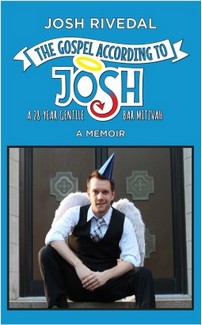
The Gospel According to Josh
The Gospel According to Josh
Joshua Rivedal
Category:
Memoir
Publisher: Skookum Hill
ISBN-10: 0986033804
Type: Non-Fiction
Pages: 282
Copyright: 8/26/2013
ISBN-13: 9780986033803
Price: $14.99 (eBook)
A dark, comedic coming of age story. How one man beat two generations of family suicide and rose from rock bottom to share his story through a play and suicide prevention program in twenty-five U.S. states and in 2 Canadian provinces—providing help, hope, and saving lives.
By the time Josh Rivedal turned twenty-five, he thought he’d have the perfect life—a few years singing on Broadway, followed by a starring role in his own television show. After which, his getaway home in the Hamptons would be featured in Better Homes & Gardens, and his face would grace the cover of the National Enquirer as Bigfoot’s not-so-secret lover. Instead, his resume is filled with an assortment of minor league theatre and an appearance on The Maury Povich Show—a career sidetracked by his father’s suicide, a lawsuit from his mother over his inheritance, and a break-up with his long-term girlfriend.
Tortured by his thoughts, he finds himself on the ledge of a fourth floor window, contemplating jumping out to inherit his familial legacy. In turn he must reach out to the only person who can help him before it’s too late.
Based in part on his acclaimed one-man show, The Gospel According to Josh is a comedic and poignant true-to-life tale of love, loss, struggle, and survival—a gospel account of one young man’s passage into manhood—his twenty-eight-year Gentile bar mitzvah.
Excerpt
ONE
AN EPILOGUE PART ONE—SORT OF
There I was at William Woods University in the middle of Missouri, decked out in a long-sleeved, blue flannel shirt and faded boot-cut jeans, standing behind a podium under a warm spotlight in front of a few hundred wide-eyed college students and some anxious faculty members, vocally paralyzed and desperately wishing I could gather myself just enough to string together a few coherent sentences for this room full of academics.
I felt like I was living that awful nightmare—you know, the one where you’re standing in front of a large group of people ready to say something epic and groundbreaking, except somehow you left your house not only forgetting to wear pants but your underpants as well, prompting the crowd to point, laugh, and throw rotten tomatoes at you with their free, non-pointing hand.
However, this moment of paralysis I was having on stage at William Woods University was all too real. I was definitely wearing pants, and this being November, tomatoes were out of season.
I had never gone stiff in front of a crowd in my entire life. By the tender age of six, I was already wooing handkerchief-waving old ladies and a church congregation of more than five hundred as a song and not-so-much dance man. Performing on stage was as second nature to me as breathing, eating, and sleeping.
But standing next to that podium and sweating under those lights, I began to experience what seemed like some kind of spiritual, out-of-body experience… which would have been awesome if I were drinking peyote tea in New Mexico with Tommy Chong and a psychoactive Sonoran Desert toad. But God knows I’m not that lucky, and whatever transcendent experience I was having was happening at the worst possible time.
I could almost see a part of me floating above my head, finding its way to a seat in the front row—eagerly anticipating whatever was going to happen next. It was like that scene from The Adventures of Tom Sawyer when Tom and Huck were sitting in the rafters watching their own funeral. Except this wasn’t supposed to be my funeral. This was my resurrection party, and I desperately wanted to celebrate with the auditorium full of spectators in front of me.
But with every silent second that passed, my credibility and grip on mystique and intrigue loosened, especially with the younger students whose hands were reaching for the smartphones on their hips to fill the time being sucked away by the lifeless question mark of a man standing before them.
And it was here that the much-needed role of cheerleader was filled by the usually ornery and disapproving voices in my head. If my brain was put up to a sonar machine, these voices would sound much like a cacophony of a Bible-quoting ball of religiosity due to my evangelical formative years, a wannabe ghetto-fabulous street thug due to my affinity for early 1990’s hip-hop, and a Spanglish mala palabra-spewing joker as a result of working in restaurants with Mexican and Ecuadorian line cooks.
(—Speak! Make a joyful noise unto the Lord…—)
(—You got this, my dude, for shizzle…—)
(—¡Sí se puede, güey!—)
Following this short bit of internal dialogue, my joints began to thaw and dexterity returned to my hands. I dabbed at my eyes with the knuckle of each forefinger, licked my lips, and couldn’t help but reflect on everything that had happened to me in the last two years. I was lucky to be alive and standing on that stage. This trippy and reminiscent stupor was quite possibly the longest fifteen seconds of my life.
Just as I regained my ability to speak, I went into the front left pocket of my jeans and removed my wallet. Inside was a tattered piece of computer paper folded over four times, which I quickly unfurled and read to myself. Scribbled on that piece of paper were three things that kept me alive only ten months earlier. I crouched over, just slightly, to drop the paper into my book bag sitting at my feet behind the podium.
“How’s everybody doing?” I asked my audience while wiping small gobs of sweat mixed with hair wax from my temples. “So basically, you know, I’ve performed the one-man show you just saw, The Gospel According to Josh, outside of the college arena quite a bit. It all started as a piece of theatre in New York City, where people, like, really dug the comedy of it. But truthfully much of the initial response I heard was in whispers. People were talking about the end, about my father’s suicide, and what they thought they knew about him—and what they thought they knew about suicide. But I knew what they were saying wasn’t true. It was incorrect.”
“What I was hearing—and bear with me—reminded me of how we as children first learned about sex. Which was how? On the playground, right? Sadly, my playground was particularly slow, bless our little hearts, and ‘till the age of twelve, I thought…”
(—Even a fool who keeps silent is considered wise…—)
(—Do not tell them that story, dawg…—)
(—They’re going to think you’re, como se llama? Estúpido…—)
“… a Fallopian tube was something people brought to a water park so they didn’t drown.”
(—You see… they laughed.—)
(—At you. Not with you, homeboy.—)
“But fortunately with sex, we catch up and learn what we need to know in school. So by the age of fifteen, sixteen, we learn what we need to know, though some of you delinquents in the back still have no idea what’s going on. I’m just kidding; you guys are alright back there.”
GET ON WITH THE STORY, BROTHA!
Right about now you might be wondering, “Why, Josh? Why are you telling me all this? What could you possibly gain by revealing yourself to the world, by choosing to tell this story?” And to that I say, “What story? I never promised to tell you a story.” But I’ll make a deal with you. If you finish all your dinner and wash your face, I will tell you a tale of struggle and survival, a gospel account of a young man’s passage into manhood—his twenty-eight-year Gentile bar mitzvah, a view into the life of a chronically unhappy artist and religious expat who wanted nothing more than to find the meaning in his father’s suicide and his own “happily ever after”… only to go through three circles of hell and a near-death experience to get everything he had always wanted. Now put your arms and legs inside the vehicle. You’re in for a bumpy ride.
|