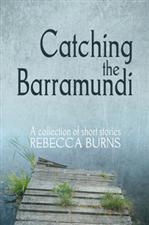
A collection of 12 short stories; the characters in each experience moments of crisis and change.
*** Longlisted for the Edge Hill Short Story Prize 2013 ***
Sudden, shattering moments of realisation; creeping, gradual self-awareness – Catching the Barramundi is a collection of contemporary short stories charting the dichotomous processes of reassessment and reflection. The settings vary, but the characters in each tale experience moments of introspection and self-scrutiny, quite out of step with their daily lives.
Excerpt
And Martyn caught a barramundi, a large one. The fish had thrashed and strained as he wrestled it into his grip. Connie turned away as he hooked his fingers into the barramundi's eyes to subdue it. His strong slender hands were moist with fish slime up to the knuckle and he wiped them casually on his shorts. Connie felt a flush of heat, almost at the bottom of her spine.
"This one's a female," Martyn said, smoothing the fish out onto his knee. It had submitted, and was opening and closing its mouth rapidly.
"How do you know?" Connie asked.
"The size. It's a big one, probably five or six years old. Barramundi are protandrous hermaphrodites." He laughed at Connie's face.
"They're what?"
"You've lived here how long, and you didn't know that?" Martyn grinned widely and Connie saw the flash of a gold tooth. She felt foolish, girl-like. Heat now crackled through her whole body.
"Barramundi start off as males," Martyn explained. "Then when they mature and reach about five years, they change gender and become female."
"What?" Connie gaped. She stared down at the dying fish lying helplessly on Martyn's lap, and suddenly felt a great sorrow. "They change sex?"
"That's right." He took a small knife from his shirt pocket and tapped the blade gently on the barramundi's head. "They aren't always this easy to catch. Sometimes I've had to use a lure, something metallic or coloured gold. They go for that, snap it up. Once they do -" and, without warning, he stabbed the fish in the head. He then quickly sliced open its stomach. "This one was about to spawn. See the black roe?"
The river slid by ominously and Connie looked out. The river, the fish, the life… there had been a shift. She seemed to appreciate the rough vitality of the water as if for the first time; it churned out towards the Gulf in a relentless fashion whilst she - she had chosen to stay put, where the life she knew was effectively over. Connie rubbed the wedding ring on her finger. The barramundi made one last jerking flap and she was drawn back to it, that strange man-woman fish now spilling its guts on Martyn's legs. She felt she might cry.
Professional Reviews
Sabotage Reviews
The stories in Rebecca Burns’ debut collection Catching the Barramundi are primarily focused on the moments of realisation in her characters’ lives, where memories from their past or unacknowledged secrets break out and confront them. The stories are set in a variety of locations, though with a clutch of stories set in a rural Australian outback, and others with a Scottish setting and often focus on loners, waifs and strays. This isolation is often deliberate, or a result of where their life has taken them. So in the title story the protagonist, Connie, is isolated after her husband has died, and not immune to the arrival of a new man into her environment. In ‘The Intruder’, a woman has gone into self-exile (and become mute) in avoidance of the horrors of her past, that are now about to come back and haunt her. Elsewhere, characters are stuck in grim towns, returning there because of illness or divorce, or simply to see what has decayed since they last visited. Whether in Scotland or Australia she is interested in those communities that have been left behind by progress.
Though not consciously themed, there is a clear pattern to much of her writing, where landscape is used to evoke our own emotional landscape, and where her protagonists are almost without exception damaged by difficult lives. Yet though there is misery here, they are not ‘misery memoirs’; the stories are often focused on moments of acceptance, realization or even transcendence. That the problems they have aren’t necessarily resolved at that point, but have reached some moment of recognition or crisis, seems central to her writing. The writing at its best has a certain luminous clarity, at one with the desolate landscapes, though at times the lack of specific detail flattens our engagement with these landscapes.
Reading these stories I was struck at first by their somewhat traditional nature, in that tales of isolation and fracture are a mainstay of a certain type of (usually American) realism. In other words, that familiar tradition – perhaps seen most recently in the writing of someone like E. Annie Proulx – means that the writer has to be at the top of their game. In half a dozen of these stories, Burns achieves that; where sparse detail enables the lives of the characters to be made real with just a few words. None of the stories are long, perhaps indicating the contemporary (often online) market for stories like this, but Burns manages to provide enough meaning for the key images of the stories to stay with the reader beyond the page.
Less successful, I felt, were those stories that seemed closer to reminisces; looking back on college years or in one case, showing a love affair from its beginning to its tragic end, through a not entirely convincing male narrator. Burns seems a careful judge of human emotion, but a little less specific when it comes to the physical world around her – more interested in the interior landscape of the characters than the external one. Where this works best is where the landscape seems at one with the lonely characters – in the title story, for instance, in ‘The Intruder’ and in ‘Hades Landing’ where a sports scholarship student returns to the company mining town for one last time after the company has pulled out.
Like a Nick Cave album, every story here seems to have a tragedy at its heart, and this concentration on death and illness does become a little wearing after a while – with several stories focusing on (different) characters suffering from cancer or other illnesses. The lightness of ‘The Mirror Man’ story – where it is only youthful memory that has expired – is therefore more than welcome.
The contemporary short story is being produced in a somewhat crowded field, and a writer can either work within the tradition or try and step outside of it. Burns is very much within the tradition, and in her best stories her carefully structured vignettes on the loneliness of the human condition hold up. ‘The Intruder’, which was longlisted for the Pushcart Prize, in particular, is her work at its very best. Where the stories are a little more humdrum – the kids in the garden of ‘The Night of the Fox’ for instance – I was yearning for some of the precise uniqueness of Lorrie Moore or Helen Simpson, who can use the finest details to elevate a seemingly tiny piece of someone’s life to a higher pitch.
Throughout the stories, Burns is careful to show, not to tell, but almost always has a design on the reader that doesn’t leave a lot of room for interpretation. The excellent final story, ‘Painting the Hay Bales’, stands out in this company for leaving the story’s poignancy unspoken. It’s an interesting, coherent and well structured debut, published by an Australian press, and where all of the stories have been published online or in magazines. Its longlisting for the Edge Hill Short Story Prize is a testimony to its qualities. I can imagine certain readers enjoying its control and precision immensely; if I had some doubts it’s because when she gets it right, the terse style and controlled narrative fit so well together that I noticed those stories that fell a little short.
Terry Rogers
My only regret about this collection is that the back cover appears so quickly, making me nostalgic for the time I spent swimming around in Ms Burns's storyland.
The intimacy of these stories, and the easy flow of the narratives, made me feel as though I were a privileged voyeur in one little portion of the lives of these folks--in my opinion, this is arguably the most important attribute of good storytelling. And the characters here, folks who seem to me that they could just as readily be found rooted into the soils of America's old swampy southeast and dusty southwest, seem to soak right into one's arteries with the warm easy flow of sweet Kentucky bourbon. I particularly enjoyed the subtle strength of the author's womenfolk. But it seems clear that Ms Burns sincerely respects all of the individuals she's spent so much time living with in her creative head, even the more seemingly less likable characters such as the 'intruder' and the 'mirror man'. In addition, I really appreciate that the author doesn't hide her characters' melancholies or treat sadness as a despicable emotion to be whitewashed, but rather, as a reasonable reaction to private or public situations, one to be empathetically understood (or, at least, respectfully observed).
The story that touched me most was 'Loving Enid'. It's certainly not one I'd recommend to a reader who wants only happy endings, but it sure did feel honest and true in every way. Same with the foxes story (Which evoked memories of putting up my uncle's musty old army pup-tent in the backyard and being too afraid to sleep in it!). In the latter tale, the side-story of mom's immense grief and dad's idiocy is very nicely set back just a bit, behind the boys' tent escapade. And I liked that their mom told them the door would be unlocked. I'd bet a pint of frothy ale that Ms Burns is a damn good mom herself. She's a talented storyteller too -- I recommend this collection.
Halfway Down the Stairs
Catching the Barramundi is a fresh collection of short story fiction by author Rebecca Burns, recently published by Odyssey Books. Whether journeying to a riverbank in rural Australia with the ever-present danger of crocodiles or walking along an island shore at the other edge of the world in Scotland, while not a travel book, Catching the Barramundi spirits you to far flung places, requiring only that readers find a shady spot on the beach or a comfy place to sit and put one’s feet up to enjoy an extended voyage of what was and what might be.
The stories offer up an inviting variety of venues, male and female narrators, and the intertwining of main characters with feral fauna and lush, living landscapes. However, it is the ever-present sadness of loves lost and lives vanquished by illness or other catastrophes that lingers over each story like a dark, all-obscuring cloud of smoke that permits only a ray or two of sunshine to enter the world of Barramundi. Burns paints a landscape of remote beauty and serenity to the reader, yet as her characters pine for the peace that this privacy affords them, they are simultaneously lonely and linger on in their seclusion long after it no longer serves them as a safe place to hide from self or others.
Nevertheless, the characters who do rise above this cloud of sometimes self-induced isolation and tragic pasts experience a side bit of pleasure with their pain, as the author often leaves the finales of her fiction open-ended, allowing the reader to determine their fate and negotiate yet another journey with newly made friends. Reading Catching the Barramundi is like welcoming an old friend into one’s home, especially for those of us here at Halfway Down the Stairs, who published two of Rebecca Burns’s stories from this collection and other fiction in recent issues. It is hoped that you will also welcome Rebecca Burns’s poignant, award-winning stories into your beach bag for summer reading or in a bookcase alongside your comfy chair, wherever you are.
A teenage boy struggling with the coming-of-age issues of sexuality, religion, and peer approval is overwhelmed, but soldiers on. After several years, he comes to understand the family forces that have left him so deeply troubled, and the process of
Pieces of Eight is an eclectic collection of eight imaginative novellas/short stories. Themes represented in the work are science fiction, paranormal, psychological drama, humor, murder/revenge and astrological fulfillment. Pieces of Eight is the com